
Degenerative Thoracolumbar
What Pfirrmann misses: a routine T2-weighted signal index reveals substantial within-grade heterogeneity in early lumbar disc degeneration
- Charité – Universitätsmedizin Berlin, Berlin, Germany
- Julius Wolff Institute for Biomechanics and Musculoskeletal Regeneration, Berlin, Germany
Abstract
Pfirrmann grading is the current standard for magnetic resonance imaging (MRI) based characterization of intervertebral disc degeneration. However, as a morphology-based ordinal classification, it may fail to detect early compositional changes and can entail information loss when continuous disc degeneration is reduced to discrete grades. A quantitative approach based on T2-weighted disc signal intensity normalized to cerebrospinal fluid, the T2 disc intensity index (T2DII), may provide a continuous marker of disc integrity. This study therefore aimed to directly compare Pfirrmann grading and T2DII for characterization of lumbar disc degeneration and to quantify their respective associations with demographic, lifestyle, and pain-related variables.
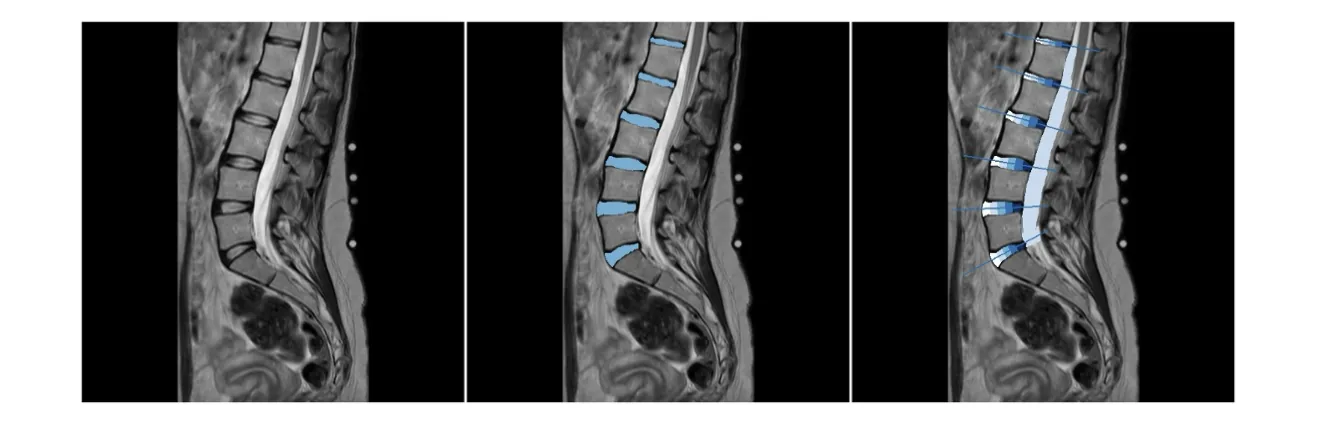
Participants enrolled in a population-based study underwent routine 3.0-T lumbar spine MRI and clinical assessment. Disc degeneration at all lumbar levels was evaluated using Pfirrmann classification and the T2DII (Fig.1). Agreement and correlation between the two measures were assessed and multivariable linear regression was used to examine associations between disc measures and age, sex, body mass index (BMI), smoking exposure, physical activity level, chronic pain status and intensity.
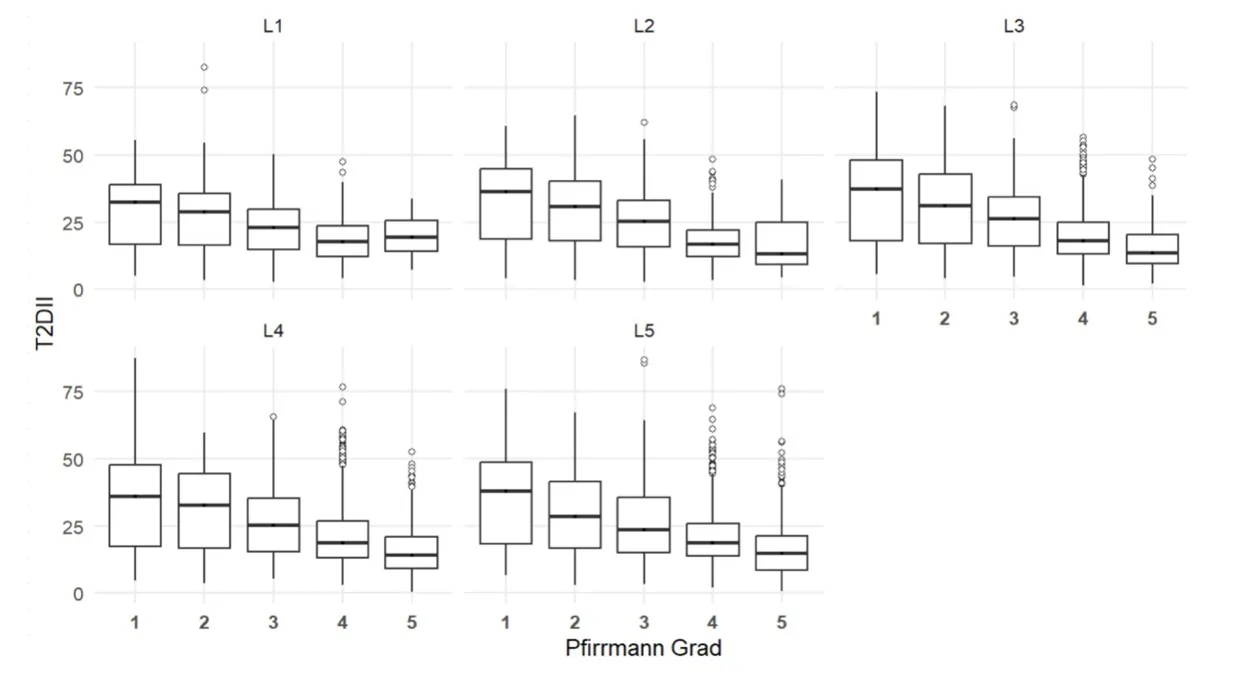
A total of 577 participants (mean age, 43.0 ± 11.7 years; 58.2% women) were included. Age was strongly associated with both disc measures (p < 0.001) but explained more variance in quantitative T2DII than in ordinal Pfirrmann grading (partial η² 0.569 vs. 0.499). Male sex was independently associated with higher T2DII (β = 3.38, p < 0.001), while lifestyle and pain-related variables showed no independent associations with either measure. In addition, within individual Pfirrmann grades, T2DII values varied widely, with the greatest dispersion in early degeneration (Pfirrmann grade 1; IQR 22.35 - 30.46,) and a progressive narrowing in advanced grades (grade 5; IQR 10.60–15.72; overall variance difference across grades p < 0.001; Fig. 2).
Quantitative disc assessment using the T2DII provided complementary information to the morphology-based Pfirrmann classification. While both approaches reflected age-related change, T2DII showed a stronger association with age and additionally identified sex-related differences not apparent with Pfirrmann grading. Moreover, T2DII preserved substantial within-grade signal variation, most pronounced at low Pfirrmann grades, indicating that morphologically similar discs can differ significantly in underlying signal-based integrity. Overall, these findings suggest that T2DII may enhance early degeneration assessment, with potential applications in longitudinal monitoring and as a sensitive indicator for preventive strategies and future disease-modifying interventions.
Figures and tables
As submitted with the abstract. Tap a figure to open it at full size.