Degenerative Thoracolumbar
Restoring Proportionate Alignment With Reciprocal Change Predicts Lower Adjacent Segment Disease
- Istituto Ortopedico Rizzoli, Bologna, Italy
Abstract
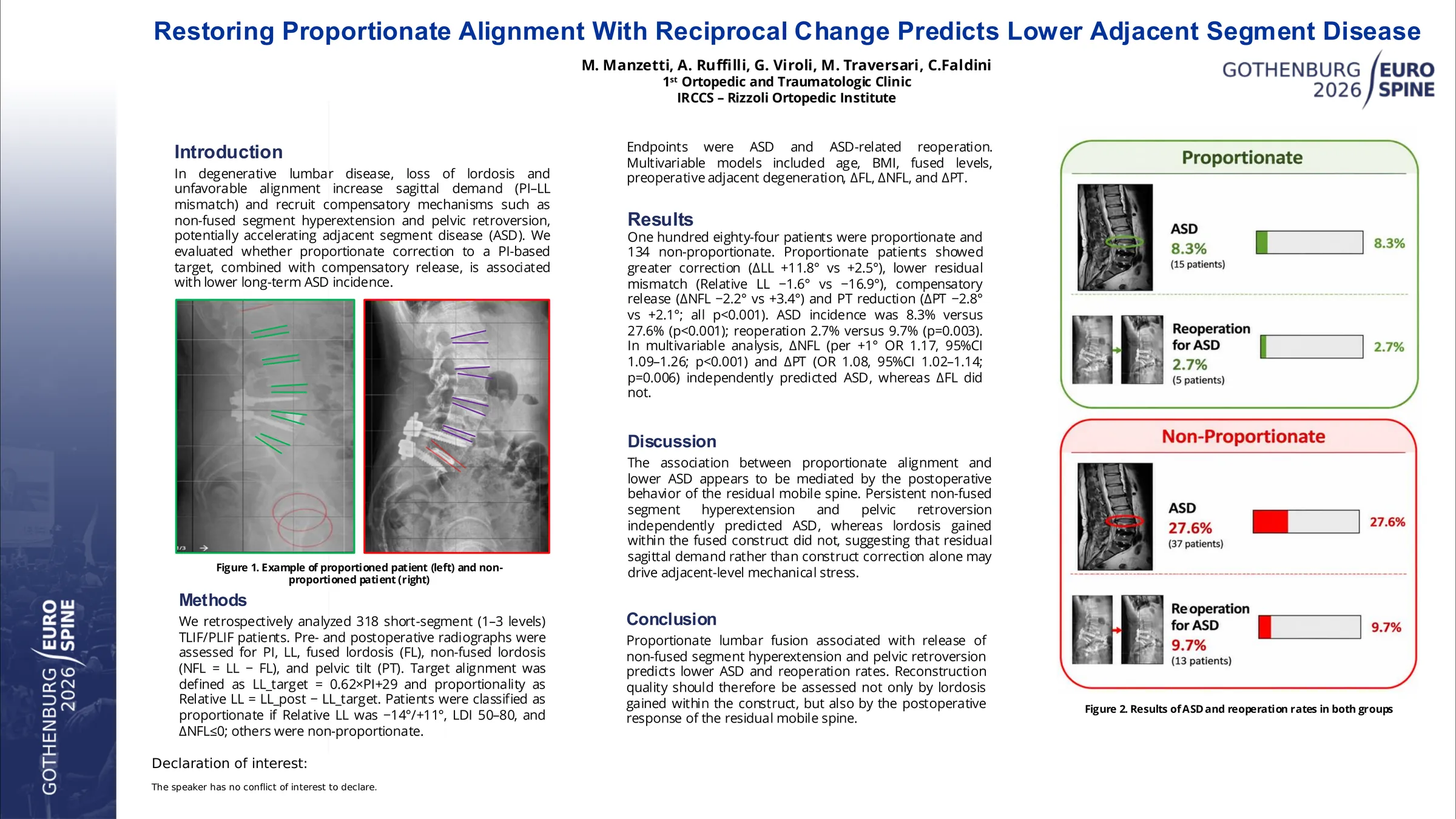
In degenerative lumbar disease, loss of lordosis and an unfavorable alignment distribution increase sagittal demand, and recruit compensatory mechanisms such as hyperextension of non-fused segments and pelvic retroversion. By altering segmental biomechanics, these compensations may accelerate adjacent-level degeneration and contribute to adjacent segment disease (ASD). We investigated whether a proportionate correction and accompanied by extension release is associated with a lower long-term incidence of ASD.
We performed a retrospective study of 318 patients undergoing short-segment posterior lumbar fusion (1–3 levels) using TLIF or PLIF for degenerative pathology. Standing full-spine radiographs were analyzed pre- and postoperatively. Measurements included pelvic incidence (PI), lumbar lordosis (LL), fused-level lordosis (FL), non-fused lordosis (NFL = LL − FL), and pelvic tilt (PT). When available, lordosis distribution was assessed using the lordosis distribution index (LDI = [L4–S1/L1–S1]×100). Individual alignment target was estimated as LL_target = 0.62×PI + 29, and proportionality as Relative LL = LL_post − LL_target. Patients were classified as “proportionate” if Relative LL was between −14° and +11°, LDI between 50 and 80, and showed a compensatory release trend (ΔNFL ≤ 0). All others were classified as “non-proportionate". Minimum follow-up was 36 months (median 62). Endpoints were ASD occurrence and ASD-related reoperation. Multivariable regressions included age, BMI, number of fused levels, preoperative adjacent-segment degeneration, ΔFL, ΔNFL, and ΔPT.
A total of 184 patients were proportionate and 134 non-proportionate. In the proportionate group, changes were: ΔLL +11.8°, Relative LL −1.6°, ΔFL +9.6°, ΔNFL −2.2°, and ΔPT −2.8°. In the non-proportionate group: ΔLL +2.5°, Relative LL −16.9°, ΔFL +4.1°, ΔNFL +3.4°, and ΔPT +2.1° (all between-group differences p<0.001). ASD incidence was 8.3% in proportionate patients versus 27.6% in non-proportionate patients (p<0.001); ASD-related reoperation was 2.7% versus 9.7%, respectively (p=0.003). In multivariable analysis, the strongest predictor of ASD was persistence/increase of non-fused segment compensation (per +1° ΔNFL: OR 1.17; 95% CI 1.09–1.26; p<0.001), followed by ΔPT (per +1°: OR 1.08; 95% CI 1.02–1.14; p=0.006).
A posterior lumbar fusion is biomechanically effective when it reduces sagittal demand proportionately to PI and achieves compensatory release. When residual demand persists, compensations increase, loading adjacent levels and associating with higher ASD and reoperation rates. Clinically, reconstruction quality should not be judged only by lordosis gained within the construct, but by the ability to extinguish compensations, particularly reflected by ΔNFL and ΔPT.