
Complications & Epidemiology
Twice as many surgical site infections between June and October than during the rest of the year: results of a retrospective analysis of single-centre data
- Lindenhof, Bern, Switzerland
Abstract
Despite adherence to perioperative infection prophylaxis protocols surgical site infections (SSI) after spine surgery still occur in ca. 3% of patients, and have a significant impact on treatment outcome and direct and indirect treatment cost.
A recent study by Damonti et al on a large cohort of patients undergoing elective knee and hip arthroplasty found a non-significant increase in infection rates in relation to outdoor temperature on the date of surgery, as well as significant correlation with temperatures>20° and with patients having a BMI of ≥25 kg/m2. In spine surgery, Spatenkova et al (Jun to Aug, OR 2.9, p=0.04) and Dunkin et al (1.3% for Jun-Sep vs 1.0% otherwise) found an increased risk of SSI when operating in the summer months, while admitting some limitations in their studies.
The aim of this study was to investigate the association between the timing of surgery and SSI, adjusting for various patient characteristics, in a monocentric patient population over the past five years.
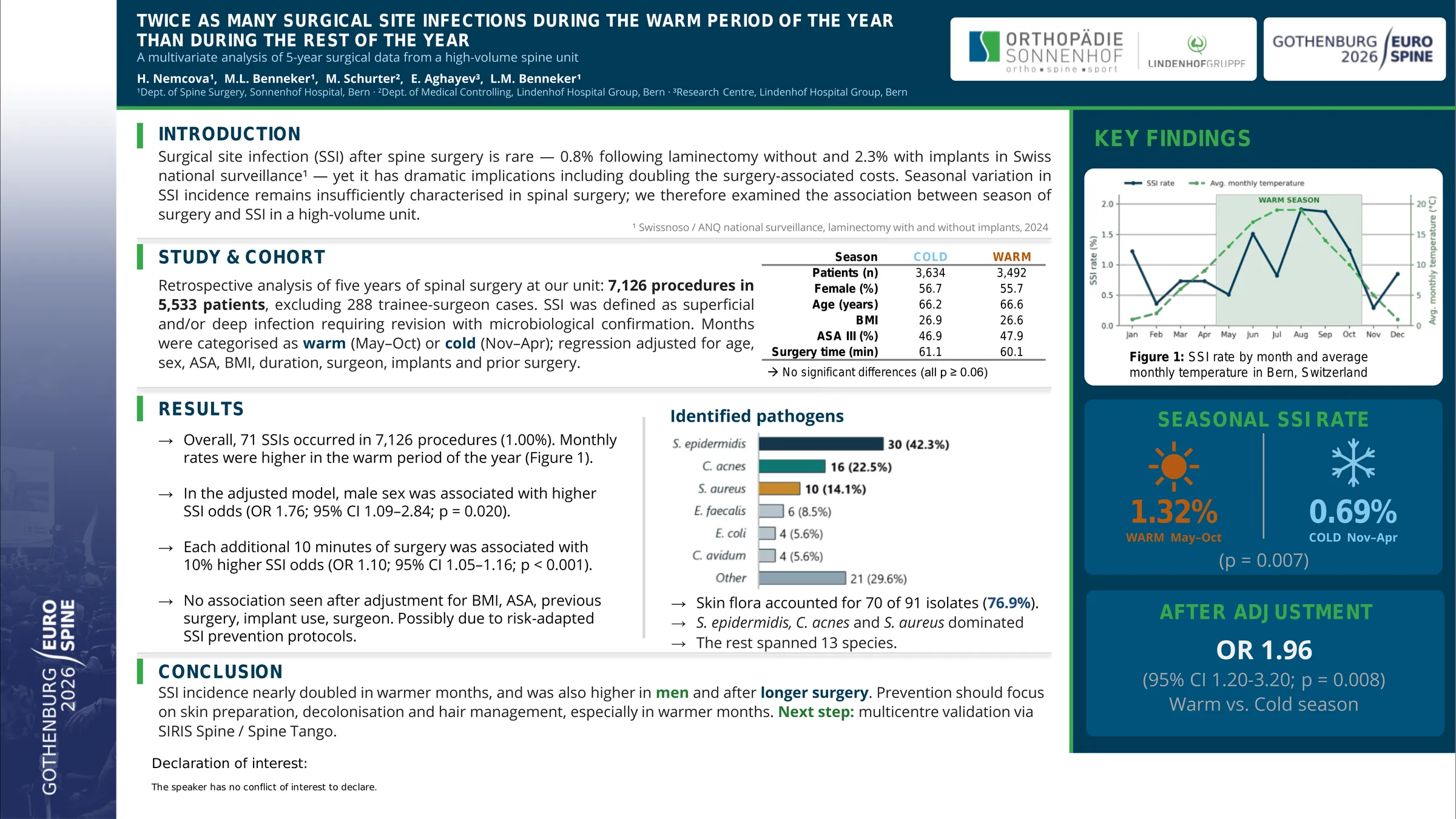
This study was a retrospective analysis of available surgeries from our spine unit between 2021 and 2025. We categorised the months of surgery as either 'warm' (Jun to Oct) or 'cold' (Nov to May). We studied the association between the time of year and SSI, adjusting for patient age, gender, ASA classification, BMI, duration of surgery, surgeon, type of implant and type of surgery (elective or emergency).
A total of 5,360 surgeries on 4,205 patients were included in the analysis. The overall SSI rate was 1.3%, compared to 2.0% in the warm and 0.9% in the cold period (p=0.001). 79% of the identified pathogens were typical skin flora bacteria.
The likelihood of an SSI was 1.72- and 2.29-times higher for male patients and those operated in the warm period, respectively (95% confidence intervals [CI] 1.06-2.79 and 1.41-3.72; p=0.027 and 0.001). Furthermore, each additional 30 minutes of surgery increased the likelihood of a SSI by a factor of 1.42 (95% CI 1.20–1.68; p<0.001).
Our findings are consistent with those of Spatenkova et al. and Dunkin et al. An analysis of a larger multicentre dataset, such as the international Spine Tango Registry, could be highly valuable.
Clinical recommendations for at-risk patients may be required to minimise elective spine surgery during heatwaves. These recommendations could include controlling the climate in patient rooms and eradicating skin flora before surgery.