Degenerative Thoracolumbar
Incidence of proximal junctional kyphosis after lumbar arthrodesis using cortical trajectory screws: comparison between freehand technique and intraoperative navigation
- , Madrid, Spain
Abstract
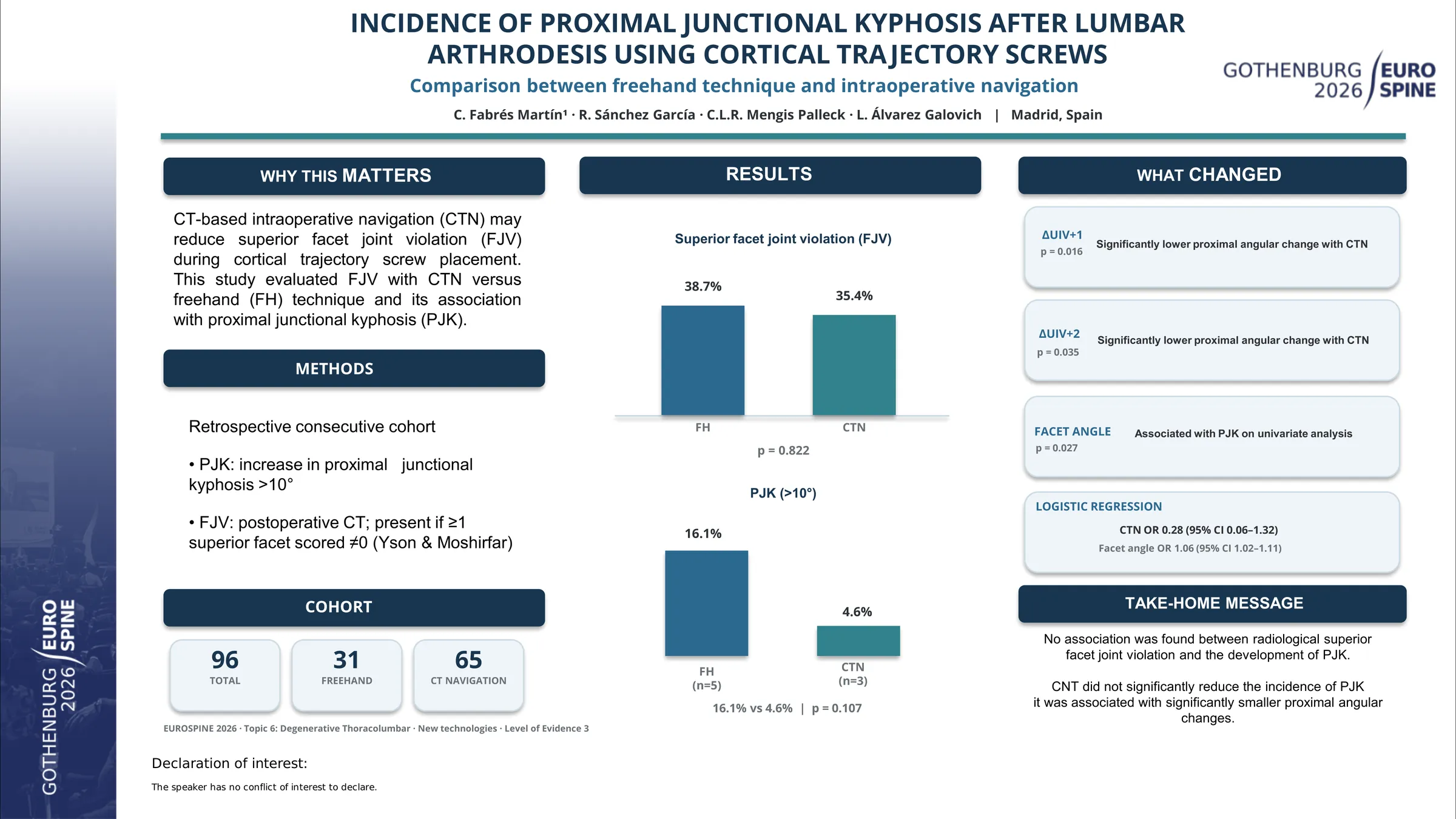
Intraoperative CT-based navigation (CTN) may reduce superior facet joint violation (FJV) compared with the freehand (FH) technique during placement of cortical trajectory screws (CTS), potentially decreasing the incidence of proximal junctional kyphosis (PJK) following lumbar arthrodesis. This study aimed to evaluate superior FJV during CTS placement using CTN versus FH and to analyze its association with PJK development.
A retrospective consecutive cohort study was conducted including patients who underwent lumbar arthrodesis with CTS between 2019 and 2024, with a minimum 1-year radiological follow-up. Patients were divided into two groups, according to screw placement technique. PJK was defined as an increase in proximal junctional kyphosis >10°. FJV was assessed using postoperative CT scans and considered present if at least one superior facet scored ≠ 0 according to the Yson and Moshirfar classification. Additional variables were analyzed including age, sex, body mass index (BMI), number of fused levels, presence of scoliosis or spondylolisthesis, and superior facet angle. Non-parametric tests were used due to non-normal data distrubition. Categorical variables were analyzed using Fisher’s exact test. Logistic regression analysis was performed to identify independent risk factors (p < 0.05).
A total of 96 patients were included (31 FH, 65 CTN). The rate of FJV did not differ significantly between groups (38.7% FH vs. 35.4% CTN; p = 0.822). The incidence of PJK (>10°) was higher in the FH group (16.1%) compared with the CTN group (4.6%); however, this difference did not reach statistical significance (p = 0.107). Nevertheless, proximal angular changes below the 10° threshold were significantly lower in the CTN group at both UIVº+1 (ΔUIVº+1; p = 0.016) and UIVº+2 (ΔUIVº+2; p = 0.035). Univariate analysis demonstrated a significant association between greater superior facet angle and PJK (p = 0.027). Logistic regression analysis showed an odds ratio (OR) of 0.28 (95% CI, 0.06–1.32) for CTN and an OR of 1.06 (95% CI, 1.02–1.11) increase in facet angle.
No association was found between radiological superior facet joint violation and the development of PJK, regardless of screw placement technique. Although CT-based navigation did not significantly reduce the incidence of PJK, it was associated with significantly smaller proximal angular changes and demonstrated a trend toward a protective effect. Superior facet angle emerged as a relevant anatomical risk factor for PJK.Larger prospective studies are required to confirm the potential protective role of surgical navigation in preventing PJK.