
Degenerative Thoracolumbar
Is the VBQ Score Ready for Routine Use? A Comparative Analysis of Diagnostic Accuracy Between Spine Surgeons and Residents
- Naresuan University Hospital, Phitsanulok, Thailand
Abstract
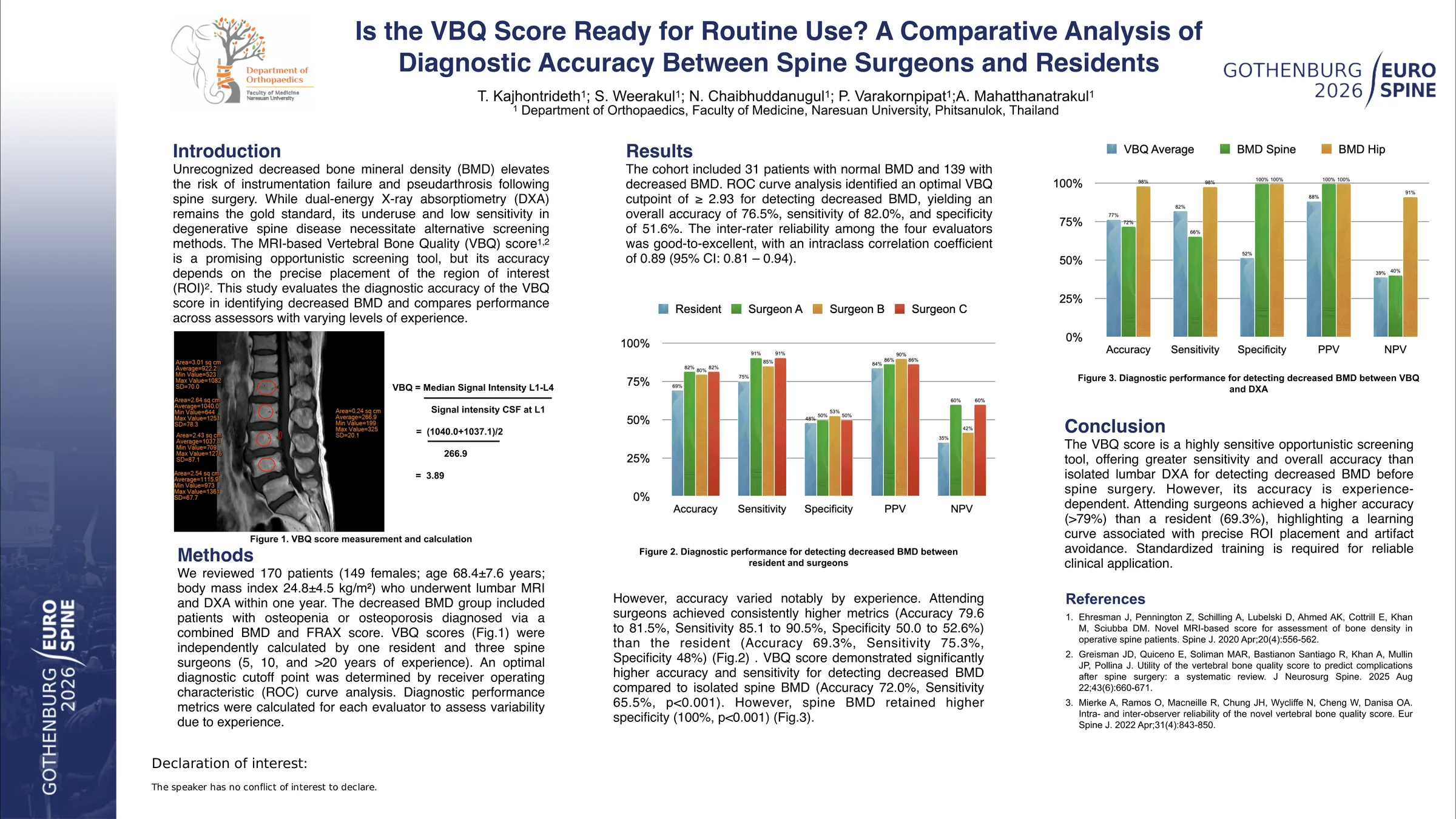
Unrecognized decreased bone mineral density (BMD) elevates the risk of instrumentation failure and pseudarthrosis following spine surgery. While dual-energy X-ray absorptiometry (DXA) remains the gold standard, its underuse and low sensitivity in degenerative spine disease necessitate alternative screening methods. The MRI-based Vertebral Bone Quality (VBQ) score is a promising opportunistic screening tool, but its accuracy depends on the precise placement of the region of interest (ROI). This study evaluates the diagnostic accuracy of the VBQ score for identifying decreased BMD and compares the performance between assessors with varying levels of experience.
We retrospectively reviewed 170 patients (149 females, 21 males; age 68.4±7.6 years; mean body mass index 24.8±4.5 kg/m²) who underwent lumbar MRI and DXA within one year. The decreased BMD group includes patients with osteopenia or osteoporosis diagnosed via a combined BMD and FRAX score. VBQ scores were independently calculated by one resident and three spine surgeons (5, 10, and >20 years of experience). An optimal diagnostic cutoff point was determined by receiver operating characteristic (ROC) curve analysis. Diagnostic performance metrics were calculated for each evaluator to assess variability due to experience.
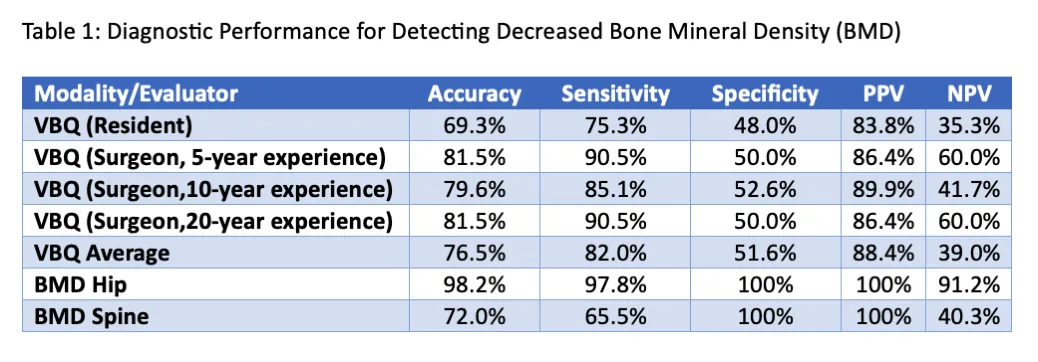
The cohort included 31 normal and 139 decreased BMD patients. ROC curve analysis identified an optimal VBQ cutpoint of ≥2.93 for detecting decreased BMD, resulting in an overall accuracy of 76.5%, a sensitivity of 82.0%, and a specificity of 51.6%. The inter-rater reliability among the four evaluators was good-to-excellent, with an intraclass correlation coefficient of 0.89 (95% CI: 0.81 – 0.94). However, accuracy varied notably by experience. Attending surgeons achieved consistently higher metrics (Accuracy 79.6-81.5%, Sensitivity 85.1-90.5%, Specificity 50.0-52.6%) than the resident (Accuracy 69.3%, Sensitivity 75.3%, Specificity 48%). The average VBQ score demonstrated significantly higher accuracy and sensitivity for detecting decreased BMD compared to isolated spine BMD (Accuracy 72.0%, Sensitivity 65.5%, p<0.001), though spine BMD retained higher specificity (100%, p<0.001)
The VBQ score is a highly sensitive opportunistic screening tool, offering greater sensitivity and overall accuracy than isolated lumbar DXA for detecting decreased BMD before spine surgery. However, its accuracy is experience-dependent. Attending surgeons achieved a higher accuracy (>79%) than a resident (69.3%), highlighting a learning curve associated with precise ROI placement and artifact avoidance. Standardized training is required for reliable clinical application.
Figures and tables
As submitted with the abstract. Tap a figure to open it at full size.