
Complications & Epidemiology
Complications and Reoperations After Four-Level Anterior Cervical Discectomy and Fusion
- Hospital for Special Surgery Main Hospital, New York, United States of America
- Hospital for Special Surgery Main Hospital, Zurich, Switzerland
Abstract
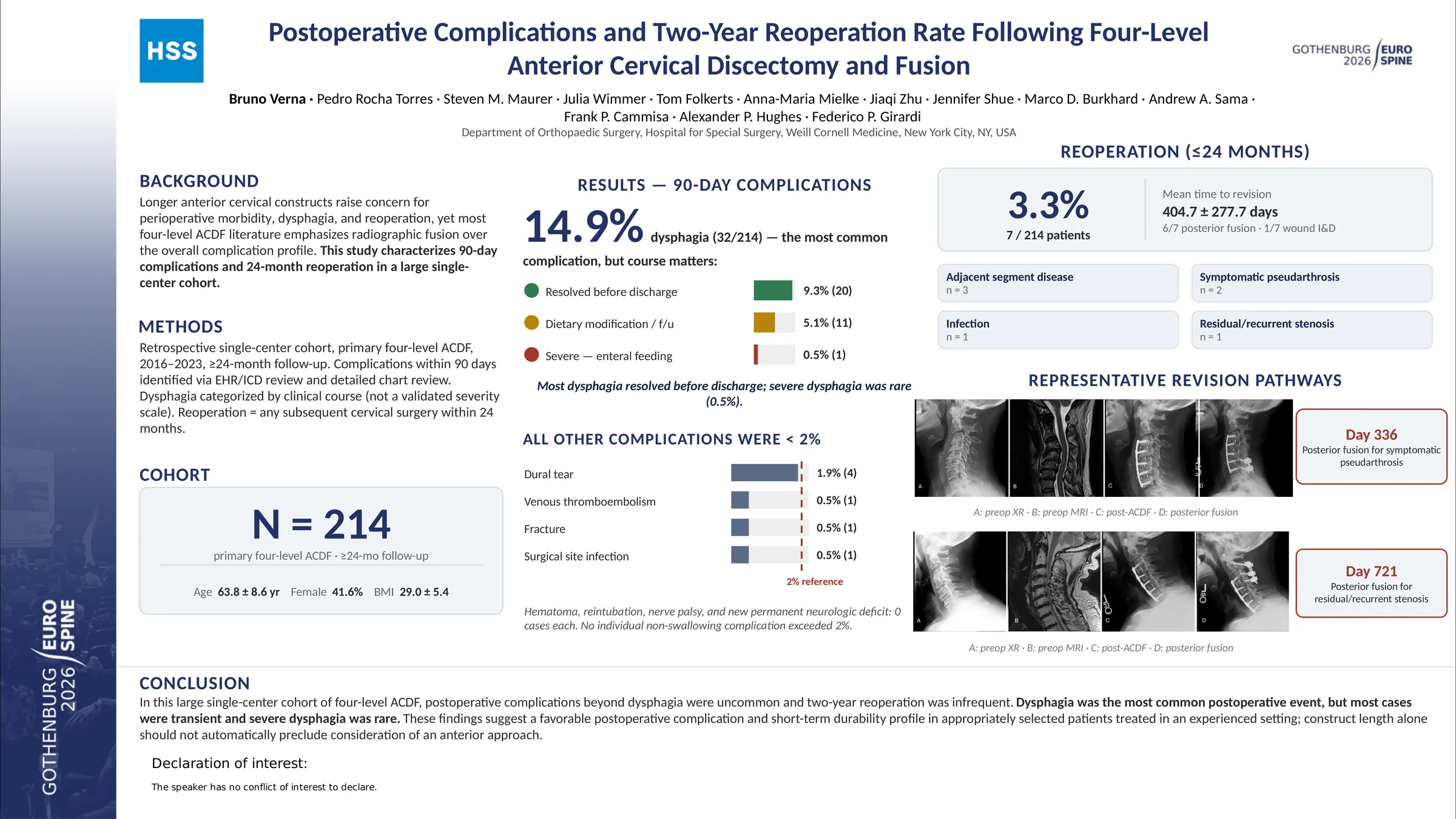
Four-level anterior cervical discectomy and fusion (ACDF) is utilized for advanced cervical degenerative pathology but remains controversial due to concerns regarding perioperative morbidity, postoperative complications and revision rates. Existing studies evaluating outcomes after extensive anterior cervical fusion are limited by small sample sizes, heterogeneous outcome definitions, and a predominant focus on fusion status rather than postoperative safety. Consequently, the postoperative complication and reoperation profile of four-level ACDF remains incompletely characterized. The objective of our study is to evaluate complications and reoperations following four-level ACDF in a large single-center cohort.
Patients undergoing four-level anterior cervical discectomy and fusion (ACDF) were retrospectively identified at a single center. Patients treated for trauma, tumor, or infection were excluded. Postoperative complications occurring within 90 days were captured using structured institutional data fields and included dysphagia, venous thromboembolism, fracture, dural tear, neurologic deficit or nerve palsy, reintubation, and infection. Postoperative dysphagia was defined as swallowing dysfunction documented in the medical record and associated with a speech-language pathology consultation; standardized dysphagia questionnaires were not used. Cervical reoperation was defined as any subsequent cervical surgical procedure occurring within 24 months of the index operation.
198 patients undergoing four-level ACDF with a minimum of two years of postoperative follow-up were included. Within 90 days postoperatively, dysphagia was the most common complication, occurring in 29 patients (14.6%). Among these, most cases were transient and resolved prior to discharge (n=17), while 11 patients required ongoing dietary modification or follow-up beyond discharge and one patient developed severe persistent dysphagia requiring enteral feeding. Other complications were uncommon, including dural tear in 4 patients (2.0%), venous thromboembolism in 1 patient (0.5%), fracture in 1 patient (0.5%), and infection in 1 patient (0.5%). Within 24 months, 7 patients (3.5%) underwent cervical reoperation: 4 posterior fusion procedures (3 with extension beyond index levels), 1 anterior revision, 1 hardware removal for screw failure, and 1 wound exploration for infection.
In this large single-center cohort of patients undergoing four-level ACDF, postoperative complications beyond dysphagia were uncommon. Although dysphagia was the most frequent postoperative event, the majority of cases were transient, and severe or persistent presentations were rare. Revision surgery occurred infrequently (3.5%), comparable to rates reported for shorter-segment surgeries. Overall, these findings suggest that four-level ACDF, when performed in an experienced setting with appropriate patient selection and perioperative management, can be associated with a favorable safety and revision profile.