
Degenerative Thoracolumbar
Use of Vertebral Bone Marrow Aspirate Clot as an Autologous Cell Therapy and Multifunctional Scaffold for Spinal Fusion – A Prospective Randomized Study
- Istituto Ortopedico Rizzoli, Bologna, Italy
Abstract
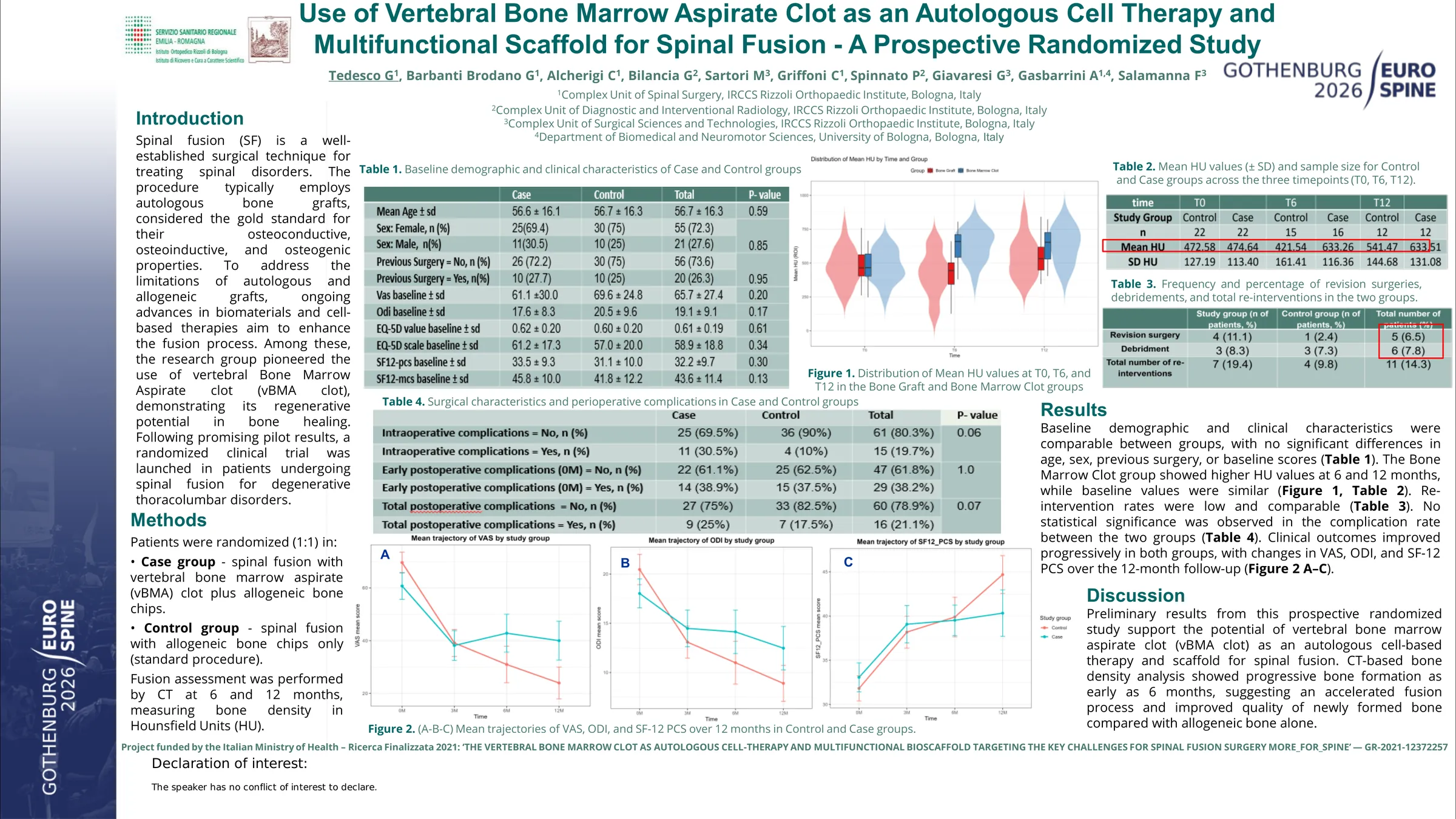
Spinal fusion (SF) is a widely used and well-established surgical technique for the treatment of spinal disorders. The SF procedure involves the use of autologous bone graft, considered the gold standard. An alternative to autologous bone is allogeneic (donor-derived) bone graft. However, to overcome the limitations associated with both autologous and allogeneic bone, continuous advances in research and biotechnology have led to the development of novel materials/scaffolds and/or cell-based therapies aimed at enhancing the spinal fusion process. With regard to cell-based therapies, the proposing research group was the first to describe the regenerative potential of vertebral Bone Marrow Aspirate clot (vBMA clot) in promoting bone regeneration. Based on encouraging findings from a pilot clinical study, a randomized clinical trial was initiated in patients undergoing spinal fusion surgery for degenerative thoracolumbar spine disorders.
Patients were randomized in a 1:1 ratio into two groups:
• Treatment group, undergoing spinal fusion using vBMA clot combined with allogeneic bone chips;
• Control group, treated exclusively with allogeneic bone chips.
SF was assessed by computed tomography (CT) scans performed at 6 and 12 months of follow-up, with measurement of bone density expressed in Hounsfield Units (HU). Clinical outcomes were evaluated using self-administered questionnaires.
Between May 2023 and December 2025, a total of 87 patients (66 females and 21 males) were enrolled, including 42 in the treatment group and 45 in the control group. 64 completed at least one year of observation. The mean age of the study population was 53.4 years. Bone density measurements (HU) at the fusion site were available for 40 patients who completed at least 6 months of follow-up. At 6 months of follow-up, the group treated with vBMA clot demonstrated significantly higher HU values compared with the control group (630 ± 124 HU vs 415 ± 166 HU), with a p-value < 0.05, confirming a statistically significant difference between the two groups. Quality of life, assessed preoperatively and during follow-up, improved in both groups. The incidence of mechanical failures and surgical site infections did not differ significantly between groups.
Preliminary data from this prospective randomized study confirm the potential of vBMA clot as an autologous cell-based therapy and multifunctional scaffold for spinal fusion in patients with degenerative spinal disorders. CT-based bone density analysis demonstrated progressive bone formation as early as 6 months of follow-up in patients treated with vBMA clot, suggesting an acceleration of the fusion process and improved quality of newly formed bone compared with the control group treated with allogeneic bone alone.