
Complications & Epidemiology
Orthospine Fitness: which markers of musculoskeletal health can explain complications in spine surgery?
- Istituto Ortopedico Rizzoli, Bologna, Italy
- Azienda Ospedaliera Universitaria "Luigi Vanvitelli", Naples, Italy
- Università degli Studi di Bari, Bari, Italy
Abstract
Complications in spinal surgery (7-20% of cases) remain an unresolved issue. In patients with degenerative conditions mechanical complications are prevalent. Readmissions, reoperations, and rehabilitation treatments have a considerable impact on both patients and healthcare system. Patients with musculoskeletal fragility are at higher risk of complications following spinal surgery. “OrthoSpine Fitness” is a multicentre study involving a large cohort of patients undergoing spinal surgery for degenerative diseases of the thoracolumbar spine. Its primary goal is to establish a comprehensive preoperative screening protocol for bone and musculoskeletal health by combining advanced imaging and modelling (dual-energy X-ray absorptiometry -DXA- and HR-pQCT), evaluation of physical frailty, cellular and molecular analyses of bone–muscle interactions, and assessment of nutritional status.
The study aims to enroll 200 patients with degenerative thoracolumbar spinal disorders requiring surgery. Collected parameters (imaging, densitometry in lumbar spine, femur and total body, bone metabolism, physical frailty assessment, and nutritional status) are analysed in relation to the incidence of surgery-related adverse events (AEs) —particularly mechanical complications—over a 12-month follow-up period.
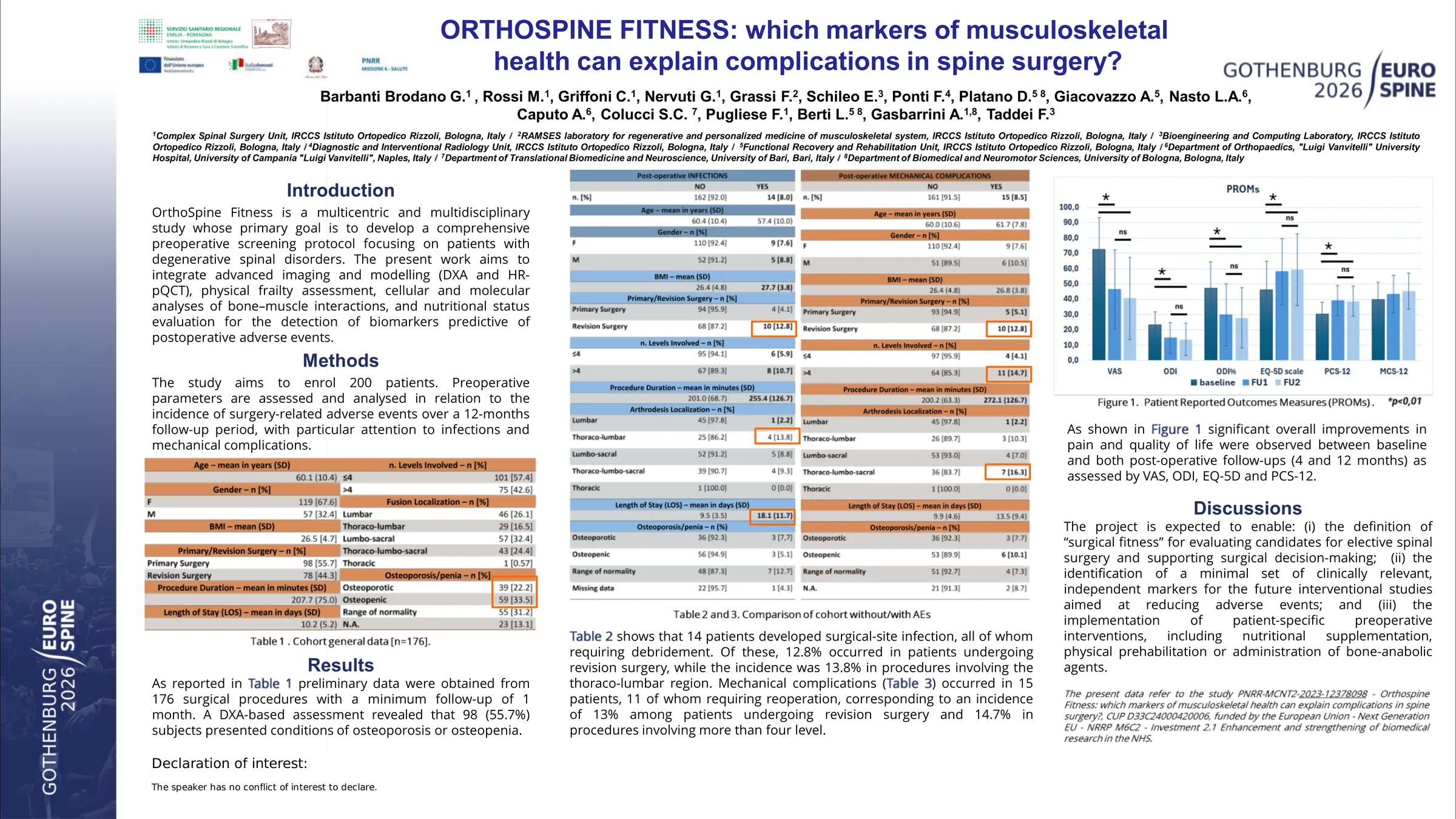
Preliminary data refer to a group of 98 operated patients (minimum follow-up: 2 months). 66 females and 32 males, mean age of 61.62 years, 42 patients had previously undergone spinal surgery. Only clinical and DXA data are presented. Based on femoral neck T-score (n=87), 38 patients (43.7%) were in the osteopenic and 21 (24.1%) in the osteoporotic range. From lumbar spine DXA (n=58), 18 patients (31%) were identified as osteopenic and 8 (13.8%) as osteoporotic. Out of 44 patients sarcopenia could be detected in 8 women (18.2%) and 1 man (2.3%) based on cut-offs by EWGSOP2. 9 patients (9.18%) developed surgical-site infections requiring debridement; 6 infections occurred following revision surgeries. 7 patients (7.14%), 5 of which had previous surgeries, experienced mechanical complications requiring reoperation: 2 patients were in the osteoporotic range and 3 in the osteopenic range. At 6-months follow-up, there was a significant overall improvement in pain and quality of life (PROMs).
The results of the project will enable: (i) the definition of “surgical fitness” to evaluate candidates for spinal surgery and potentially improve surgical decision-making; (ii) the identification of a minimal set of significant and independent markers to be monitored in future interventional studies aimed at reducing the risk of AEs in spinal surgery; and (iii) the implementation of patient-specific preoperative interventions (nutritional supplementation, physical prehabilitation, or administration of bone anabolic agents).