
Adult Deformity
Association Between Symptom Duration and CBVA Improvement After Nuchal Ligament Reconstruction and Stabilization Surgery for Dropped Head Syndrome
- Tokyo Medical University, Tokyo, Japan
Abstract
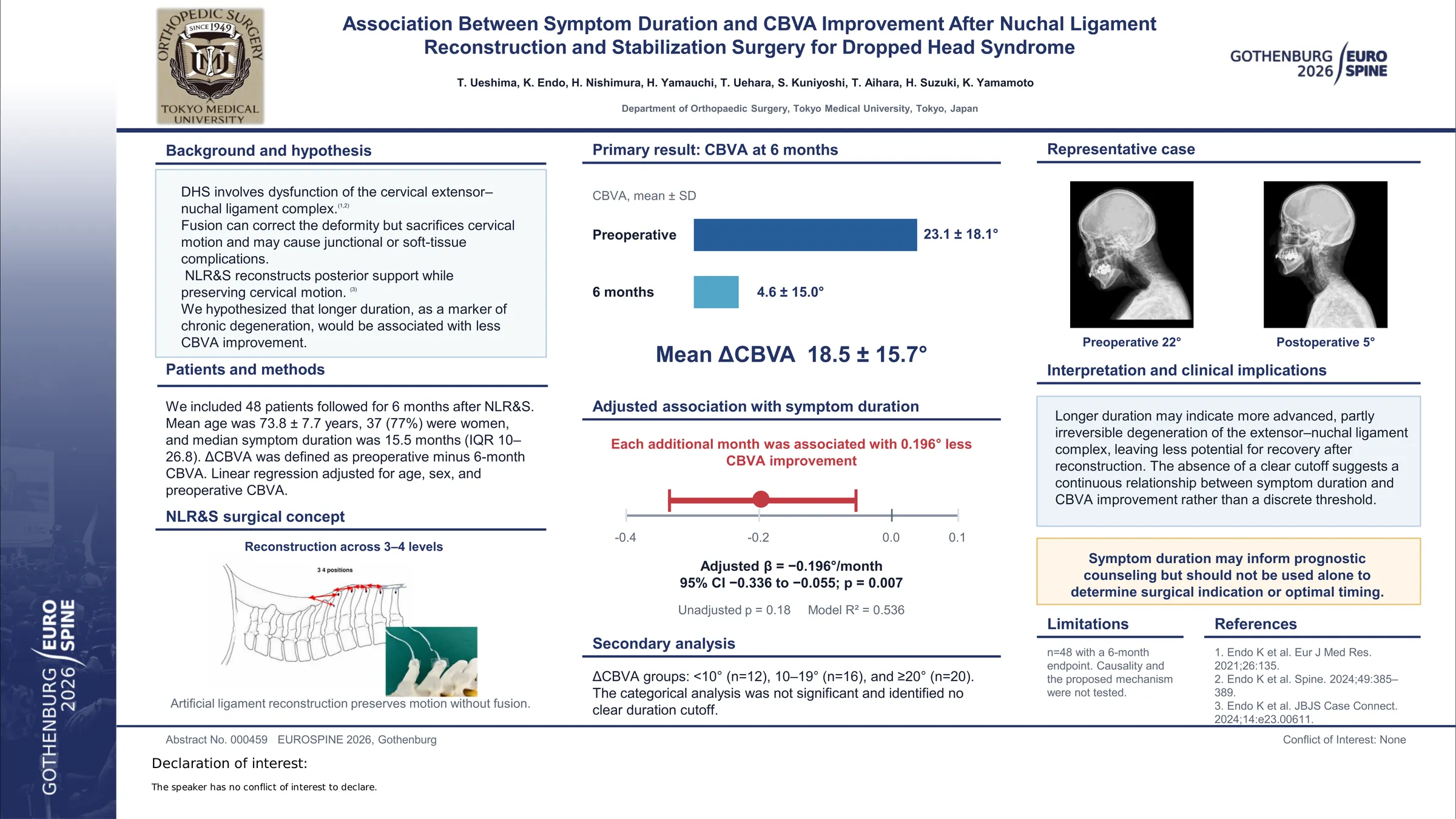
Spinal fusion is commonly performed for Dropped Head Syndrome (DHS); however, it is associated with reduced cervical range of motion and potential development of adjacent segment disease (ASD). Nuchal Ligament Reconstruction and Stabilization (NLR&S) has been proposed as a motion-preserving alternative. However, factors influencing postoperative improvement following NLR&S, particularly the role of symptom duration, remain unclear. This study aimed to investigate the association between symptom duration and postoperative chin–brow vertical angle (CBVA) improvement at 6 months.
Forty-eight patients who underwent NLR&S and were followed for at least 6 months were included. The primary outcome was the change in CBVA from baseline to 6 months (ΔCBVA). The association between symptom duration (months) and ΔCBVA was examined using univariate and multivariable linear regression analyses adjusted for age, sex, and preoperative CBVA. For secondary analysis, ΔCBVA was categorized into three groups: <10°, 10–19°, and ≥20°.
The mean age was 73.8 ± 7.7 years, and 37 patients (77%) were female. Median symptom duration was 15.5 months (IQR 10–26.8). Mean preoperative CBVA was 23.1 ± 18.1°, improving to 4.6 ± 15.0° at 6 months, with a mean ΔCBVA of 18.5 ± 15.7°.
Univariate analysis demonstrated no significant association between symptom duration and ΔCBVA (p = 0.18). In contrast, multivariable analysis showed that longer symptom duration was independently associated with smaller ΔCBVA (β = −0.196 per month; 95% CI −0.336 to −0.055; p = 0.007; R² = 0.536), as shown in Figure 1.
In the categorical analysis, the distribution of patients was 12 (<10°), 16 (10–19°), and 20 (≥20°), and no significant association was observed. No clear cutoff value for symptom duration was identified.
Longer symptom duration was independently associated with reduced CBVA improvement at 6 months after NLR&S. The relationship appeared continuous rather than threshold-based, as no distinct cutoff for symptom duration was observed. These findings suggest that symptom duration may quantitatively influence postoperative improvement without defining an absolute surgical indication threshold.
Figures and tables
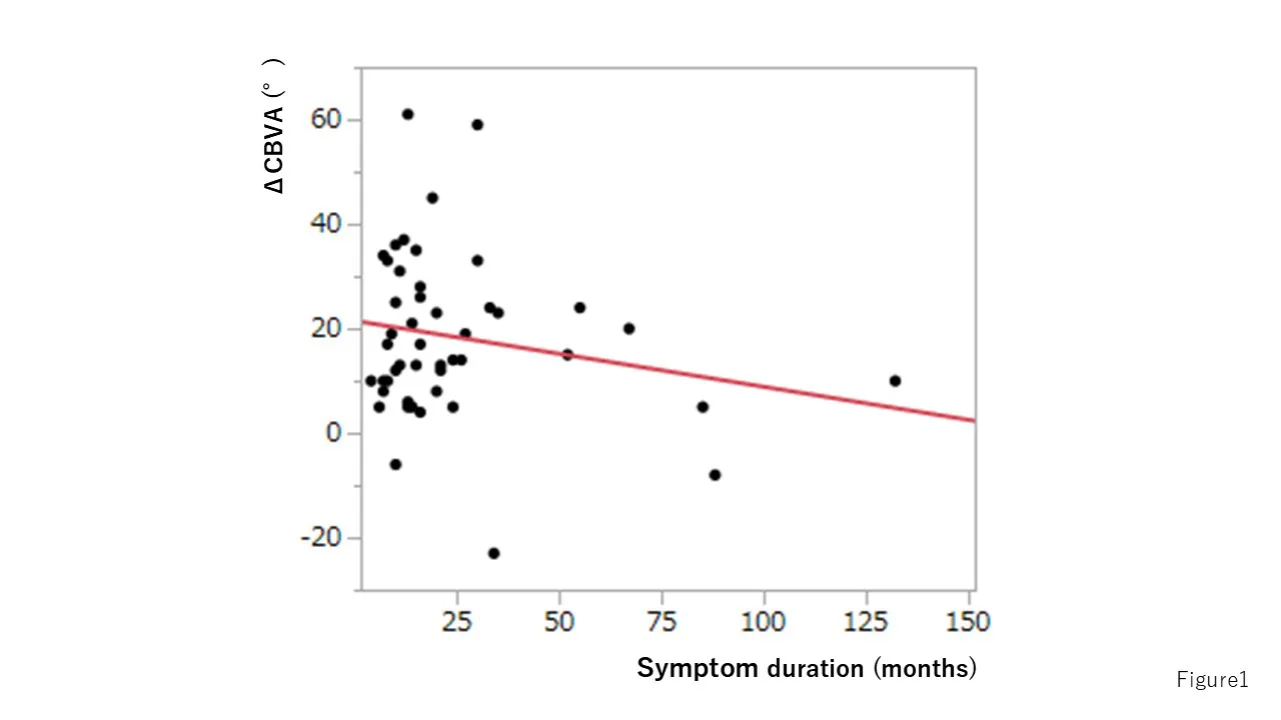
As submitted with the abstract. Tap a figure to open it at full size.