
Tumours & Infection
European retrospective multicenter study in patients with vertebral metastases (Train-Metastra)
- Istituto Ortopedico Rizzoli, Bologna, Italy
- Università di Bologna, Bologna, Italia, Bologna, Italy
- Buda Health Center, Budapest, Hungary
- University Medical Center Utrecht, Utrecht, Netherlands
- Charité-Universitätsmedizin Berlin, Berlin, Germany
- Università degli studi di Bologna, Bologna, Italy
Abstract
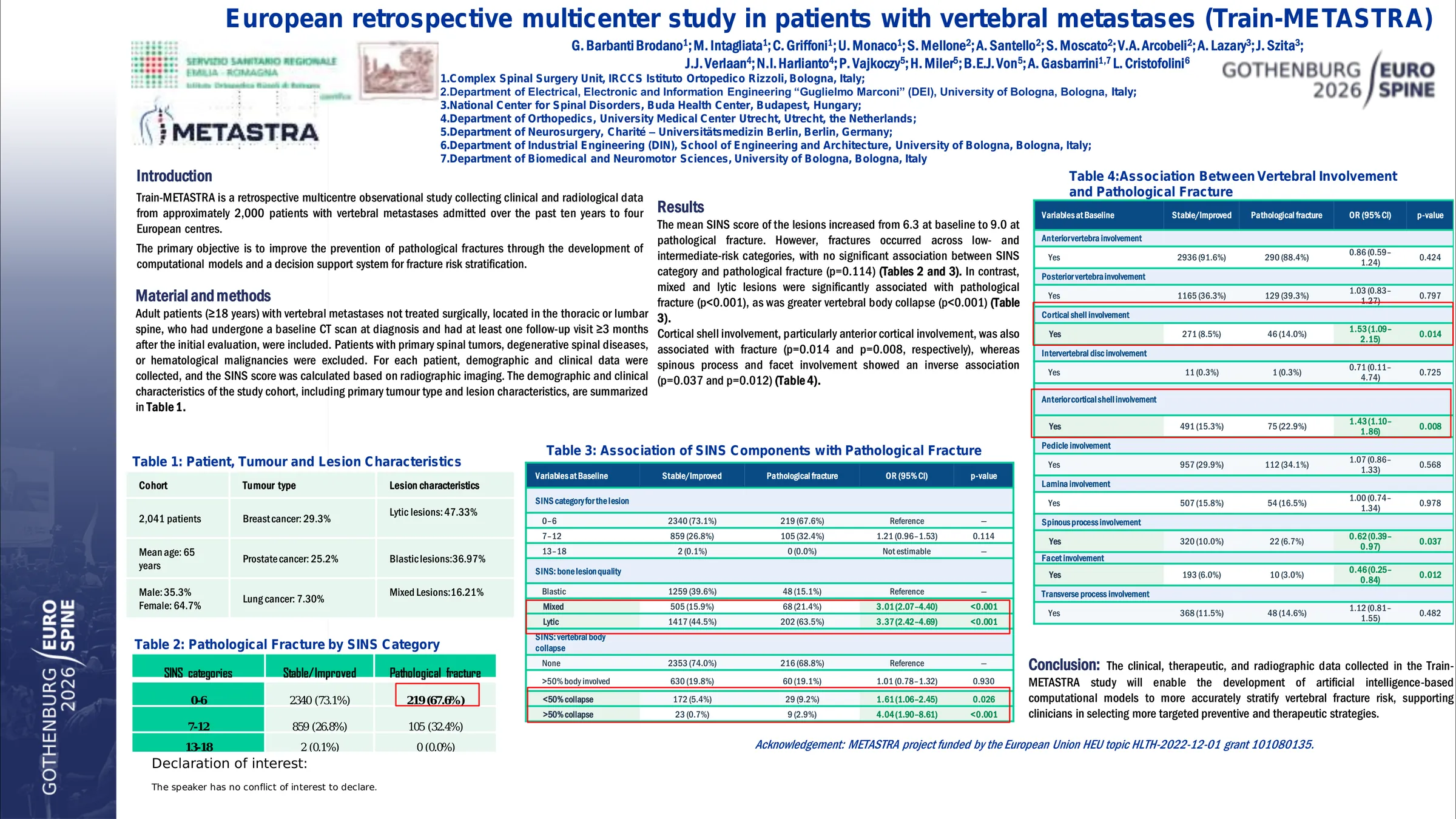
Train-METASTRA is a retrospective multicentre observational study collecting clinical and radiological data from approximately 2,000 patients with vertebral metastases admitted over the past ten years to four European centres (IOR, CHA, UMCU, BHC).The primary objective is to improve the prevention of pathological fractures through the development of computational models and a decision support system for fracture risk stratification. Currently, risk assessment relies mainly on the Spine Instability Neoplastic Score (SINS), which has limited reliability due to the restricted number of parameters, the subjectivity of evaluation, and the limited size of validation cohorts.The study aims to overcome these limitations by improving the accuracy of risk stratification and treatment planning.
Adult patients (≥18 years) with vertebral metastases not treated surgically, located in the thoracic or lumbar spine, who had undergone a baseline CT scan at diagnosis and had at least one follow-up visit ≥3 months after the initial evaluation were included. Patients with primary spinal tumors, degenerative spinal diseases, or hematological malignancies were excluded.For each patient, demographic and clinical data were collected, and the SINS score was calculated based on radiographic imaging.
A total of 2,041 patients were enrolled across the four participating centres, 35.3% of whom were male, with a mean age of 65 years. The most common primary tumors metastasizing to the spine were breast cancer (35.05%) and prostate cancer (25.35%). Overall, 3,467 lesions were analyzed, predominantly lytic (47.44%).Most lesions were treated with systemic therapies and/or radiotherapy, and 86.53% remained stable during follow-up. Only 9.39% of lesions progressed to pathological fracture.SINS was assessed in 2,490 lesions, with a mean baseline value of 6.20. Lesions were stratified into three risk categories (SINS 0–6, 7–12, and 13–18); fracture events were observed in both the low-risk (SINS 0–6) and intermediate-risk (SINS 7–12) groups. At the time of pathological fracture, the mean SINS was 9.36.
The clinical, therapeutic, and radiographic data collected in the Train-METASTRA study will enable the development of artificial intelligence–based computational models to more accurately stratify vertebral fracture risk, supporting clinicians in selecting more targeted preventive and therapeutic strategies.