
Degenerative Thoracolumbar
Transverse Abdominis Plane block in eXtreme Lateral Interbody Fusion surgery: a prospective, randomized pilot feasibility trial
- Jessa Hopital, Hasselt, Belgium
Abstract
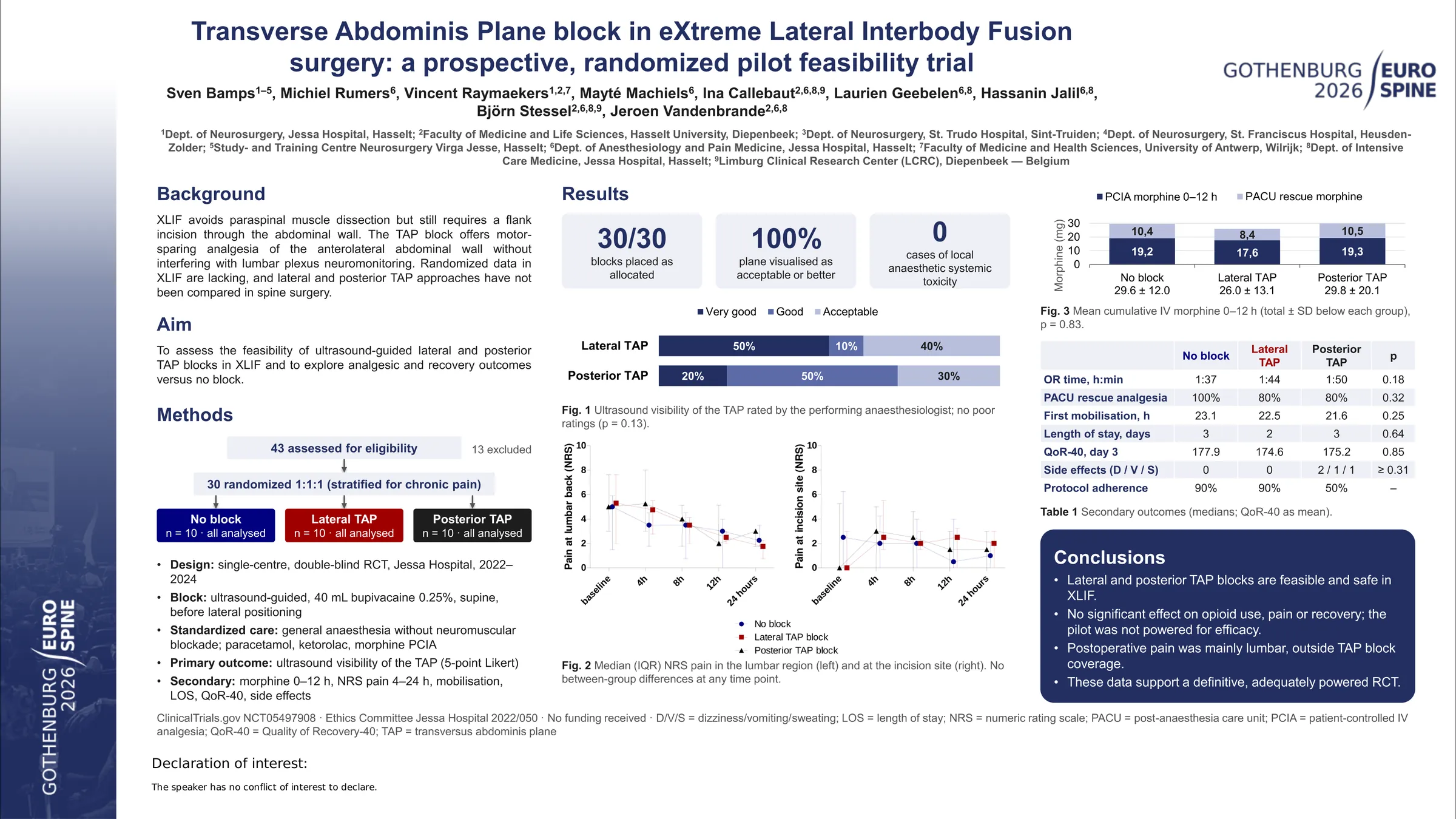
eXtreme Lateral Interbody Fusion (XLIF) is a minimally invasive spine surgery technique that avoids extensive muscular dissection and visceral manipulation. The Transverse Abdominis Plane (TAP) block, used in abdominal surgery, has the theoretical capacity to provide analgesia for XLIF. This study aimed to evaluate the feasibility and postoperative outcomes of lateral and posterior TAP blocks in XLIF surgery, compared to no block.
This single centre, randomized, double-blind feasibility trial enrolled 30 patients undergoing elective XLIF surgery. Patients were randomized to receive a lateral TAP block, a posterior TAP block or no block. All received standardized general anaesthesia and postoperative analgesia including a patient-controlled intravenous morphine device. The primary outcome was ultrasound identification of the correct transverse abdominis plane in XLIF patients. Secondary outcomes included cumulative morphine consumption in the 12 first postoperative hours, pain scores, time to mobilization, length of stay, side effects and quality of recovery (QoR-40).
All TAP blocks were successfully placed with acceptable to very good ultrasound visualization. No significant differences were found in postoperative pain scores, cumulative morphine consumption, quality of recovery, nor time to mobilization. Mild side effects (dizziness, vomiting) were reported only in the posterior TAP group. No patients suffered local anaesthesia systemic toxicity. Also, block placement did not alter total operating room time.
Lateral and posterior TAP blocks can be safely and effectively implemented in XLIF surgery. While no significant clinical benefit was observed, the results support feasibility and justify further investigation in larger trials to assess the true analgesic impact of TAP blocks in XLIF surgery.