Adult Deformity
Stand-Alone Lateral Lumbar Interbody Versus Circumferential Fusion in Adult Scoliosis: A Comparative Analysis of Reoperation Risk
- Hospital for Special Surgery Main Hospital, New York, United States of America
Abstract
Surgical treatment of adult scoliosis requires balancing surgical invasiveness with long-term construct durability. Circumferential (360°) fusion provides robust deformity correction and mechanical stability but is associated with increased perioperative morbidity, whereas stand-alone lateral lumbar interbody fusion (SA-LLIF) has emerged as a less invasive alternative with concerns regarding reduced construct stability. Reoperation represents a clinically meaningful outcome to compare the durability of these surgical strategies.
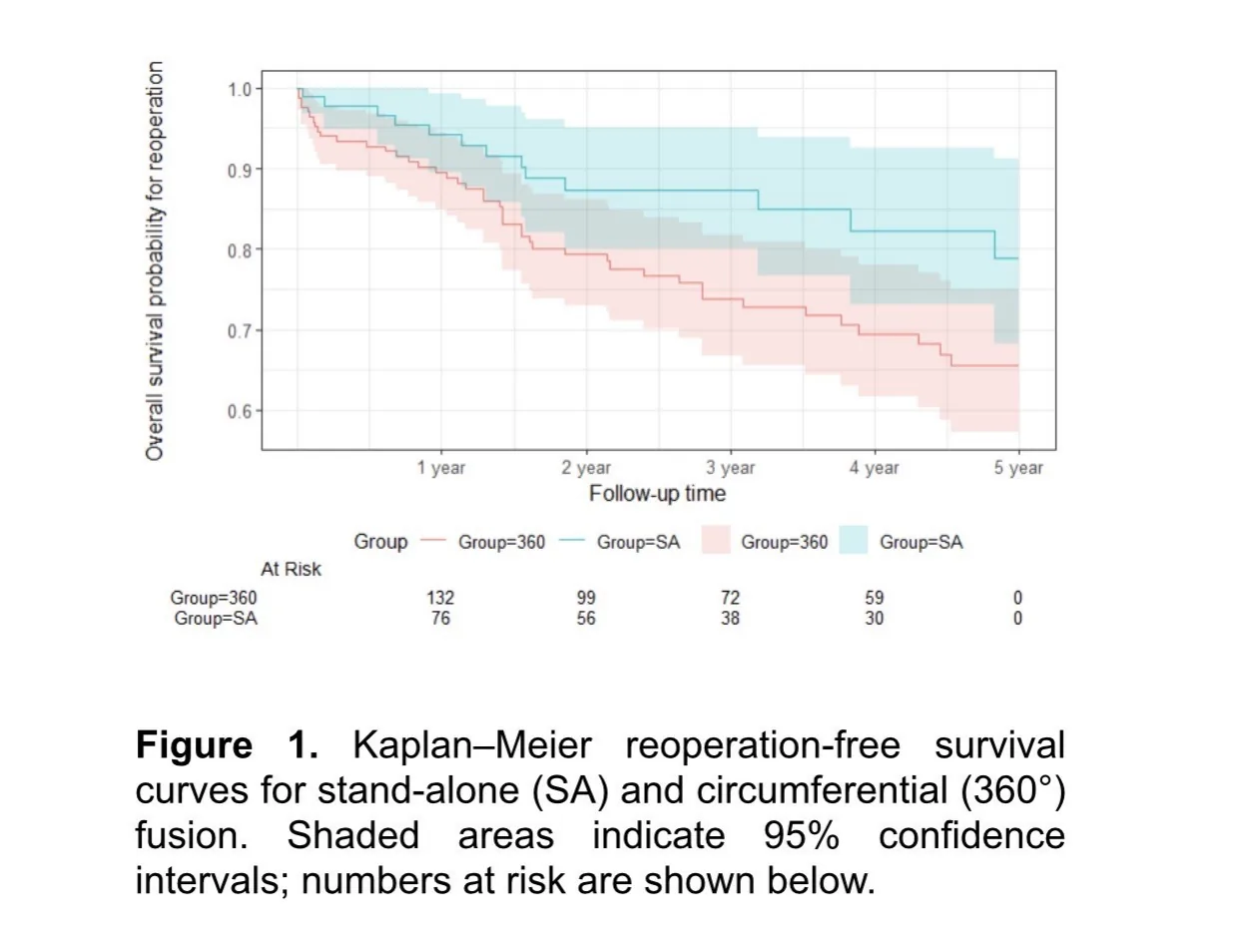
Adult scoliosis patients undergoing surgical treatment with either SA-LLIF or circumferential fusion were retrospectively identified. Reoperation was defined as the primary outcome. Time-to-event analysis was performed using Kaplan–Meier estimates and Cox proportional hazards regression, adjusting for age, Charlson Comorbidity Index, preoperative Cobb angle, and preoperative PI–LL mismatch. Patients were followed for reoperation for up to 5 years postoperatively, with censoring at last clinical follow-up (mean follow-up 3.9 years).
A total of 259 patients were included (SA-LLIF: n = 91; circumferential fusion: n = 168). Median follow-up was 3.5 years (IQR, 2.0–7.0). At 2 years after the surgery, the reoperation-free survival probability for stand-alone group was 87.2% while for circumferential group was 79.3%. Reoperation occurred in 13 patients in the SA-LLIF group and 44 patients in the circumferential group within 5 years after the surgery. In unadjusted analysis, stand-alone fusion was associated with a lower hazard of reoperation (hazard ratio [HR] 0.53; 95% CI 0.29–0.98; p = 0.045). This association remained significant after adjustment for age, comorbidity burden, preoperative Cobb angle, and preoperative PI-LL mismatch (adjusted HR 0.50; 95% CI 0.26–0.96; p = 0.037). Five-year revision-free survival favored the SA-LLIF group (p = 0.04), with cumulative revision rates of 14% for the first group compared with 26% for circumferential fusion. Mean coronal Cobb angle correction was greater in the circumferential group (−21.7° ± 9.6) compared with the SA-LLIF group (−11.0° ± 6.4; p < 0.001). Most reoperations involved procedures to add levels to the index construct (68.4%), commonly due to adjacent segment disease, proximal junctional kyphosis, and hardware failure. Same-level revisions (31.6%) were less frequent and were primarily related to pseudarthrosis, hardware repositioning, neural decompression, and infection. Stand-alone fusion was associated with substantially lower estimated blood loss (88 ± 44 vs. 1154 ± 1061 mL; p < 0.001) and shorter length of hospital stay (4.7 ± 3.7 vs. 8.0 ± 4.0 days; p < 0.001).
In adult scoliosis, SA-LLIF was associated with a lower risk of reoperation compared with circumferential fusion, despite achieving less coronal deformity correction, highlighting the trade-off between deformity correction and surgical morbidity.
Figures and tables
As submitted with the abstract. Tap a figure to open it at full size.