
Adult Deformity
The Hybrid Bipolar Construct in Adult Spinal Deformity: Preliminary Results & Surgical Technique
- UZ Leuven, Vorst, Brussel, Belgium
- UZ Leuven, Leuven, Belgium
Abstract
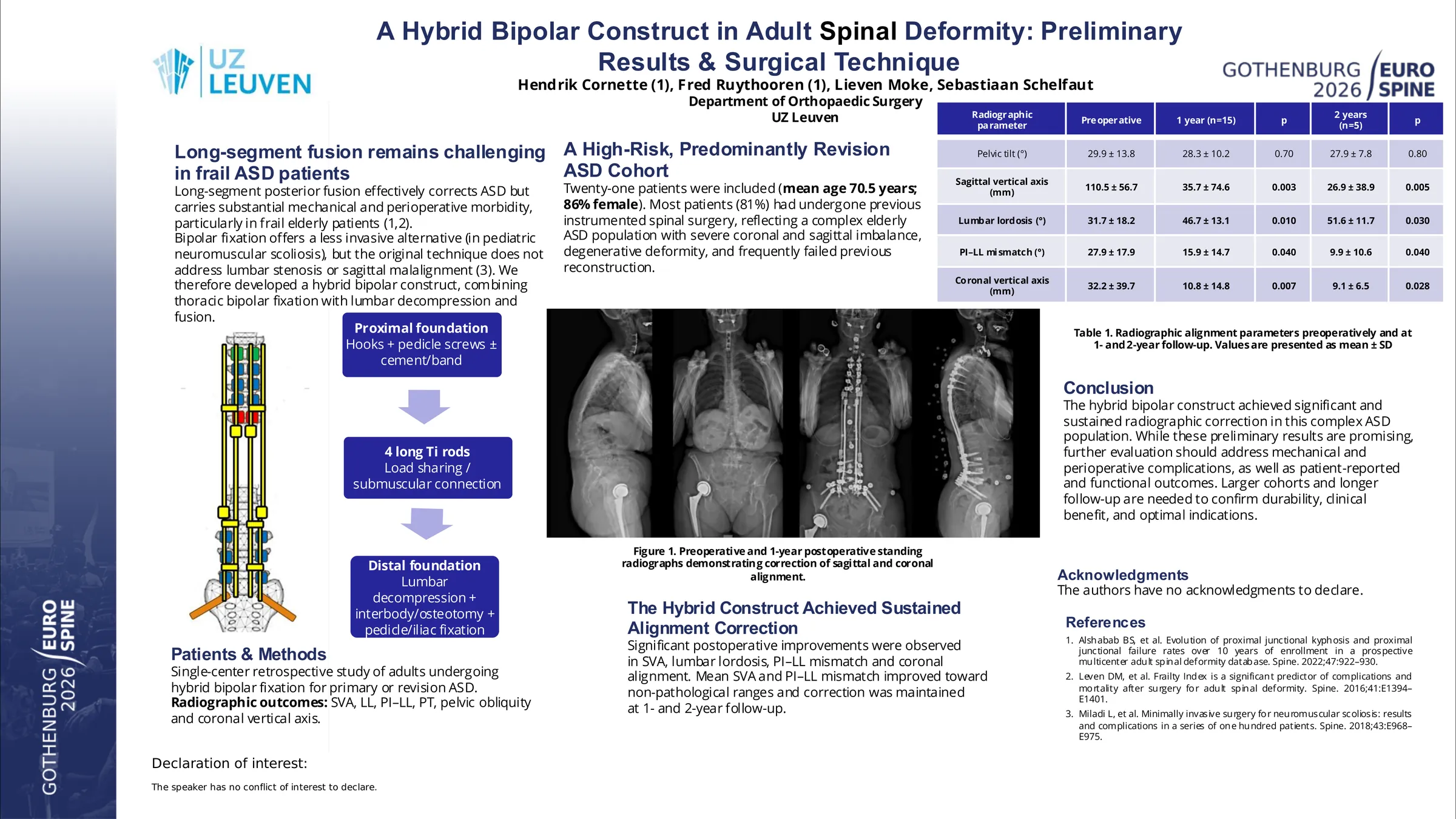
Adult spinal deformity (ASD) presents major surgical challenges. Long-segment posterior spinal fusion remains the standard treatment but is associated with high rates of mechanical complications, prolonged recovery and substantial morbidity. These risks are amplified in elderly, frail patients.
The bipolar construct was developed in pediatric neuromuscular scoliosis to reduce morbidity while maintaining deformity correction. This concept may also be applicable in adult deformity; however, the original technique does not adequately address degenerative lumbar stenosis or sagittal malalignment, the common drivers of symptoms in ASD.
We developed a hybrid bipolar construct combining minimally invasive thoracic bipolar fixation with an open posterior lumbar fusion, allowing decompression and restoration of lumbar lordosis while preserving the advantages of a less invasive approach. In this article we present our novel technique and share our preliminary radiographic results.
This single-center retrospective study included adult patients treated with a hybrid bipolar construct at a tertiary care hospital. Several types of adult spinal deformity were adressed: primary degenerative, neuromuscular, progressive idiopathic, hyperkyphosis, flat-back deformity, or revision cases.
Radiographic parameters included sagittal vertical axis (SVA), lumbar lordosis, pelvic incidence, pelvic tilt, pelvic obliquity, and C7–S1 coronal vertical axis. Mechanical complications (PJK/PJF) and implant-related failure were recorded.
Twenty-one patients were included (mean age 70.5 years; 86% female). Most patients (81%) had prior instrumented spinal surgery, primarily for proximal junctional kyphosis or implant failure with nonunion.
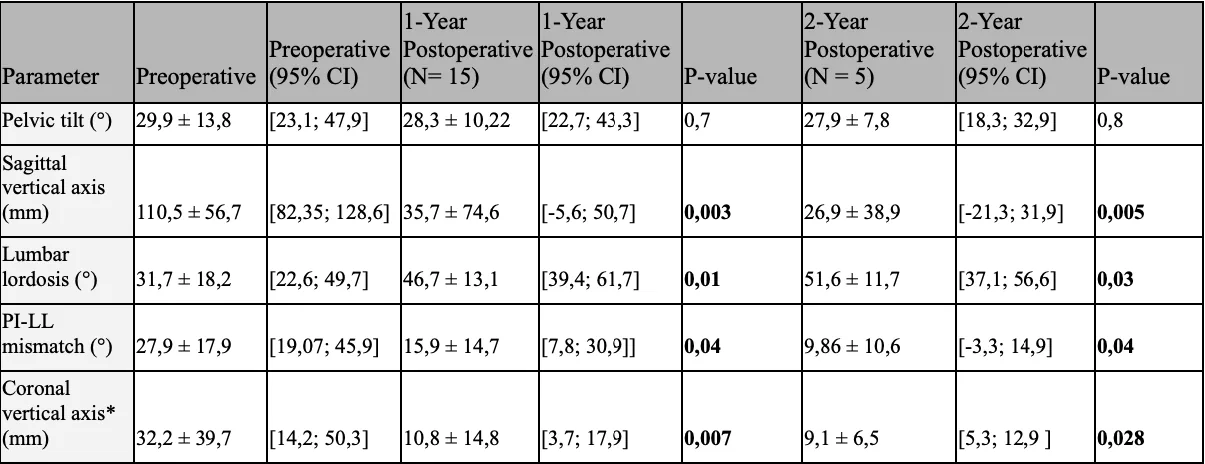
Significant improvements in spinal alignment were observed postoperatively. Mean sagittal vertical axis and PI–LL mismatch improved to within non-pathological ranges and were maintained at 1- and 2-year follow-up. Lumbar lordosis significantly increased at all time points. Pelvic tilt improved early postoperatively but returned toward baseline at later follow-up.
The hybrid bipolar construct appears to be a feasible and effective option for high–surgical-risk ASD patients, providing meaningful deformity correction and sagittal alignment improvement. Although complications remain common in this complex population, early rates of PJK/PJF appear lower than those with traditional long-segment posterior fusion. Larger studies with longer follow-up are needed to confirm durability and define optimal indications.
Figures and tables
As submitted with the abstract. Tap a figure to open it at full size.