
Growing Spine
Prognostic value of Mehta angle in mild idiopathic adolescent scoliosis
- Chu Jean Minjoz, STRASBOURG, France
- Chu Jean Minjoz, Besançon, France
- CHRU strasbourg - Les Hôpitaux Universitaires de Strasbourg , STRASBOURG, France
- Arts et Métiers ParisTech, Paris, France
Abstract
Early prediction of curve progression in adolescent idiopathic scoliosis (AIS) allows an early treatment which helps to prevent complications. Mehta angle is a prognostic parameter that has been shown to have a correlation with the evolution of early onset scoliosis. However, its prognostic value in mild AIS has not been studied.
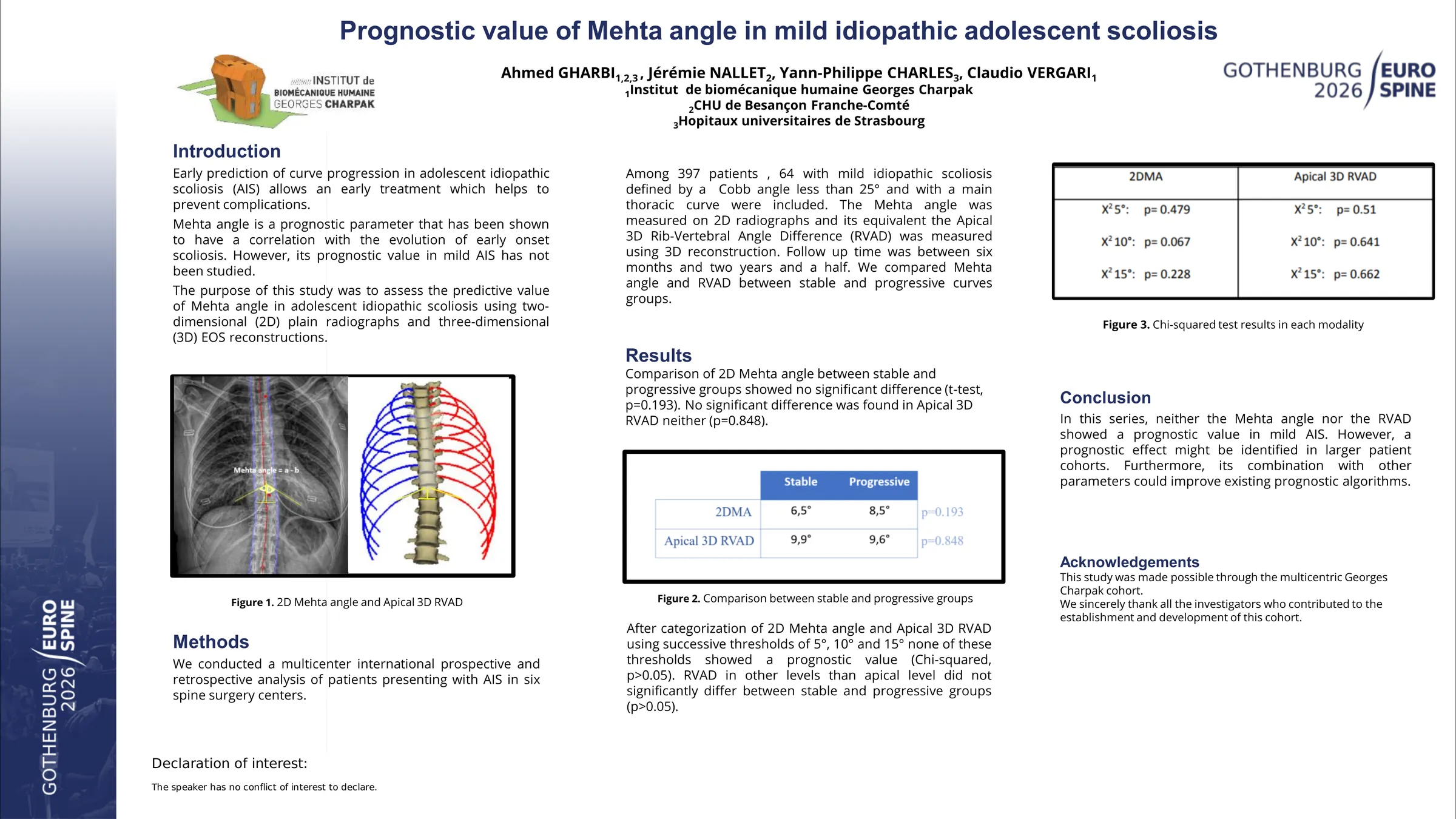
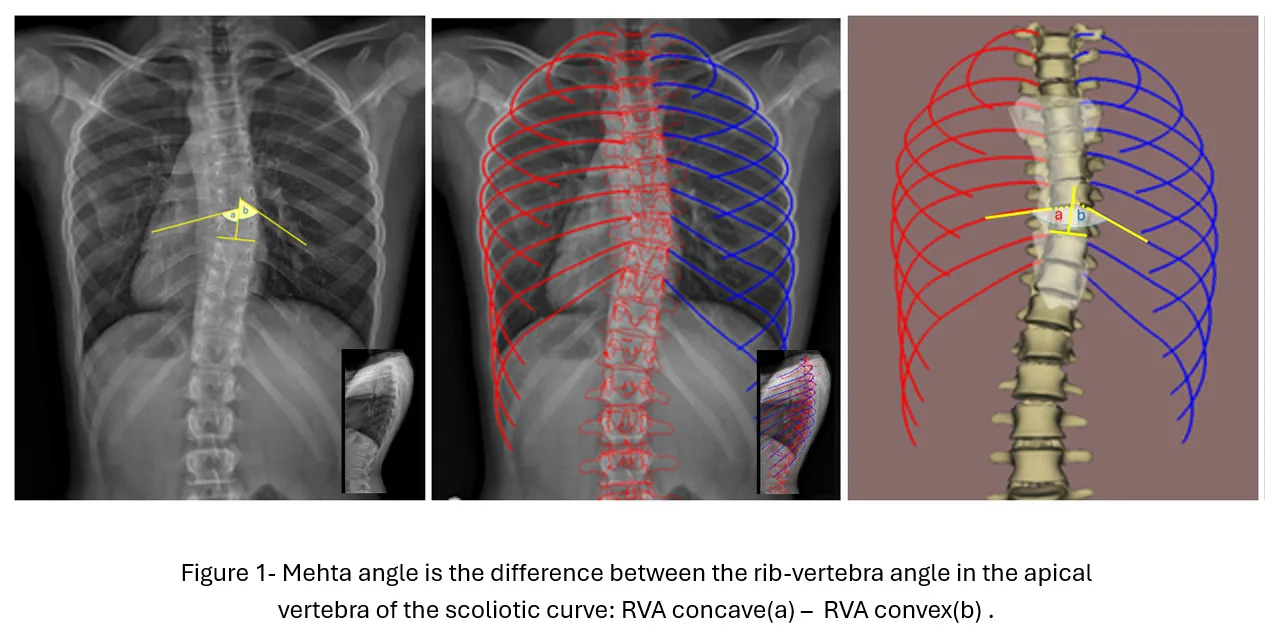
The purpose of this study was to assess the predictive value of Mehta angle in mild adolescent idiopathic scoliosis using two-dimensional (2D) plain radiographs and three-dimensional (3D) EOS reconstructions.
We conducted a multicenter international prospective and retrospective analysis of patients presenting with AIS in six spine surgery centers. Among 397 patients , 64 with mild idiopathic scoliosis defined by a Cobb angle less than 25° and with a main thoracic curve were included.Follow up ended when we discharged patients or when a brace was prescribed.Follow up time was between six months and two years and a half. The Mehta angle was measured on 2D radiographs and its equivalent the Apical 3D Rib-Vertebral Angle Difference (RVAD) was measured using 3D reconstruction. We compared Mehta angle and RVAD between stable and progressive curves groups.
Comparison of 2D Mehta angle between stable and progressive groups showed no significant difference (t-test, p=0.193). No significant difference was found in Apical 3D RVAD neither (p=0.848).
After categorization of 2D Mehta angle and Apical 3D RVAD using successive thresholds of 5°, 10° and 15° none of these thresholds showed a prognostic value (Chi-squared, p>0.05). RVAD in other levels than apical level did not significantly differ between stable and progressive groups (p>0.05).
In this series, neither the Mehta angle nor the RVAD showed a prognostic value in mild AIS. However, given the small values of Mehta angles observed in mild idiopathic scoliosis, a prognostic effect might be identified in larger patient cohorts.
Figures and tables
As submitted with the abstract. Tap a figure to open it at full size.