
Trauma
The Impact of Surgical Timing on Neurological Recovery in Traumatic Thoracic and Thoracolumbar Spinal Cord Injury: A Systematic Review and Meta- analysis
- Zarns University, Salvador, Brazil
- EBMSP, Salvador, Brazil
- UNISA, São , Brazil
- Uni Atenas, passos, Brazil
- Hospital são rafael, Salvador, Brazil
Abstract
The timing of surgical decompression is an important prognostic factor in traumatic spinal cord injury(tSCI), yet evidence supporting early surgery is derived mainly from cervical injuries, leaving thoracic and thoracolumbar data limited and heterogeneous. This systematic review and meta-analysis analyzed the impact of early versus delayed decompression on neurological recovery after traumatic thoracic or thoracolumbar spinal cord injury.
A systematic review and meta-analysis was conducted according to PRISMA 2020. PubMed, Embase, and Cochrane were searched from inception to November 2025. RCTs and analytical observational studies were included if they enrolled patients ≥16 years with acute thoracic/thoracolumbar tSCI (T1–L2), compared decompression ≤24 h or ≤8 h versus >24 h or >8 h, and reported neurological recovery using ASIA and/or Frankel. Primary outcomes were ASIA grade improvement ≥1, ≥2, and ≥3. Pooled ORs (95% CI) were calculated using a random-effects Mantel–Haenszel model; heterogeneity was assessed using I² and Cochran’s Q. Analyses were performed in RevMan 5.4. Risk of bias was assessed with RoB 2 (RCTs) and ROBINS-I (non-randomized studies).
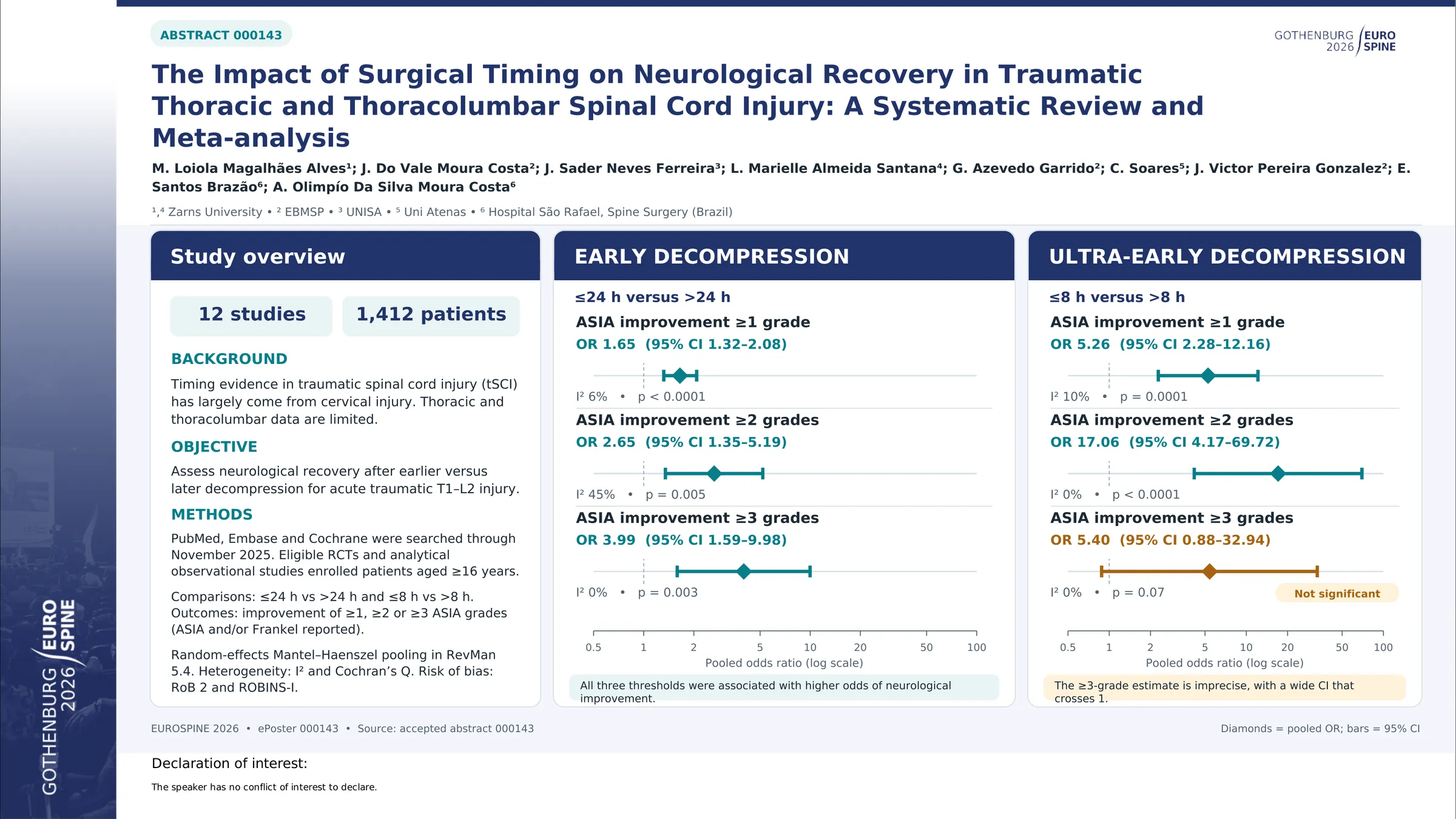
Twelve studies encompassing 1,412 patients were included. Early decompression (≤24 hours) was associated with a significantly higher likelihood of neurological improvement compared with delayed decompression (>24 hours). The pooled analysis demonstrated a statistically significant effect favoring early surgery for improvement of at least one ASIA grade (OR 1.65, 95% CI 1.32–2.08, I² = 6%, p < 0.0001), at least two ASIA grades (OR 2.65, 95% CI 1.35–5.19, I² = 45%, p = 0.005), and three or more ASIA grades (OR 3.99, 95% CI 1.59–9.98, I² = 0%, p = 0.003). Ultra-early decompression (≤8 hours) was associated with a significantly higher likelihood of neurological improvement of at least one ASIA grade compared with later decompression (>8 hours) (OR 5.26, 95% CI 2.28–12.16, I² = 10%, p = 0.0001). For improvement of at least two ASIA grades, ultra-early decompression was associated with a significantly higher likelihood of neurological improvement compared with later decompression (>8 hours) (OR 17.06, 95% CI 4.17–69.72, I² = 0%, p < 0.0001). For improvement of three or more ASIA grades, ultra-early decompression also did not show a statistically significant association (OR 5.40, 95% CI 0.88–32.94, I² = 0%, p = 0.07).
Early surgical decompression within 24 hours was associated with significantly improved neurological recovery in traumatic thoracic and thoracolumbar spinal cord injury. Ultra-early decompression within 8 hours showed a strong effect size for neurological improvement, but evidence for more marked recovery, such as improvement of three or more ASIA grades, remains limited by small sample sizes and wide confidence intervals.