
Adult Deformity
The Use of Biplanar Custom 3D printed ALIF Cages in Lumbar Deformity Surgery
- Mayo Clinic, Rochester, United States of America
- University of Kentucky, Lexington, United States of America
Abstract
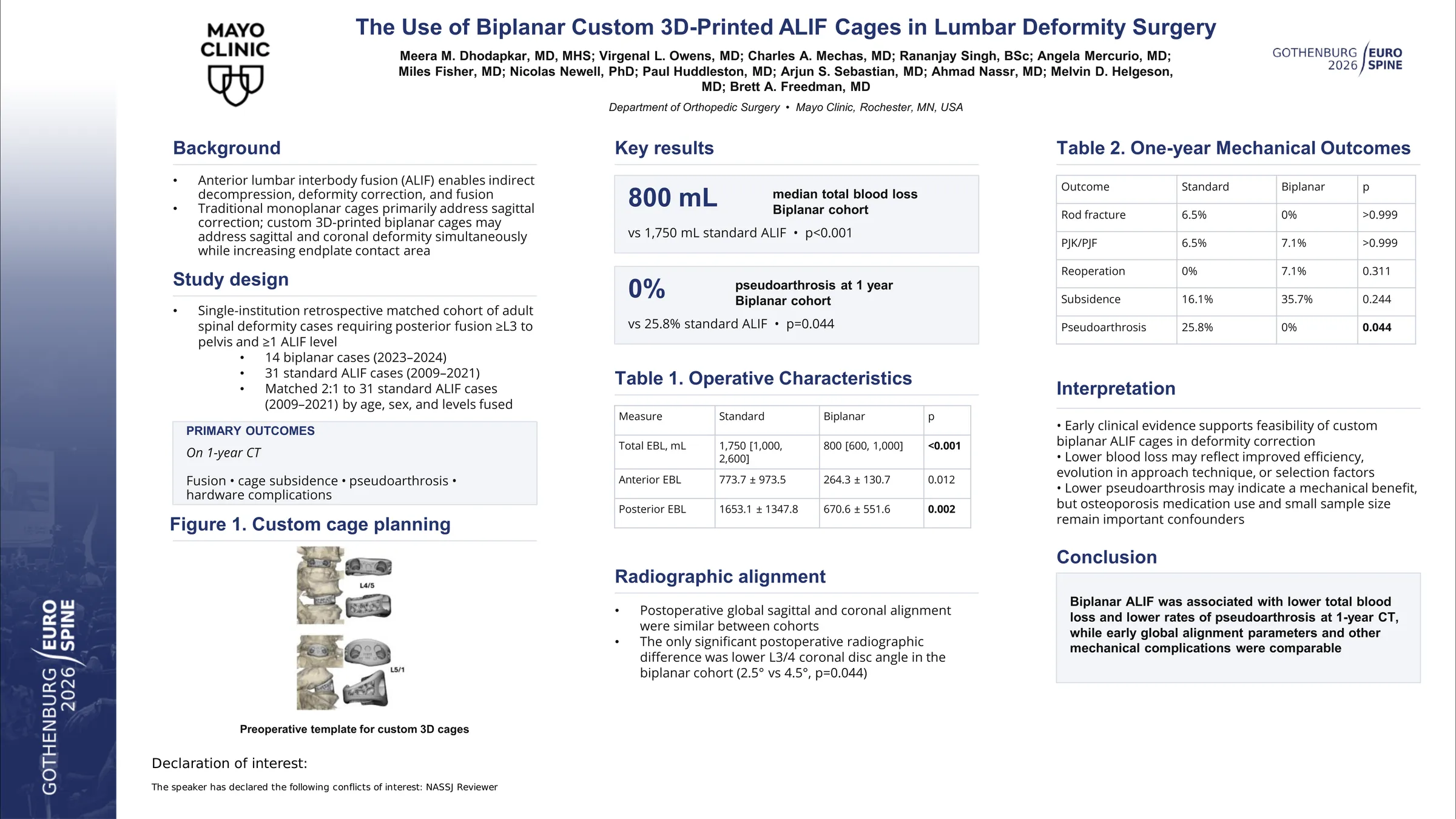
Anterior lumbar interbody fusion (ALIF) is a common surgical procedure that involves anterior access to the lumbar spine to address multiple spinal pathologies and has been shown to be a powerful tool for indirect decompression. Standard, monoplanar ALIF cages have been used historically to correct sagittal plane deformity; however, with the recent technological advancement of 3D-printed custom implants, biplanar ALIF cages that can account for both sagittal and coronal plane deformity are possible.
A retrospective cohort study was performed at a single institution. Deformity cases were pulled via a surgical records review. We identified adult spinal deformity cases with a minimum posterior levels of L3-pelvis and one ALIF level and developed a cohort of biplanar cases and a matched cohort of traditional ALIF cases 2:1 on age, sex, number of instrumented levels. Preoperative demographics were collected as well as preoperative radiographic data, postoperative radiographic data, surgical outcomes, and medical complications. Primary outcomes assessed were fusion at the levels of ALIF, subsidence of the ALIF cages, pseudoarthrosis, and implant/endplate surface contact. Secondary outcomes included post-operative radiographic measures such as PI-LL mismatch, segmental and regional lordosis, coronal cobb angles, PJK, mechanical complications, reoperation, and medical complications. CT scans at 1-yr post-operatively were analyzed for presence of bony fusion as well as to determine implant subsidence.
The study cohort consisted of 14 biplanar and 31 standard ALIF cases. There were no significant differences in age, sex, or ASA classification. Comparing standard vs biplanar ALIF, pre-operatively there were no significant differences in CSVL, fractional cobb angle, L4-S1 lordosis, or preoperative DEXA scan. There was a significant difference in pelvic tilt (28.9 degrees vs 21.5; p < 0.05) and lumbar lordosis (27.9 vs 40.3; p< 0.05). Intraoperatively, there were no significant differences in use of navigation and in the number of revision cases. Postoperatively, there were no significant differences in CSVL, fractional cobb angle, pelvic tilt, pelvic incidence, PI-LL mismatch, L1-4 lordosis, L4-S1 lordosis, L1-S1 lordosis, SVA, subsidence, pseudoarthrosis, proximal junctional kyphosis/failure, or reoperations. Pseudoarthrosis rates were higher in the standard group but were not significant due to small sample size (6 vs. 0; p =0.1573). There was a significant difference in rod fractures between standard and biplanar (9 vs. 0; p <0.05).
This study demonstrates that both standard and biplanar ALIF procedures provide significant improvements in thoracolumbar deformity correction. No significant differences were found in either group regarding radiographic parameters postoperatively. Biplanar ALIF procedures may provide protection from rod fractures, as well as pseudoarthrosis.