
Degenerative Thoracolumbar
Intertransverse Fusion in TLIF: A Paired Intra-Patient Comparison of Allograft Versus Autograft with Long-Term Follow-up
- Clinica Universidad de Navarra, Pamplona, Spain
- Clinica Universidad de Navarra, Madrid, Spain
Abstract
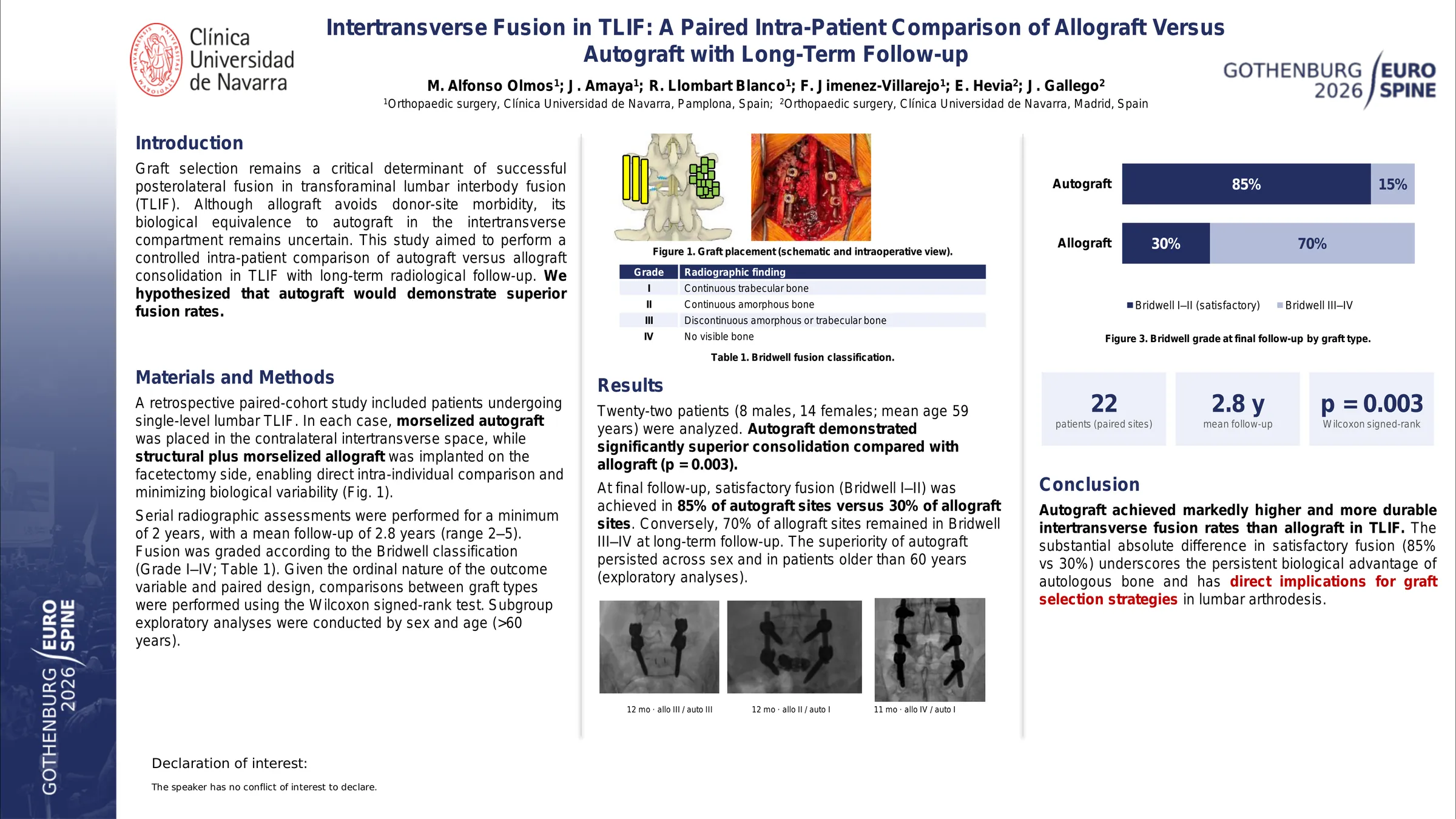
Graft selection remains a critical determinant of successful posterolateral fusion in transforaminal lumbar interbody fusion (TLIF). Although allograft avoids donor-site morbidity, its biological equivalence to autograft in the intertransverse compartment remains uncertain. This study aimed to perform a controlled intra-patient comparison of autograft versus allograft consolidation in TLIF with long-term radiological follow-up. We hypothesized that autograft would demonstrate superior fusion rates.
A retrospective paired-cohort study included patients undergoing single-level lumbar TLIF. In each case, morselized autograft was placed in the contralateral intertransverse space, while structural plus morselized allograft was implanted on the facetectomy side, enabling direct intra-individual comparison and minimizing biological variability.
Serial radiographic assessments were performed for a minimum of 2 years, with a mean follow-up of 2.8 years (range 2–5). Fusion was graded according to the Bridwell classification (Grade I–IV). Given the ordinal nature of the outcome variable and paired design, comparisons between graft types were performed using the Wilcoxon signed-rank test. Subgroup exploratory analyses were conducted by sex and age (>60 years).
Twenty-two patients (8 males, 14 females; mean age 59 years) were analyzed. Autograft demonstrated significantly superior consolidation compared with allograft (p = 0.003).
At final follow-up, satisfactory fusion (Bridwell I–II) was achieved in 85% of autograft sites versus 30% of allograft sites. Conversely, 70% of allograft sites remained in Bridwell III–IV at long-term follow-up. The superiority of autograft persisted across sex and in patients older than 60 years (exploratory analyses).
Autograft achieved markedly higher and more durable intertransverse fusion rates than allograft in TLIF. The substantial absolute difference in satisfactory fusion (85% vs 30%) underscores the persistent biological advantage of autologous bone and has direct implications for graft selection strategies in lumbar arthrodesis.