
Degenerative Thoracolumbar
Adjacent level decompression in spinal stenosis provides similar outcomes to index surgery
- Zealand University Hospital, Køge, Denmark
- Zealand University Hospital, K√∏ge, Denmark
- Kolding Hospital, Kolding, Denmark
Abstract
Lumbar spinal stenosis (LSS) is commonly treated with decompressive surgery and is associated with substantial improvement in pain and disability. Some patients however may later require adjacent level decompression due to progression of degenerative changes. Because ICD-10 coding does not specify spinal level, subsequent decompressions may be misclassified as reoperations despite occurring at a different anatomical level. We hypothesized that adjacent level decompression is analogous to contralateral hip replacement. As such, the aim of this study was to compare patient-reported outcomes after index versus adjacent level decompression for LSS using an equivalence framework.
This retrospective cohort study was based on the DaneSpine database. Patients undergoing one-level index decompression with completed pre- and one-year postoperative patient-reported outcomes (VAS-back, VAS-leg, ODI and EQ-5D) were included. Those who subsequently underwent adjacent level decompression were included if they completed new preoperative and one-year follow-up assessments.
Primary analyses compared proportional improvement following the first and second surgeries using paired two one-sided tests for equivalence (α=0.05; 90% confidence intervals). Equivalence margins were defined by established minimal clinically important differences (MCID). EQ-5D was analyzed using absolute change due to its scale properties. Sensitivity analyses were performed using absolute MCID thresholds, and responder transition probabilities were calculated.
A total of 109 patients were included. Mean age at first surgery was 67.1 years, 45.0% were female, and the mean interval between surgeries was 4.1 years. Preoperative disability was similar before both procedures, and postoperative scores were comparable.
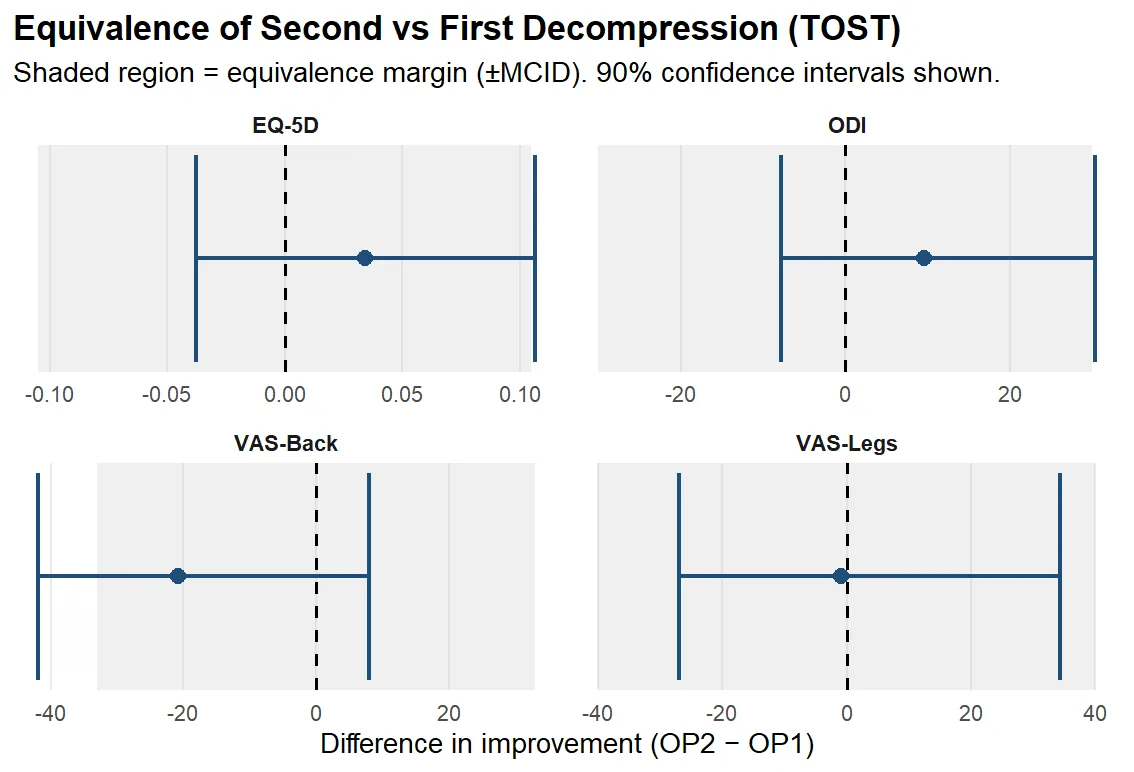
In proportional equivalence analyses, equivalence was demonstrated for VAS-leg (±40% margin, p=0.039), while ODI, VAS-back and EQ-5D showed borderline non-equivalence (p=0.052, p=0.390 and p=0.053) (figure1). In sensitivity analyses, equivalence was confirmed for ODI, VAS-back and VAS-leg, whereas EQ-5D remained borderline.
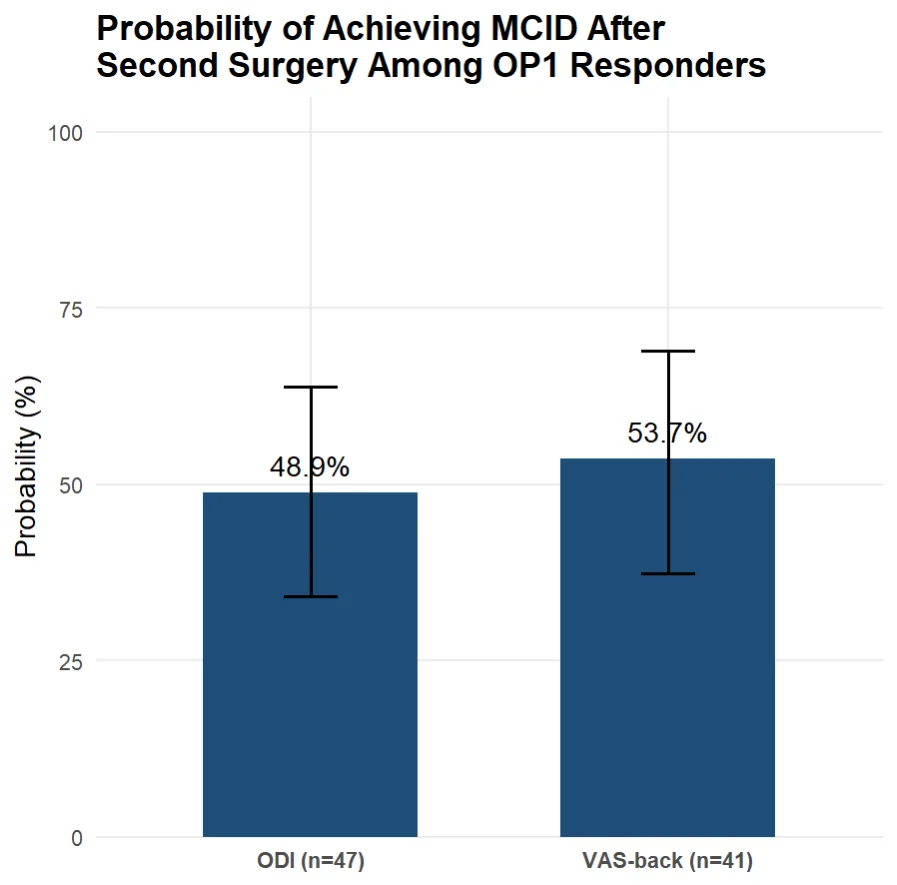
Among patients achieving MCID after the index surgery, 48.9% (95% CI 34.1–63.9%) for ODI and 53.7% (95% CI 37.4–69.0%) for VAS-back respectively achieved MCID again following the second surgery (figure 2).
Adjacent level decompression for LSS provides clinical improvement comparable to that achieved after the index procedure, particularly for pain and disability. These findings suggest that surgery at a different lumbar level represents treatment of new pathology rather than failure of the index operation and may be considered analogous to contralateral hip arthroplasty.
Figures and tables
As submitted with the abstract. Tap a figure to open it at full size.