
Degenerative Thoracolumbar
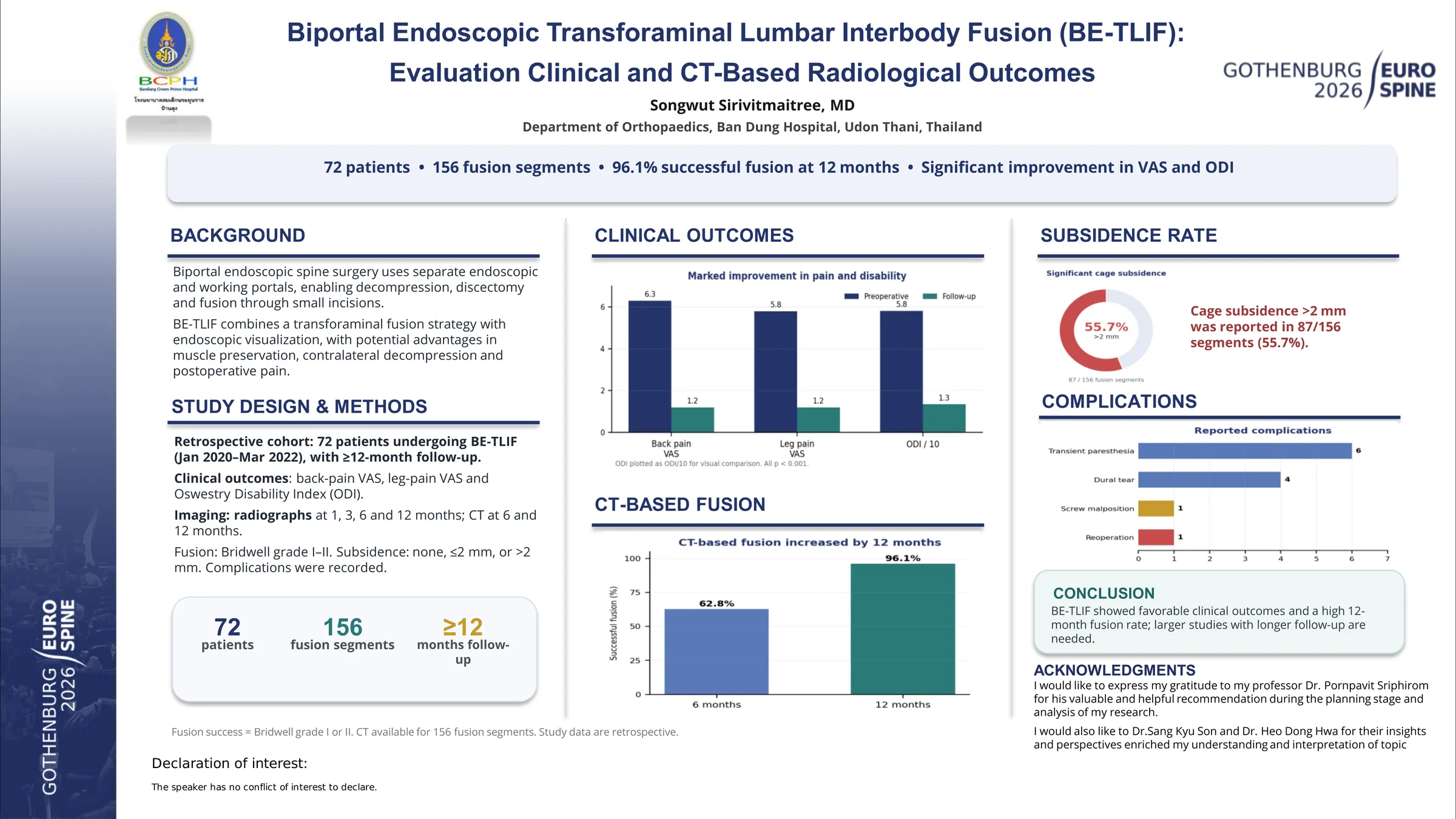
Bipotal endoscopic tranforaminal lumbar interbody fusion (BE-TLIF) : Evaluation clinical and CT- based radiological outcome
- bandung crown prince hospital, Udon Thani, Thailand
Abstract
Biportal endoscopic spine surgery is a type of minimally invasive spine surgery that uses two small incisions to insert an endoscope and surgical instruments. Biportal endoscope provides various procedures, such as decompression, discectomy, and fusion. BE- TLIF is a surgical technique that combines the advantages of minimally invasive and endoscopic spine surgery. It is a type of spinal fusion surgery through a transforaminal approach that aims to stabilize the spine and relieve pain caused by various spinal disorders, such as degenerative disc disease, spondylolisthesis, and recurrent disc herniation. The advantage of BE- TLIF does not require a tubular retractor which may reduce muscle damage ,independent endoscopic and instrument ports were easily to contralateral decompression and reduce postoperative pain. Biportal endoscopic TLIF is a promising alternative to conventional open or minimally invasive TLIF, but it requires a learning curve and more studies to evaluate its long-term outcomes
Retrospective cohort study
This study included 156 patients who underwent BE-TLIF between January 2020 and March 2024. All of the patients were observed at least a 12-month follow-up. We collected demographic data, total operation time and length of hospital stay. Clinical outcomes measures included visual analogue scale (VAS) scores for lower back pain and leg pain, Oswestry Disability Index (ODI),Plain film x-ray 1, 3, 6,12 months postoperatively and then every year thereafter. Computed tomography (CT) of the lumbar spine 6 and12 months postoperatively. The fusion rate was assessed using the Bridwell interbody fusion grading system. Cage subsidence was classified into no subsidence, no more than 2 mm, and more than 2 mm, Postoperative complications were also noted.
There were significant improvement in VAS for lower back pain from 6.3±0.8 to 1.2±0.5, VAS for leg pain from 5.8±1.3 to 1.2±0.4, ODI from 58.1±11.9 to 13.4±4.6. The p-values were all <0.001. The average hospital stay was 4.7±1.1 days. The CT studies available for 156 fusion segments. 6 months after surgery showed successful fusion (Bridwell grade I or grade II) in 98 segments (62.8%). 1 year after surgery showed successful fusion (Bridwell grade I or grade II) in 150 segments (96.1%). Significant cage subsidence of more than 2 mm was only noted in 87 segments (55.7%). Complications included 4 dural tear, 1 pedicle screws malposition, and 6 transient paresthesia, in which 1 patient required reoperations.
BETLIF may have favorable clinical outcomes, high fusion rate and lower complication. BETLIF may be a good alternative treatment for lumbar spine disorder (stenosis, instability, and spondylolisthesis). Further studies with large samples and long-term follow-up are needed.