
Adult Deformity
Does vertebroplasty at the upper instrumented and adjacent vertebrae prevent proximal junctional kyphosis and failure in adult spinal deformity surgery?
- Strasbourg University Hospital, Strasbourg, France
- Vall d'Hebron University Hospital, Barcelona, Spain
- Vall d'Hebron Institut de Recerca (VHIR), Barcelona, Spain
- Chu De Bordeaux - Haut-Lévêque, Bordeaux, France
- ELSAN Polyclinique Jean Villar, Clinique du Dos, Bordeaux-Terrefort, Pessac, France
- Acibadem University Maslak Hospital, Istanbul, Türkiye
- Schulthess Klinik, Zurich, Switzerland
- La Paz University Hospital, Madrid, Spain
- CHRU strasbourg - Les Hôpitaux Universitaires de Strasbourg , Strasbourg, France
- . European Spine Study Group (Vall d'Hebron University Hospital, Barcelona, Spain
Abstract
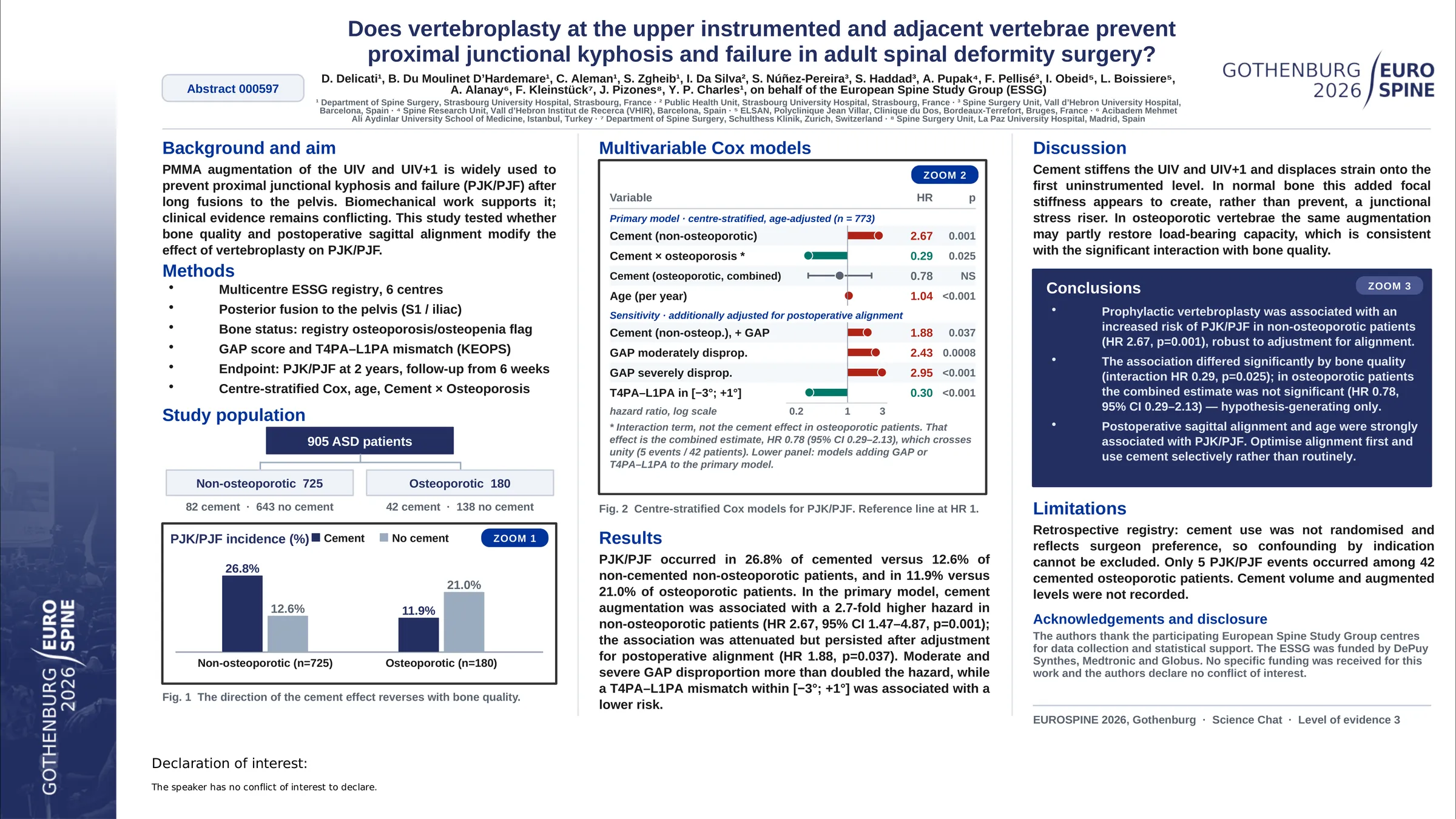
Proximal Junctional Kyphosis and Failure (PJK/PJF) remain prevalent mechanical complications following Adult Spinal Deformity (ASD) surgery. Prophylactic cement augmentation at the Upper Instrumented Vertebra (UIV) and UIV+1 has been advocated to reinforce the bone–implant interface and mitigate proximal failure, however its true effectiveness remains controversial. The purpose was to evaluate the impact of prophylactic vertebroplasty on PJK/PJF and determine whether its effect is modulated by bone quality and sagittal alignment.
A retrospective multicenter register study included ASD patients >60 years, with lower thoracic UIV (T8-T12), fused to the pelvis. The primary endpoint was the incidence of PJK/PJF. Patients were groupedaccording to cement augmentation and osteoporosis (femoral T-score <-2.5). Multivariable regressionand Cox proportional hazards models were performed to assess the influence of sagittal alignment,including the Global Alignment and Proportion (GAP) score and vertebral Pelvic Angles (T4PA–L1PA),age, interaction between osteoporosis and cement augmentation.
Among 725 patients without osteoporosis, 82 underwent prophylactic cement augmentation and 643non-cemented instrumentation. In this group, patients treated with cement were older (67±6 vs 61±14years, p=0.005), more frequently female (90% vs 77%, p=0.006), and had a higher PJK/PJF rate (27%vs 13%, p<0.001) with increased risk over time (HR 2.73, p<0.001). Among 180 patients withosteoporosis, 42 had cement augmentation and 138 no cement. In this subgroup, age and genderdistribution were comparable, incidence of PJK/PJF (12% vs 21%, p=0.2). Multivariate regressionmodels showed that the risk of developing PJK/PJF over time was lower after cement augmentation inosteoporotic patients only (HR 0.24; p=0.01). Age at surgery was associated with increased risk (HR 1.05per year; p<0.001). Postoperative malalignment was determinant: moderately and severelydisproportioned GAP categories were at risk (HR 2.53, p=0.0004 and HR 2.64, p=0.0002). In modelsincluding T4PA–L1PA difference, each 1°-increase in mismatch was associated with a 5%-increase inPJF/PJK risk (HR 1.05, p<0.001). Patients within the T4PA–L1PA range [−3°;1°] had a lower risk (HR0.34, p=0.002).
Prophylactic cement augmentation did not protect non-osteoporotic patients and was associated with increased PJK/PJF. A possible explanation is that the rigid cement core within healthy cancellous bone may cause peri-cemental trabecular microfailure, predisposing to proximal junctional collapse. In contrast, reduced PJK/PJF risk was observed only in osteoporotic patients.Postoperative sagittal alignment and age were strongly associated with failure, supporting the concept that PJK/PJF in elderly patients is primarily alignment driven.
Figures and tables
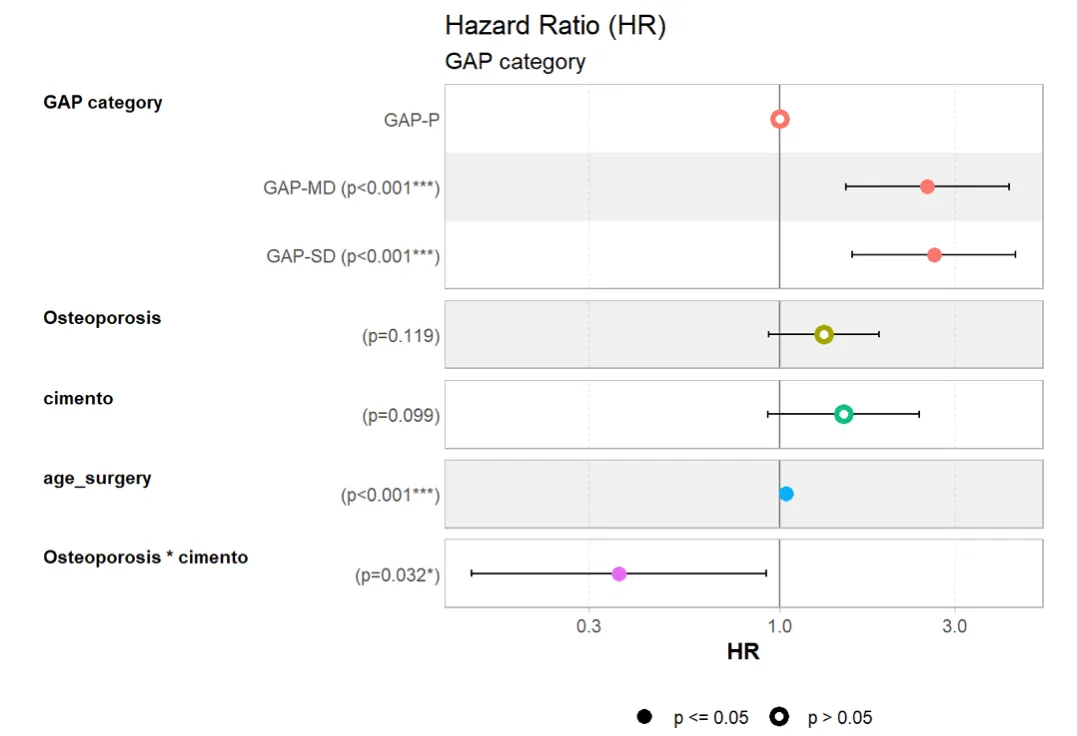
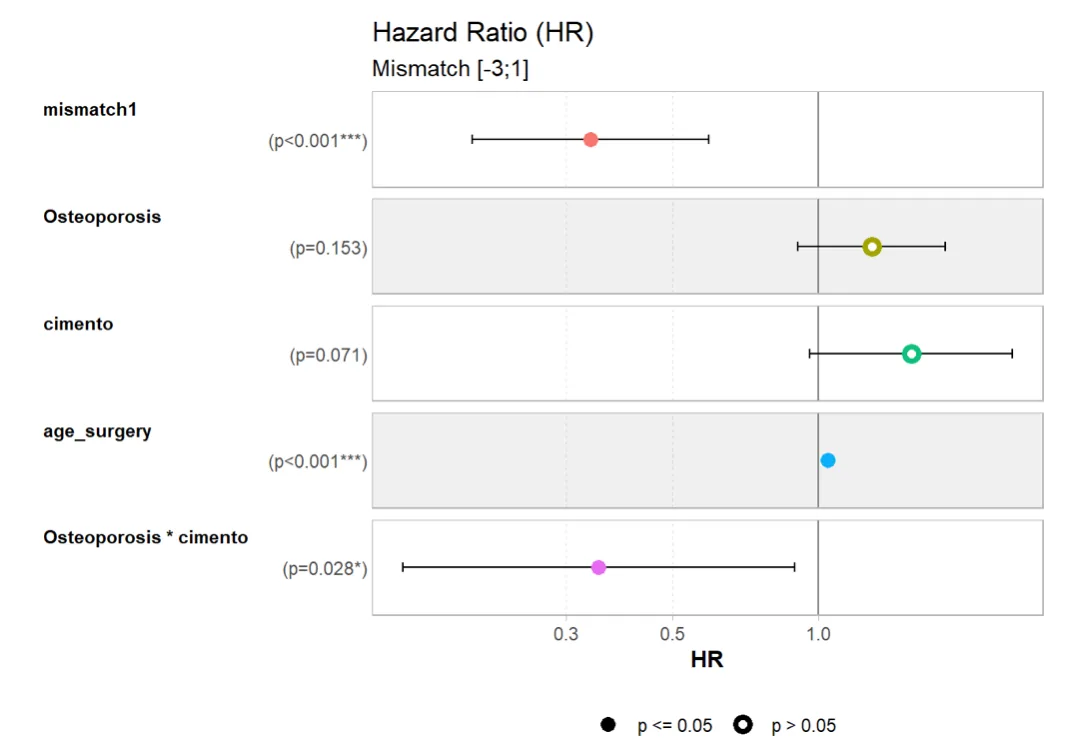
As submitted with the abstract. Tap a figure to open it at full size.