
Basic Science & Economics
The Right Patient, the Right Indication: Optimizing Outcomes of Minimally Invasive Sacroiliac Joint Fusion
- Hôpital Privé du Dos Francheville, Périgueux, France
Abstract
Minimally invasive sacroiliac joint (SIJ) fusion is an established option for patients with SIJ-related pain refractory to conservative treatment, yet outcomes remain variable and predictors of response are not well defined. This study aimed to develop and validate suggest a predictive contributing algorithm for patient selection.
We performed a single-center retrospective study of 119 procedures consecutive minimally invasive SIJ fusion procedures including 101 patients between January 2021 and January 2025. 74 procedures with complete 12-month follow-up were analyzed. Patient-reported percentage improvement was assessed and categorized as good (>70%), intermediate (50-69%), or poor (<50%). Three multivariable predictive models were developed using z-score hierarchical clustering model following pre and peroperative parameters. Secondary outcomes included Oswestry Disability Index (ODI), visual analog scale (VAS) for back and leg pain, and achievement of ODI minimal clinically important difference (MCID,≥15 points) and Patient acceptable symptom state (PASS,<25 points) following literature threshold.
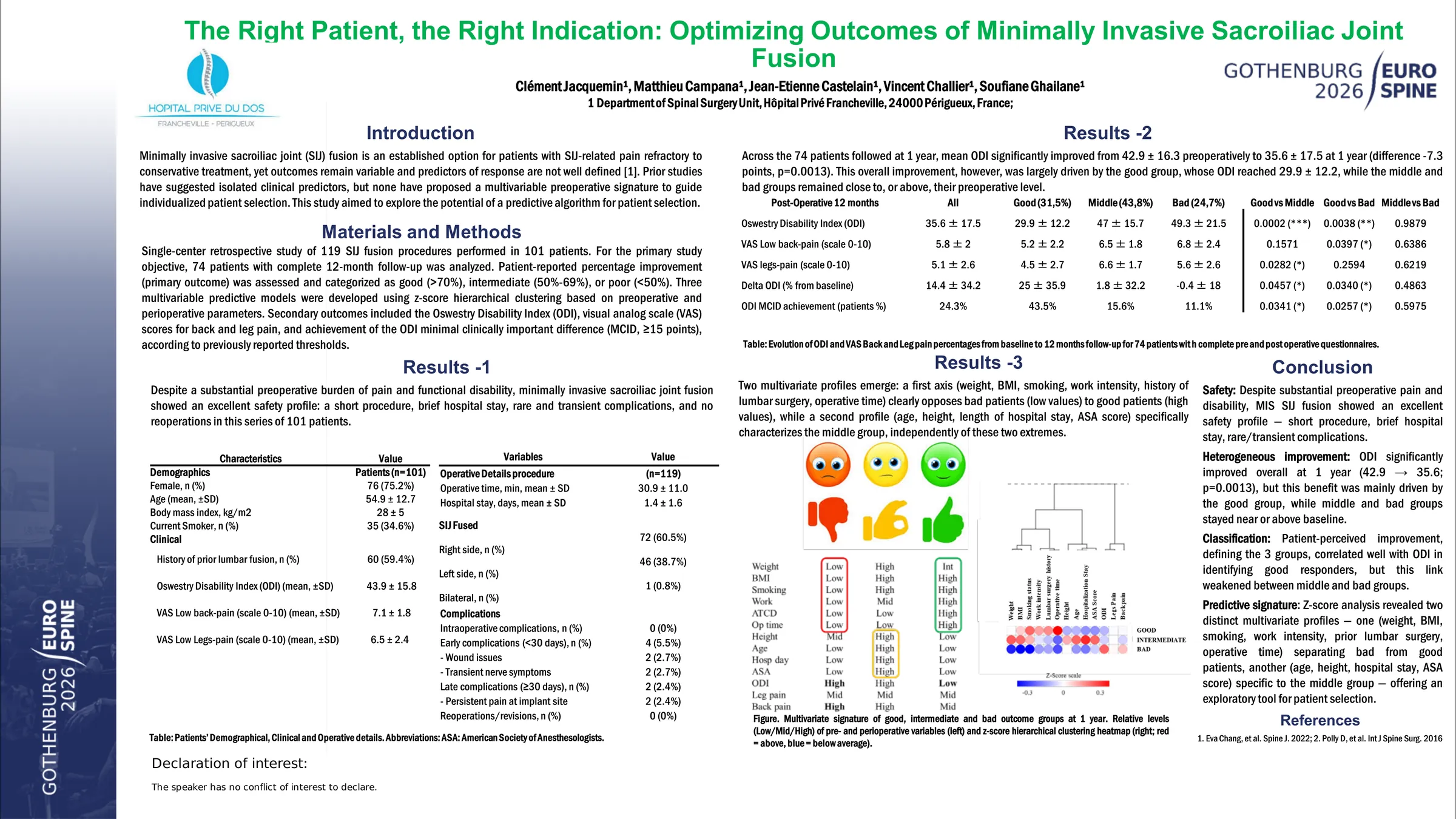
Mean patient-reported improvement was 56.7%±24.2% (median 60%). Good, intermediate, and poor outcomes occurred in 31.5%, 43.8%, and 24.7% of procedures, respectively. Mean ODI improved from 42.9±16.3 to 35.6±17.5 (difference -7.3 points, p=0.0013). VAS back pain improved from 7.0±1.8 to 5.8±2 (p<0.0001) and VAS leg pain from 6.3±2.5 to 5.1±2.6 (p=0.001). ODI MCID was achieved in 24.3% overall and 43.5% with good outcomes versus 15.6-11.1% with intermediate/poor outcomes (p=0.0203). PASS was achieved in 27.4% overall. Univariate analysis failed to demonstrate significant differences between groups, except for sex, with a higher proportion of males in the poor outcome group. In contrast, multivariable analysis identified a specific clustering of preoperative BMI, smoking status, work intensity, history of lumbar spine surgery, ODI score, and VAS back pain level that discriminated between the good and poor outcome groups (FIGURE).
The development of an exploratory model that identifies a multivariate signature influencing the success of mini invasive sacroiliac joint fusion surgery is groundbreaking and provides additional tools for both patients and clinicians. We identified a cluster of preoperative and intraoperative variables levels that may contribute to surgical success or failure one year after the procedure. Several predictive factors for success were identified, including employment status, smoking status, and a history of lumbar spine surgery. In contrast, patients with poor outcomes tended to report more important back pain and ODI handicap scores. Furthermore, poor patients’ group were also younger, with a lower body mass index, and were unemployed or works with very low physical impact on the lumbar spine.
Figures and tables
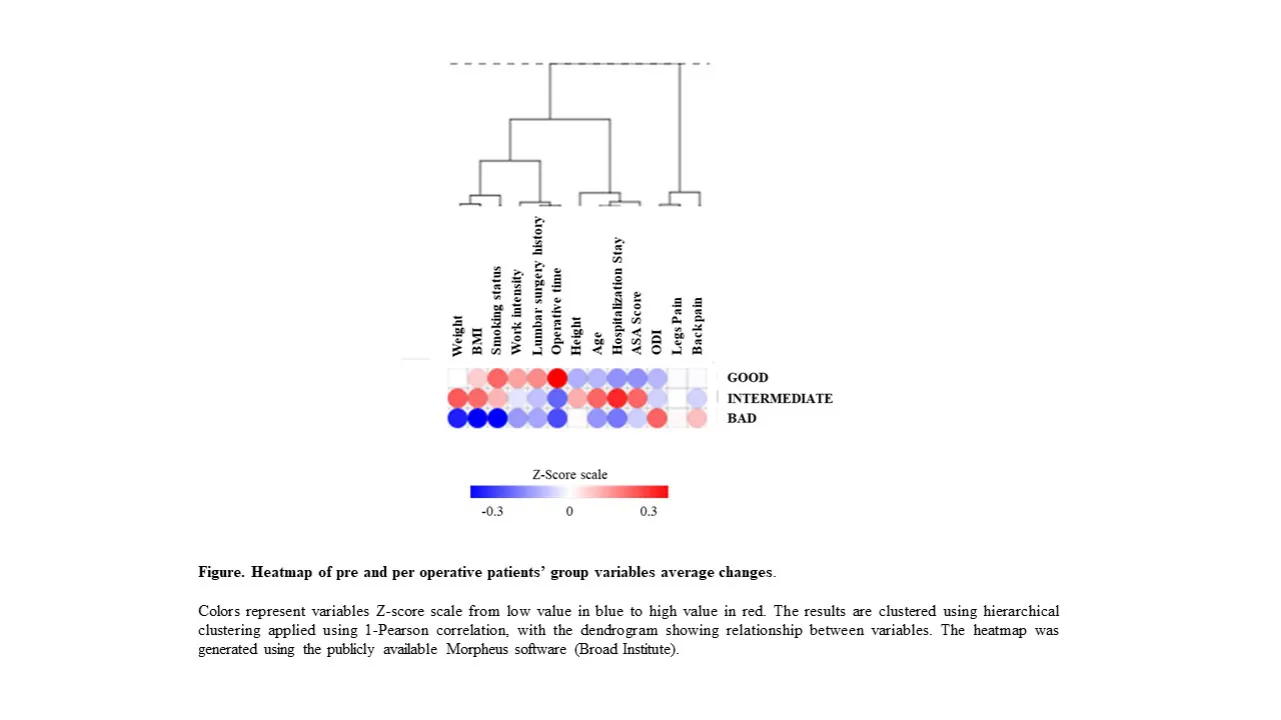
As submitted with the abstract. Tap a figure to open it at full size.