
Adult Deformity
The Mechanical Lever Arm and Distal Junctional Kyphosis: A Preliminary Biomechanical Analysis of Construct Length and Vertebral Bone Density
- Ichihara Hospital, Tsukuba, Ibaraki, Japan
- Ichihara Hospital, Tsukuba, Japan
Abstract
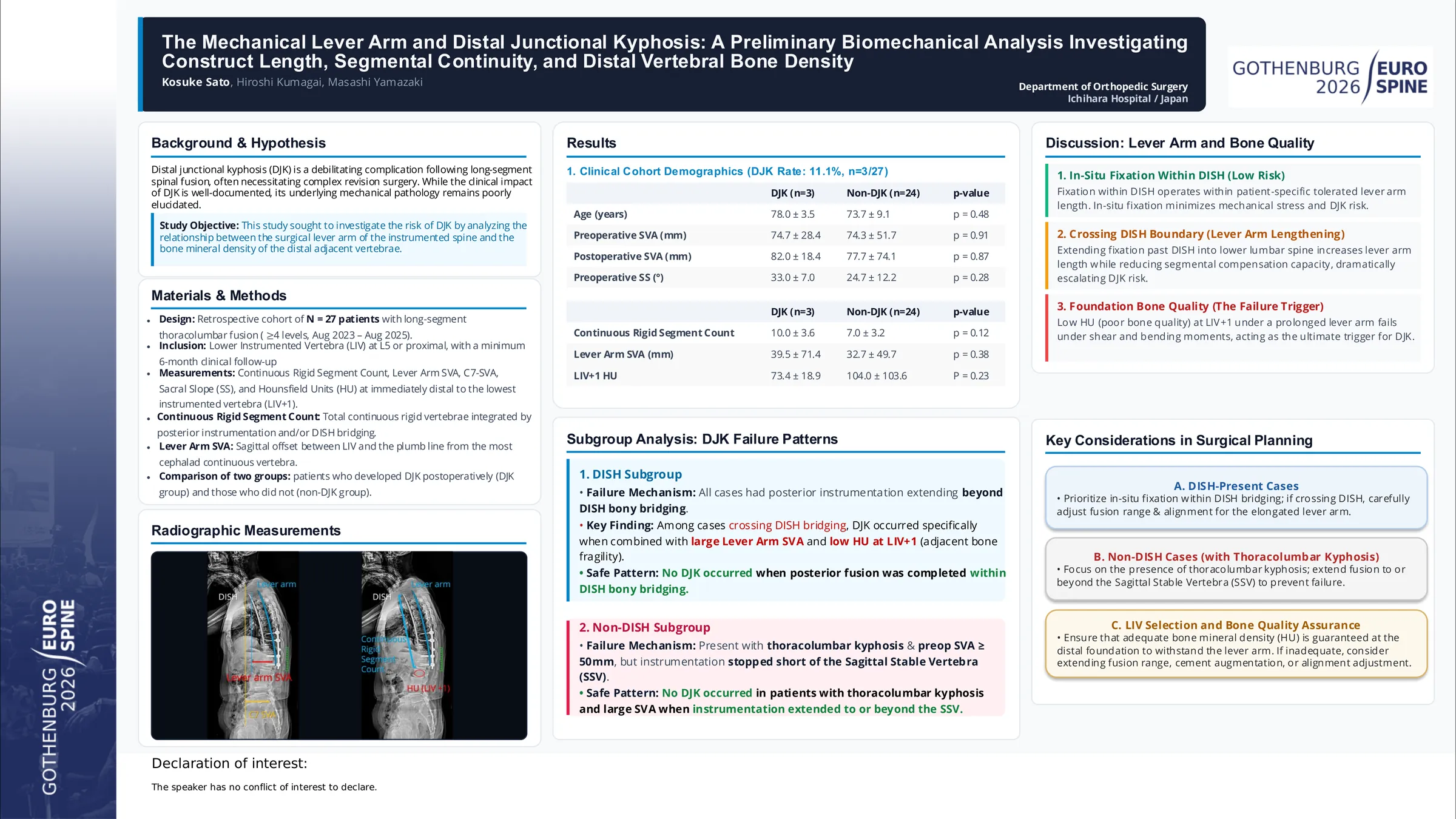
Distal junctional kyphosis (DJK) is a debilitating complication following long-segment spinal fusion, often necessitating complex revision surgery. While the clinical impact of DJK is well-documented, its underlying mechanical pathology remains poorly elucidated. This study sought to investigate the risk of DJK by analyzing the relationship between the surgical lever arm of the instrumented spine and the bone mineral density of the distal adjacent vertebrae.
This preliminary retrospective analysis was conducted on consecutive patients undergoing thoracolumbar fusion (≧4 levels) between August 2023 and August 2025. Inclusion criteria required a Lower Instrumented Vertebra (LIV) at L5 or proximal, with a minimum 6-month clinical follow-up. Key parameters included the total number of vertebral segments integrated into the construct—defined as the "lever arm" (via instrumentation or pre-existing bony bridges/DISH)—the sagittal vertical axis (SVA), and the Hounsfield Units (HU) of the vertebra immediately distal to the LIV.
The study included 27 patients, with a DJK incidence of 11.1% (n=3). No significant differences were observed regarding age, preoperative/postoperative SVA, PI-LL mismatch, or sacral slope. Analysis of the fusion lever arm revealed that patients with Diffuse Idiopathic Skeletal Hyperostosis (DISH) demonstrated a higher risk of DJK when surgical instrumentation violated the existing structural equilibrium by extending beyond pre-existing bony bridges. Conversely, lengthening the lever arm within the limits of original bony bridges did not result in DJK. Notably, at the thoracolumbar junction, failure occurred when the LIV was not anchored to a sagittal stable vertebra. In the lower lumbar region, a long lever arm combined with low HU in the distal adjacent segment was strongly associated with DJK occurrence.
The synergy between the mechanical lever arm and local bone quality is a primary determinant of DJK. Our findings suggest a "two-hit" phenomenon where mechanical leverage from a long construct exceeds the compensatory capacity of low-density distal vertebrae. While limited by a small cohort, these preliminary results suggest that surgical planning must prioritize the selection of a sagittal stable vertebra for the LIV and account for the structural continuity and bone density of the adjacent segment to mitigate DJK risk.