Growing Spine
Real-world effectiveness of conservative treatment of adolescents with idiopathic scoliosis
- Università degli studi di Milano, milano, Italy
- ISICO, Milan, Italy
- IRCCS Istituto Ortopedico Galeazzi, Milan, Italy
Abstract
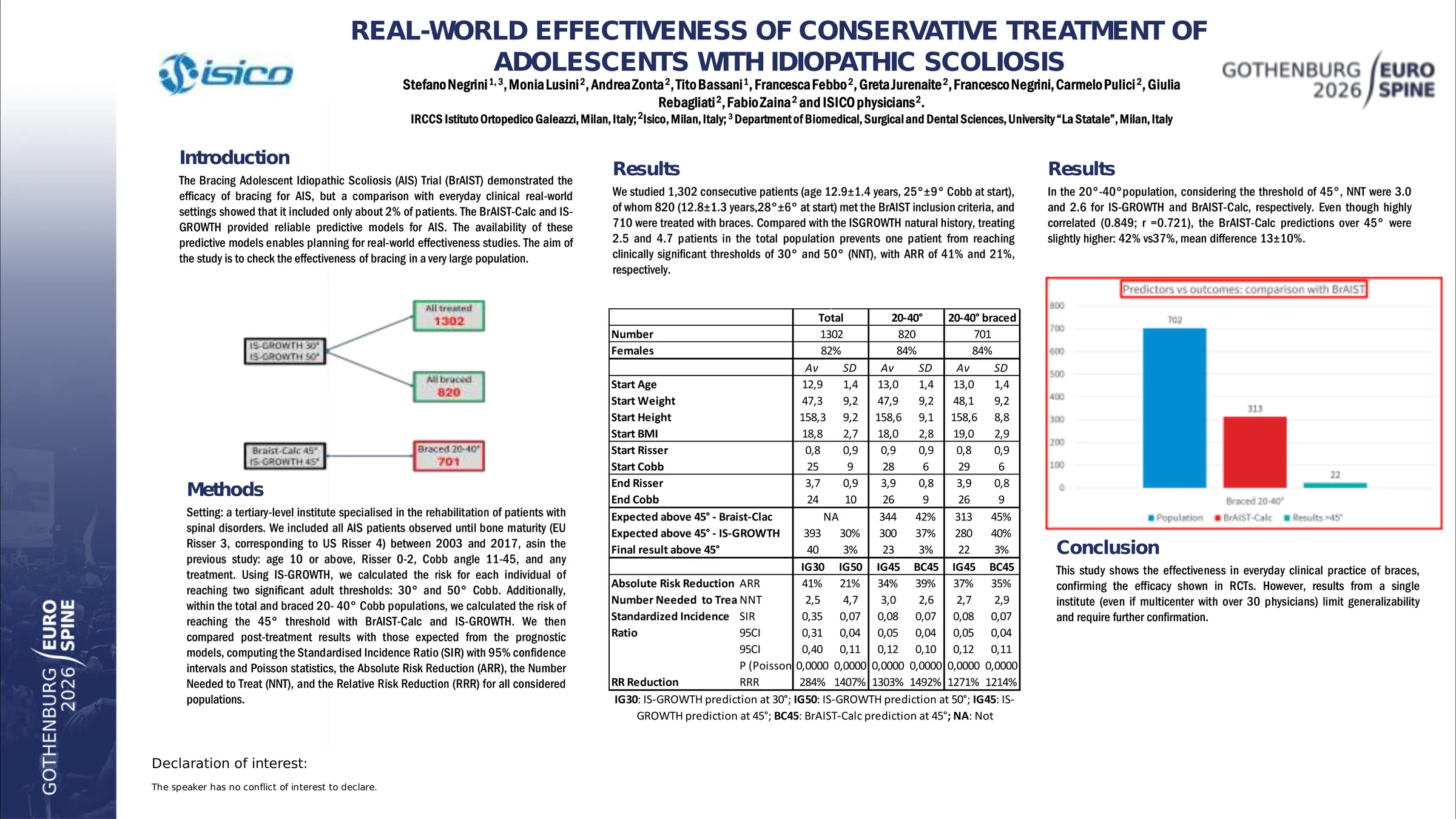
The Bracing Adolescent Idiopathic Scoliosis (AIS) Trial (BrAIST) demonstrated the efficacy of bracing for AIS, but acomparison with everyday clinical real-world settings showed that it included only about 2% of patients. TheBrAIST-Calc and IS-GROWTH provided reliable predictive models for AIS. The availability of these predictive modelsenables planning for real-world effectiveness studies. The aim of the study is to check the effectiveness of bracing in a very large population.
Secondary analysis of a retrospective study on prospectively collected data, comparing results atbone maturity to the expected individual natural history. Setting: a tertiary-level institute specialised in the rehabilitation of patients with spinal disorders. We included allAIS patients observed until bone maturity (EU Risser 3, corresponding to US Risser 4) between 2003 and 2017, asin the previous study: age 10 or above, Risser 0-2, Cobb angle 11-45, and any treatment. Using IS-GROWTH, wecalculated the risk for each individual of reaching two significant adult thresholds: 30° and 50° Cobb. Additionally,within the total and braced 20-40° Cobb populations, we calculated the risk of reaching the 45° threshold withBrAIST-Calc and IS-GROWTH. We then compared post-treatment results with those expected from the prognosticmodels, computing the Standardised Incidence Ratio (SIR) with 95% confidence intervals and Poisson statistics,the Absolute Risk Reduction (ARR), the Number Needed to Treat (NNT), and the Relative Risk Reduction (RRR) for all considered populations.
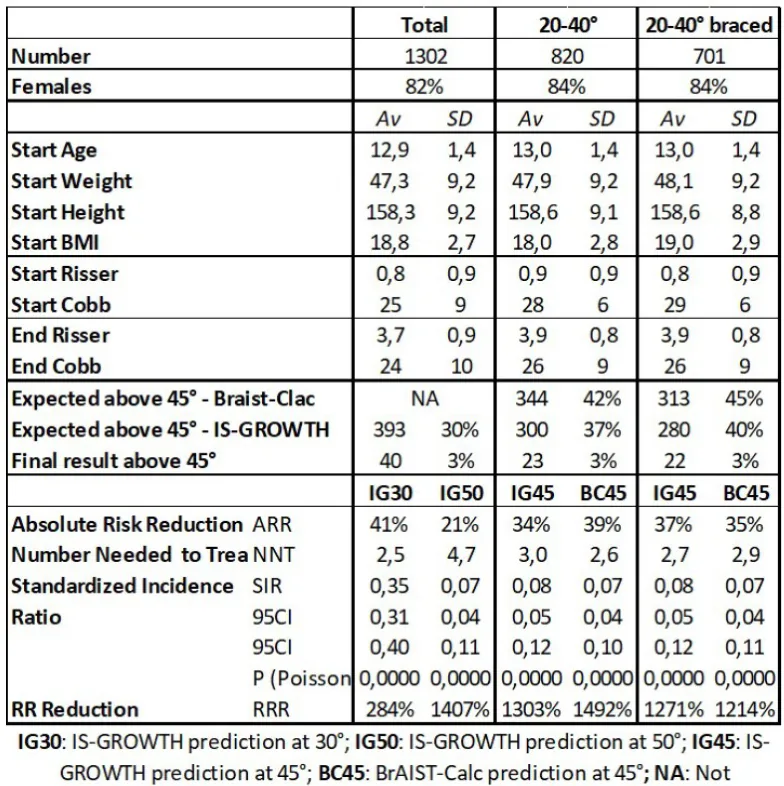
We studied 1,302 consecutive patients (age 12.9±1.4 years, 25°±9° Cobb at start), of whom 820 (12.8±1.3 years,28°±6° at start) met the BrAIST inclusion criteria, and 710 were treated with braces. Compared with the ISGROWTHnatural history, treating 2.5 and 4.7 patients in the total population prevents one patient from reachingclinically significant thresholds of 30° and 50° (NNT), with ARR of 41% and 21%, respectively. In the 20°-40°population, considering the threshold of 45°, NNT were 3.0 and 2.6 for IS-GROWTH and BrAIST-Calc, respectively.Even though highly correlated (0.849; r =0.721), the BrAIST-Calc predictions over 45° were slightly higher: 42% vs37%, mean difference 13±10%.
This study shows the effectiveness in everyday clinical practice of braces, confirming the efficacy shown in RCTs. However, results from a single institute (even if multicenter with over 30 physicians) limit generalizability and require further confirmation. Valid predictive models allow effectiveness studies, which are crucial for showing the real-world relevance of RCTs'results. RCTs focus on internal validity in controlled environments, while effectiveness studies like this evaluatebenefits in routine practice, offering a better view of public health impact.
Figures and tables
As submitted with the abstract. Tap a figure to open it at full size.