
Adult Deformity
Patient-Specific, Radiation-Free Spinal Motion Modeling Challenges Standard Intervertebral Motion Assumptions
- KU Leuven, Leuven, Belgium
- UZ Leuven, Leuven, Belgium
Abstract
Quantitative spine models frequently rely on fixed intervertebral motion distributions derived from cadaveric experiments. These reference values are widely applied in clinical and biomechanical simulations, despite limited evidence that they represent in vivo behavior, particularly in patients with altered spinal mechanics such as adult spinal deformity (ASD) or post-fusion conditions. The present study evaluated whether individualized spinal motion patterns differ from commonly applied literature-based ratios using a radiation-free modeling framework.
Five participants (three with ASD, one asymptomatic control, and one subject with sacralization) were included, of whom two ASD patients had previously undergone lumbar fusion. Subjects performed seated forward flexion and bilateral lateral bending (≥3 trials per task). A novel radiation-free, personalized modeling and simulation pipeline using MRI and motion capture was used to estimate intervertebral motion across T1-S1. Patient-specific intervertebral contributions to overall spinal motion were measured and compared to literature-based values.
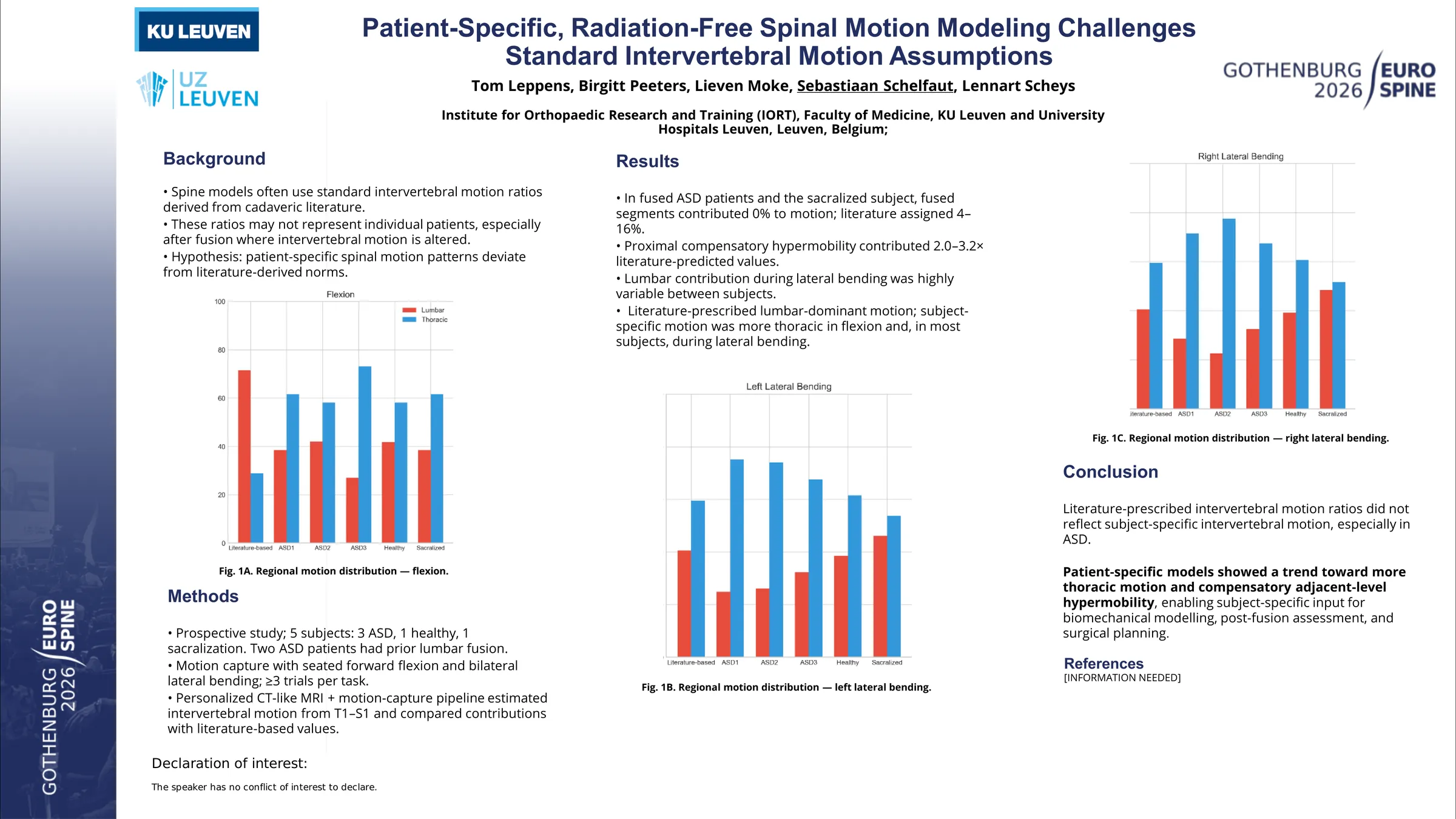
Across participants, individualized intervertebral motion patterns consistently differed from literature-based estimates. Mean deviations per segment were 4.2 ± 3.6% during flexion, 2.8 ± 2.3% during left lateral bending, and 2.7 ± 2.2% during right lateral bending. During flexion, reference models emphasized lumbar dominance, whereas measured patterns demonstrated increased thoracic involvement in all subjects. Similarly, lateral bending was predominantly thoracic in most participants, contrasting with expected lumbar predominance. In fused and sacralized spines, segments with no physiological mobility were still assigned motion (4–16%) by reference models. Adjacent segments exhibited compensatory increases in mobility, reaching up to 2.0–3.2 times predicted values (Fig 1).
Standard intervertebral motion distributions derived from cadaveric data do not adequately represent individualized spinal kinematics, particularly in surgically altered spines. Patient-specific optimization revealed systematic shifts toward greater thoracic contribution and pronounced adjacent-level compensation. The proposed radiation-free workflow enables personalized biomechanical modeling and may improve post-operative assessment and surgical planning.
Figures and tables
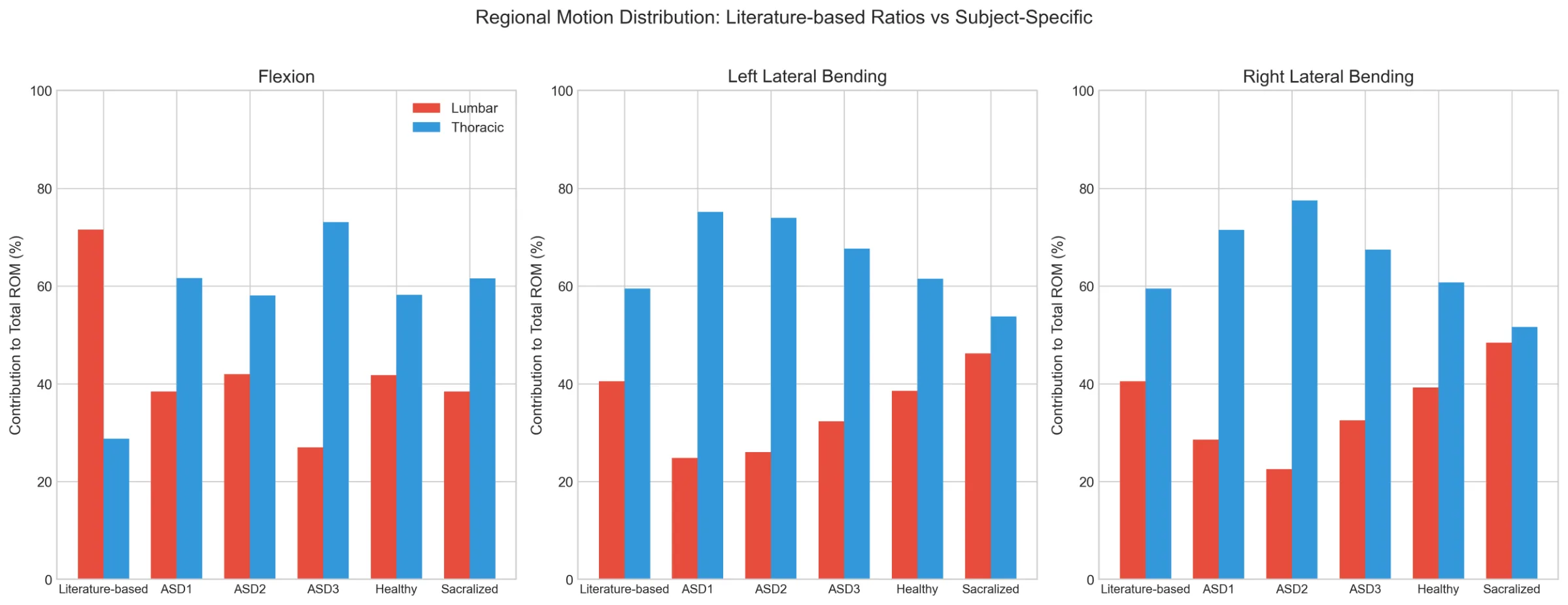
As submitted with the abstract. Tap a figure to open it at full size.