
Degenerative Thoracolumbar
High Prevalence of Radiographic Lumbar Disc Ossification After Posterolateral Fusion Without Disc Manipulation: Reliability of a Modified McAfee-Based Classification
- Clinica Universidad de Navarra, Pamplona, Spain
- Universidad de Navarra, Pamplona, Spain
- Clinica Universidad de Navarra, Madrid, Spain
Abstract
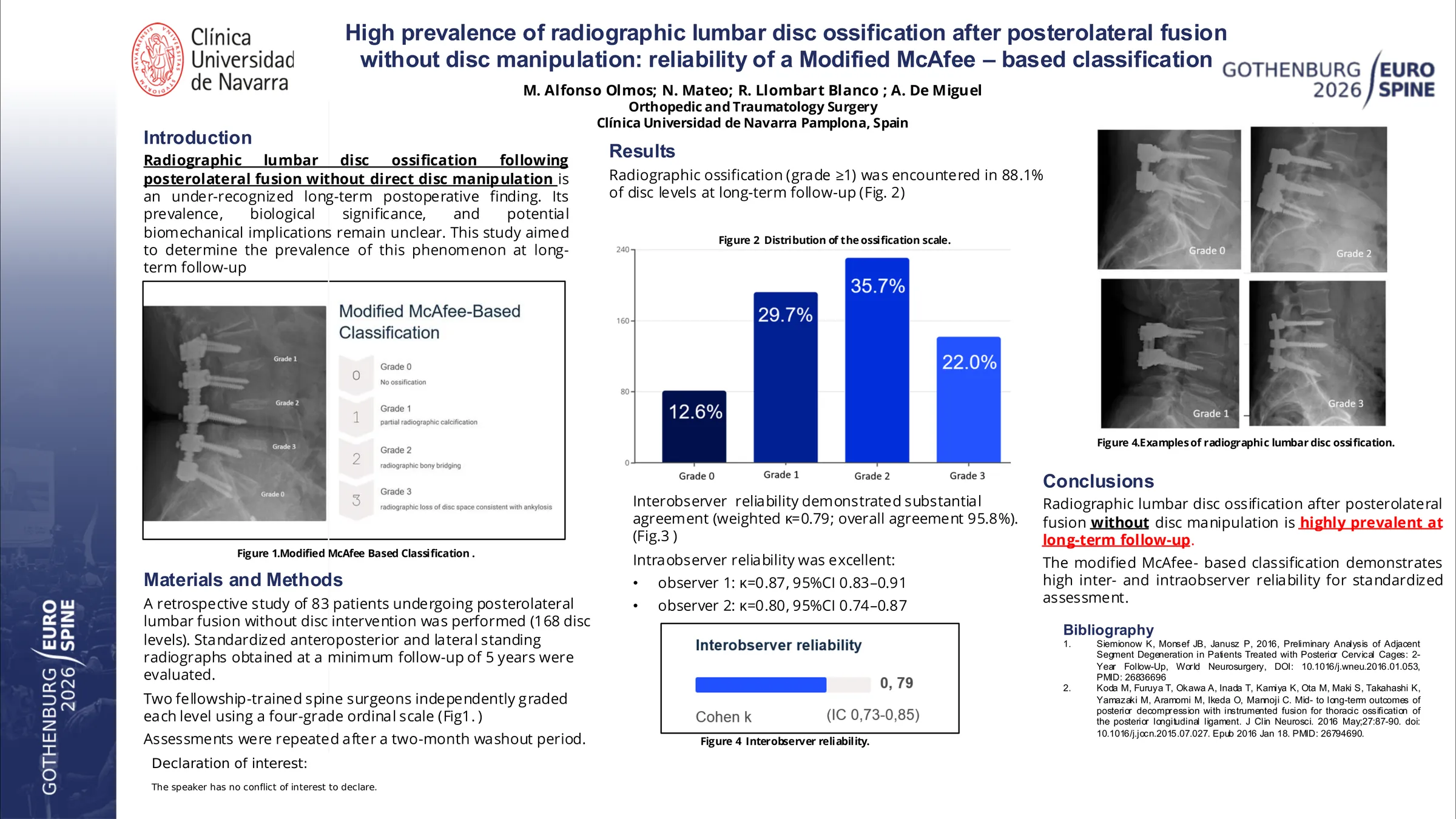
Radiographic lumbar disc ossification following posterolateral fusion without direct disc manipulation is an underrecognized long-term postoperative finding. Its prevalence, biological significance, and potential biomechanical implications remain unclear, and no standardized radiographic classification currently exists. This study aimed to determine the prevalence of this phenomenon at long-term follow-up and to evaluate the inter- and intraobserver reliability of a modified McAfee-based four-grade classification system.
A retrospective study of 83 patients undergoing posterolateral lumbar fusion without disc intervention was performed (168 disc levels). Standardized anteroposterior and lateral standing radiographs obtained at a minimum follow-up of 60 months were evaluated. Two fellowship-trained spine surgeons independently graded each level using a four-grade ordinal scale:
0 = no ossification1 = partial radiographic calcification2 = radiographic bony bridging3 = radiographic loss of disc space consistent with ankylosis
Assessments were repeated after a two-month washout period. Inter- and intraobserver reliability were calculated using quadratic weighted kappa coefficients and percentage agreement.
Radiographic ossification (grade ≥1) was encountered in 88.1% of disc levels at long-term follow-up. Interobserver reliability demonstrated substantial agreement (weighted κ=0.79, 95%CI 0.73–0.85; overall agreement 95.8%). Intraobserver reliability was excellent (observer 1: κ=0.87, 95%CI 0.83–0.91; observer 2: κ=0.80, 95%CI 0.74–0.87). Level-specific analysis showed consistent agreement (κ range 0.73–0.84), with slightly lower values at L4–L5.
Radiographic lumbar disc ossification after posterolateral fusion without disc manipulation is highly prevalent at long-term follow-up. The modified McAfee-based classification demonstrates high inter- and intraobserver reliability for standardized assessment. These findings suggest that disc ossification may represent a common biological evolution following posterolateral fusion and warrant further investigation regarding its biomechanical and clinical implications.