
Tumours & Infection
Morphological Features Associated with Biomechanical Deterioration and Need for Stabilization in Spinal Metastases – Results from a Modified Delphi Study from the AO Spine Knowledge Forum (KF) Tumor
- National Center for Spinal Disorders, Budapest, Hungary
- AO Foundation, Davos, Switzerland
- Duke University, Durham, United States of America
- Sunnybrook Health Sciences Centre, University of Toronto, Toronto, Canada
- The University of Texas MD Anderson Cancer Center Main Building, Houston, United States of America
- University Hospital Basel, Basel, Switzerland
- University Medical Center Utrecht, Utrecht, Netherlands
- Memorial Sloan Kettering Cancer Center, New York, United States of America
- Johns Hopkins University School of Medicine, Baltimore, United States of America
- Istituto Ortopedico Rizzoli, Bologna, Italy
- Oxford University Hospitals NHS Foundation Trust, Oxford, United Kingdom
- Alma Mater Studiorum, Bologna, Italy
- University of British Columbia, Vancouver, Canada
- Brown University, Warren Alpert School of Medicine, Providence, United States of America
- New York University Langone Health, New York, United States of America
- University of Britisch Columbia, Vancouver, Canada
Abstract
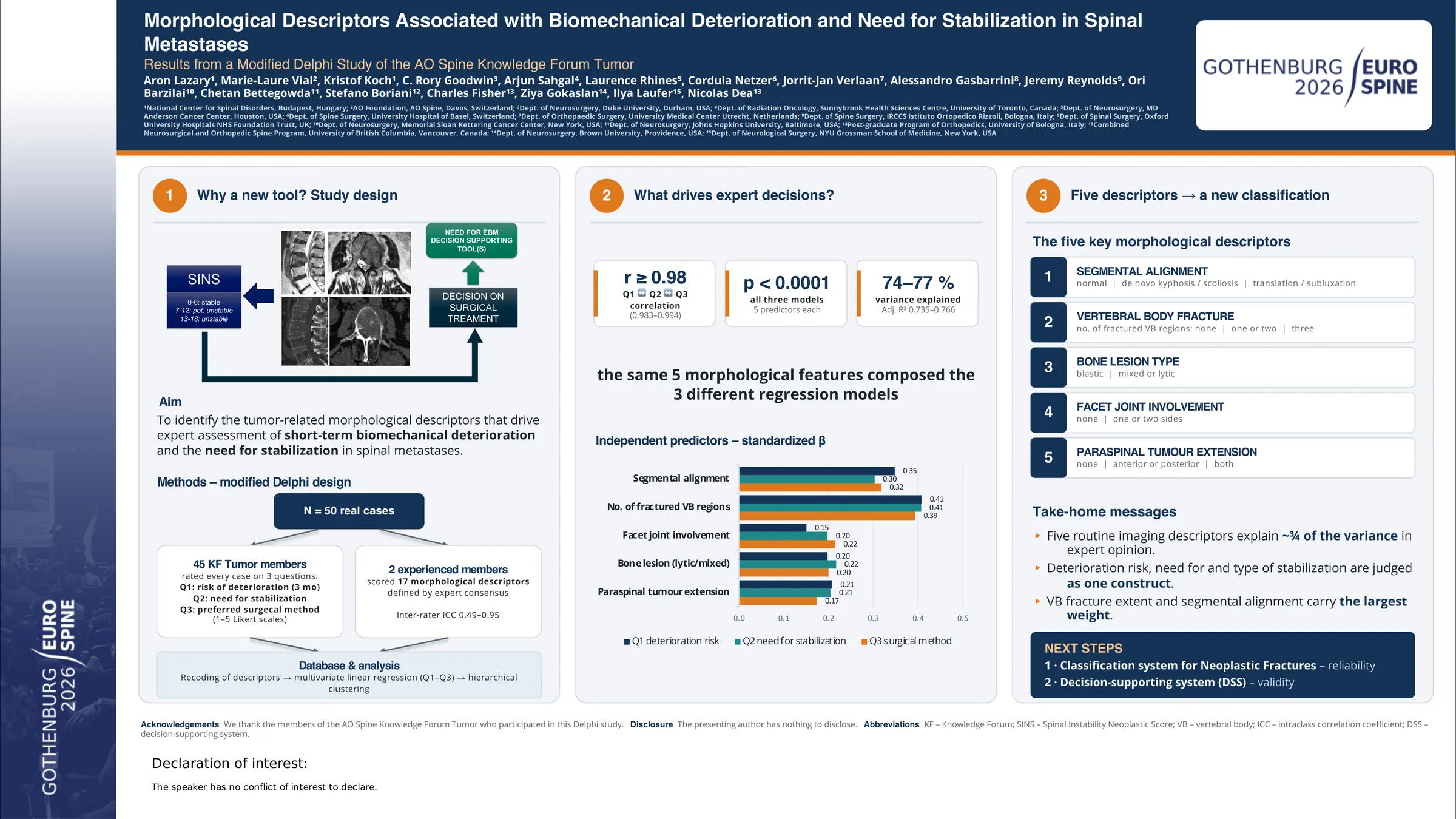
The Spinal Instability Neoplastic Score is a widely used and cited referral tool to identify patients with potentially unstable spinal metastases; however, treatment decision (ie. need for stabilization) may also be influenced by various morphological and clinical factors. The aim of this study is to develop an evidence-based decision-making tool for surgical treatment in patients with spinal metastases. In this first stage, we identified morphological descriptors associated with biomechanical deterioration.
Fifty standardized case studies, including CT and MRI images, were evaluated by members of the AO Spine KFTumor. Key Opinion Leader assessments were obtained regarding 1) risk of biomechanical deterioration, 2) need for stabilization, 3) preferred type of stabilization. These ratings were used to determine the relative severity score for each case. Based on group consensus, 17 different morphological parameters were defined and subsequently evaluated by two experienced spine tumor surgeons using categorical scales. The resulting dataset of morphological descriptors was analyzed in relation to the mean severity scores using univariate andmultivariate linear regression models, as well as hierarchical clustering.
A total of 45 KF Tumor members participated in the Delphi study. The case collection demonstrated a harmonic distribution of the three severity scores. Risk of biomechanical deterioration was strongly correlated with both the need for surgery (r=0.994) and the type of stabilization surgery (r=0.983). The three severity scores were used as dependent variables in three multivariate linear regression models to evaluate the influence of the morphological descriptors. The final models were highly significant (p<0.0001) and identified segmental alignment, extension of vertebral body fracture, lesion type, facet joint involvement and paravertebral tumor extension as significant predictors. These models explained 76.6%, 75.4% and 73.5% of the variance in the three severity scores. Using these five parameters, hierarchical clustering identified two distinct patient groups with significantly different levels of biomechanical severity (p<0.0001).
Based on our analysis, five morphological parameters were identified as the most important imaging features that may influence a surgeon’s decision-making process on on the need for stabilization surgery in patients with spinal metastases. Clinical parameters as well as other factors may modify the therapeutic decision, thus the identification of these key parameters and their inclusion into a comprehensive decision-support system is essential.