
Degenerative Thoracolumbar
End-to-End Deep Learning–Based Grading of Lumbar Facet Joint Degeneration and Analysis of Segmentation-Induced Performance Degradation
- Nantong First People's Hospital, Nantong, China
Abstract
Facet joint degeneration is an important imaging biomarker associated with chronic low back pain. Clinical grading is performed at the joint level and requires both accurate localization and severity assessment. However, most existing studies focus on segmentation or image-level classification, with limited evaluation of end-to-end grading performance. As multiple joints with different severities may coexist in a single scan, facet joint grading is inherently an instance-level task. This study aims to develop an end-to-end automated grading framework and analyze the impact of segmentation errors on severe degeneration detection.
A total of 145 lumbar CT scans were included, each annotated with five facet joints labeled as background, non-severe, or severe degeneration.
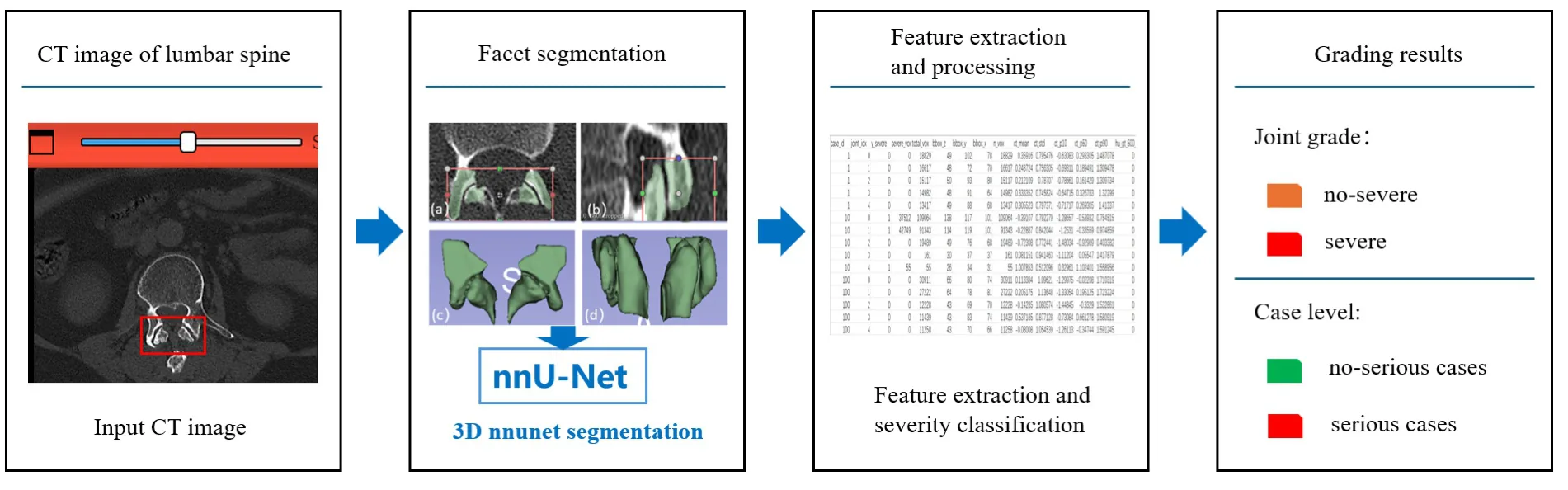
A 3D nnU-Net was trained for binary joint segmentation. Connected component analysis was used to extract joint instances, from which volumetric, morphological, and intensity features were derived to build a joint-level severe degeneration classifier.
Two evaluation settings were designed: (1) an oracle setting using ground-truth joint regions; and (2) an end-to-end setting using automatically segmented joints.
A direct three-class nnU-Net model was trained as a baseline. Performance was assessed at joint and case levels using AUC, F1-score, accuracy, and confusion matrices.
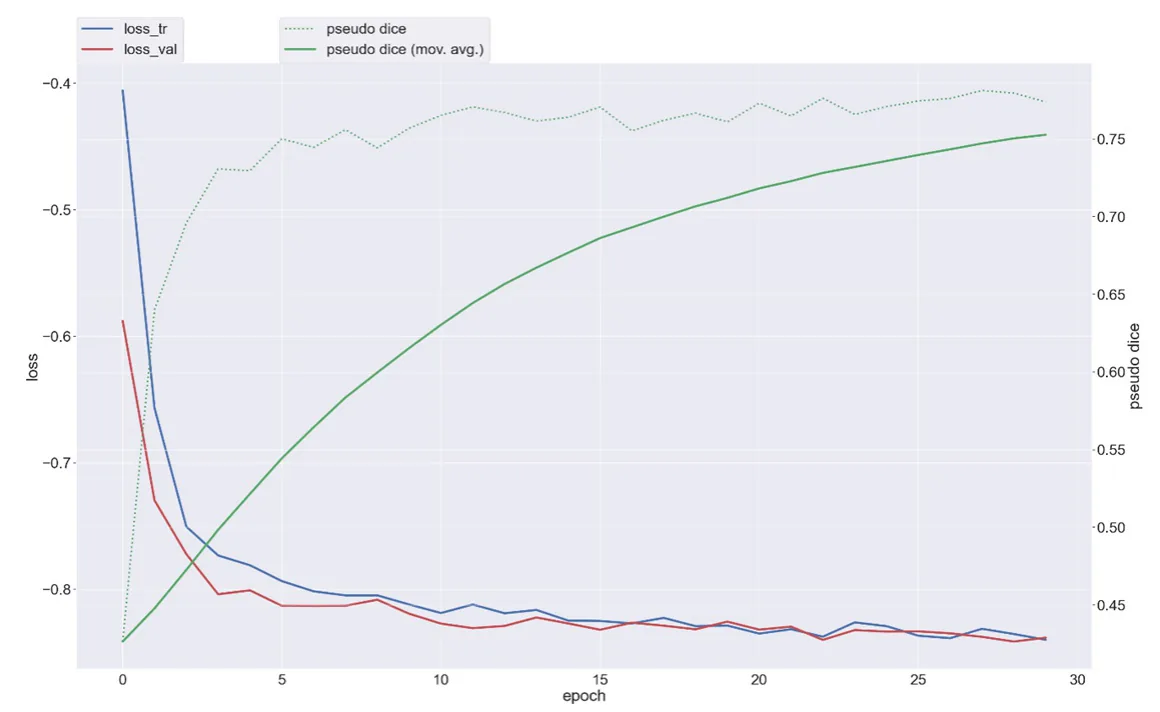
The joint segmentation model achieved a mean Dice coefficient of 0.77 on the validation set.
Under the oracle setting, joint-level severe degeneration classification achieved an AUC of 0.76, indicating moderate discriminative ability when joint localization was accurate.
In the end-to-end setting, joint-level AUC decreased to 0.73, and severe degeneration recall dropped substantially to 0.16. Case-level severe detection accuracy was 0.45 under an any-severe aggregation rule. Error analysis demonstrated that missed detections, fragmented joint regions, and instance mismatches during segmentation were the primary contributors to the reduced severe recall.
The direct three-class segmentation approach showed unstable performance for joint-level severe degeneration assessment and did not provide reliable clinical grading results.
Lumbar facet joint degeneration grading is fundamentally an instance-level clinical task. Although semantic segmentation models may achieve satisfactory voxel-wise performance, segmentation errors significantly impair downstream severity assessment in end-to-end pipelines. These findings suggest that accurate joint localization and instance-aware modeling are critical for developing clinically reliable automated grading systems for facet joint degeneration.
Figures and tables
As submitted with the abstract. Tap a figure to open it at full size.