
Adult Deformity
Are Pain Intensity Measures Interchangeable? Agreement among ODI, SRS-22, and COMI in Chronic Low Back Pain with and without Scoliosis
- ISICO, Milan, Italy
- IRCCS Istituto Ortopedico Galeazzi, Milan, Italy
- University Medical Center Utrecht, Utrecht, Netherlands
- Arcobaleno fisioterapia, Milano, Italy
- Università degli studi di Milano, Milano, Italy
Abstract
Pain is a major complaint of patients with musculoskeletal disorders, but its measurement is challenging. Various scales, including the Visual Analogue Scale (VAS), Numerical Rating Scale (NRS), Graphic Rating Scale (GRS), as well as some questions from the Oswestry Disability Index (ODI) and the SRS-22, are commonly used in the assessment of low back pain (LBP). Numerical ratings and verbal descriptions could induce patients to give different results and scores. The purpose of this study was to determine and compare the responsiveness of three pain scales or questions about pain intensity in a group of patients with chronic LBP (CLBP) with and without scoliosis
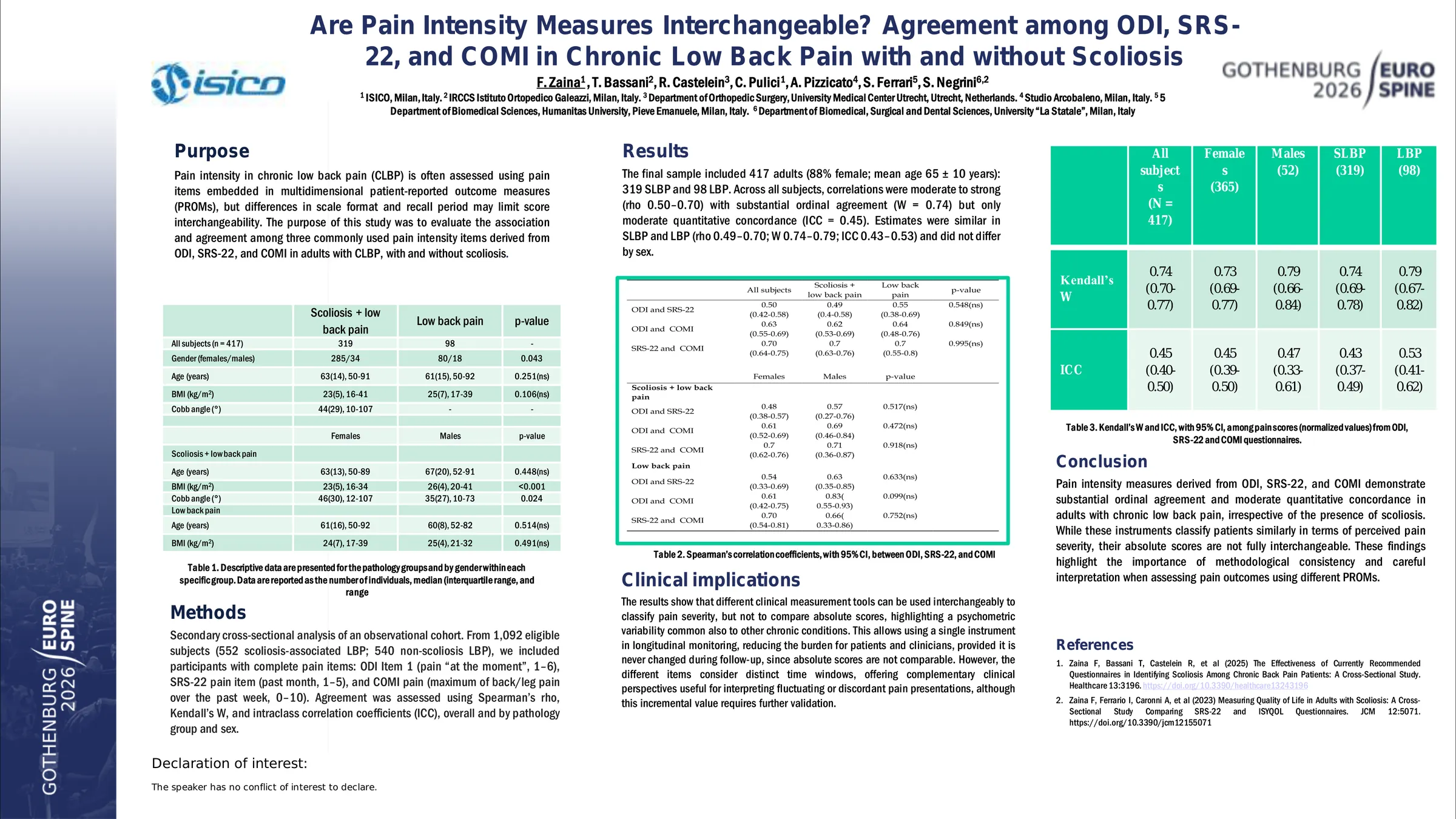
From the original sample of 1,092 subjects (552 SLBP; 540 LBP), we included all those who completedthe questions: self-reported Pain at the moment (question 1 from ODI), Pain in the last month (question 2of SRS-22), and the GRS for back Pain (question 2a from COMI).Participants were divided into two pathology groups: scoliosis with cLBP (SLBP) and without scoliosis(LBP). Collected variables included gender, age, body mass index (BMI), and Cobb angle (for the SLBPgroup only). Self-reported Pain, assessed using one question from each of three questionnaires, wascompared as follows: ODI – Pain at the moment, an ordinal variable with six levels ranging from “no pain”to “maximum imaginable pain,” converted into an integer variable from 1 to 6. SRS-22 – Pain in the lastmonth, an ordinal variable with five levels from “no pain” to “severe pain,” converted into an integervariable from 1 to 5. COMI Back – Pain in the last week, an integer variable from 0 (“no pain”) to 10 (“worst pain”).
We included 417 subjects. 365 (88%) females and 54 (12%) males, with a mean age of 65 ± 10 years. Thedataset comprised 319 subjects in the SLBP group and 98 in the LBP group. Median (IQR) pain levelsfrom the ODI and SRS-22 were 3(1) in both the SLBP and LBP groups, while COMI Back pain scores were5(3) and 5(4), respectively. Considering all subjects, Spearman's coefficients ranged from 0.50 to 0.69,Kendall's W was 0.74, and ICC was 0.61. Results were very similar between SLBP and LBP groups:Spearman's coefficients ranged from 0.49 to 0.65; Kendall's W ranged from 0.74 to 0.79; and ICC rangedfrom 0.60 to 0.65. No significant differences were observed between females and males.
Pain intensity measures demonstrate substantial ordinal agreement and moderate quantitativeconcordance in adults with cLBP, irrespective of the presence of scoliosis. The intraclass correlationcoefficient showed moderate quantitative concordance, suggesting that although the measures overlapsubstantially, absolute values are not fully interchangeable. These findings highlight the importance of methodological consistency and careful interpretation whenassessing pain outcomes using different PROMs.
Figures and tables
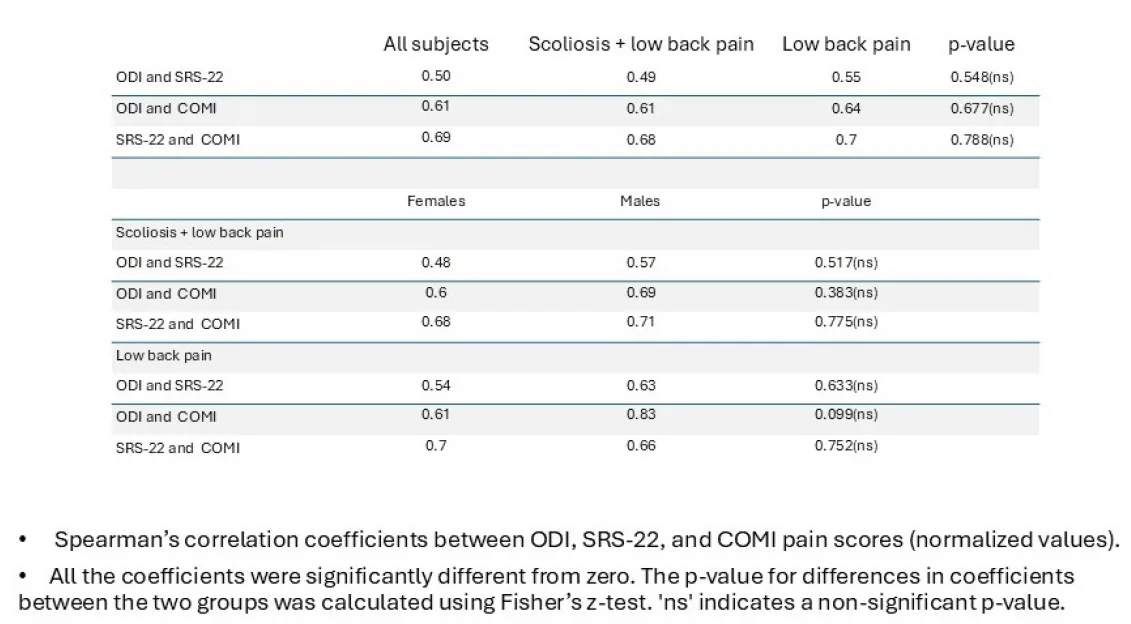
As submitted with the abstract. Tap a figure to open it at full size.