
Degenerative Thoracolumbar
Iatrogenic Spondylolysis After Lumbar Decompression in Achondroplasia: Incidence, Characteristics, and Clinical Course
- Yokohama Rosai Hospital, Yokohama, Japan
Abstract
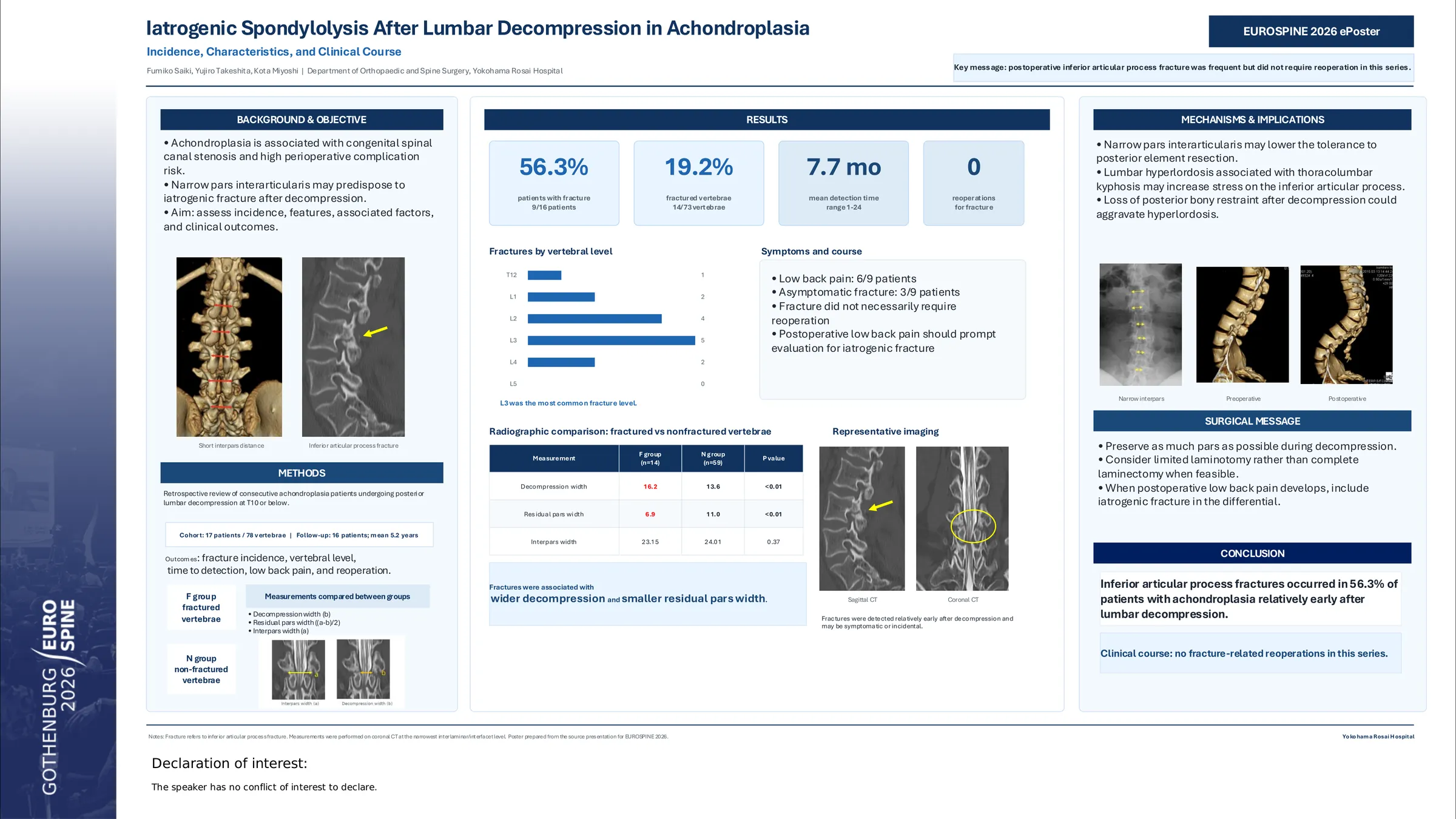
Achondroplasia is characterized by congenital spinal canal stenosis and progressive narrowing of the interpars distance in the lumbar spine. Owing to these anatomical features, lumbar decompression carries a high risk of perioperative complications. However, postoperative inferior articular process fracture (iatrogenic spondylolysis) has rarely been described, and its clinical course remains unclear. This study investigated the incidence, characteristics, and outcomes of postoperative inferior articular process fracture after lumbar decompression in patients with achondroplasia.
We retrospectively reviewed consecutive patients with achondroplasia who underwent posterior lumbar decompression below T10 at our institution between October 2008 and August 2021. The incidence, affected levels, time to detection, symptoms, and need for revision surgery were evaluated. All decompressed laminae were divided into fracture (F) and non-fracture (N) groups. Interpars distance, decompression width, and residual pars width were measured on coronal CT at the pars level and compared between groups.
Sixteen patients were available for follow-up (mean age 33.5 years, mean follow-up 5.2 years). Postoperative inferior articular process fracture occurred in 9 patients (56.3%). Among 73 decompressed laminae, fractures were identified in 14 laminae, most frequently at L3. Fractures were detected at a mean of 7.7 months postoperatively, and three patients were asymptomatic. All cases improved with conservative treatment, and no patient required revision surgery. Compared with the non-fracture group, the fracture group showed significantly greater decompression width and significantly smaller residual pars width on CT, whereas preoperative interpars distance did not differ significantly.
Inferior articular process fracture after lumbar decompression in patients with achondroplasia occurred at a high frequency but was generally manageable with conservative treatment. Excessive decompression and insufficient residual pars width may increase the risk of postoperative fracture. Careful preservation of the pars during decompression is essential to reduce this complication in achondroplasia.