
Tumours & Infection
Dental intervention is associated with 6-week CRP normalization in infectious spondylitis
- Tottori University, Yonago, Japan
Abstract
Six weeks of antimicrobial therapy is widely accepted as the standard treatment duration for infectious spondylitis. However, in routine clinical practice, inflammatory markers do not necessarily normalize by this time point in all patients. Persistent systemic inflammation may reflect ongoing infectious sources outside the primary spinal focus. Oral infectious sources have been increasingly recognized as potential contributors to hematogenous infection. However, their role in early inflammatory resolution in infectious spondylitis remains unclear.
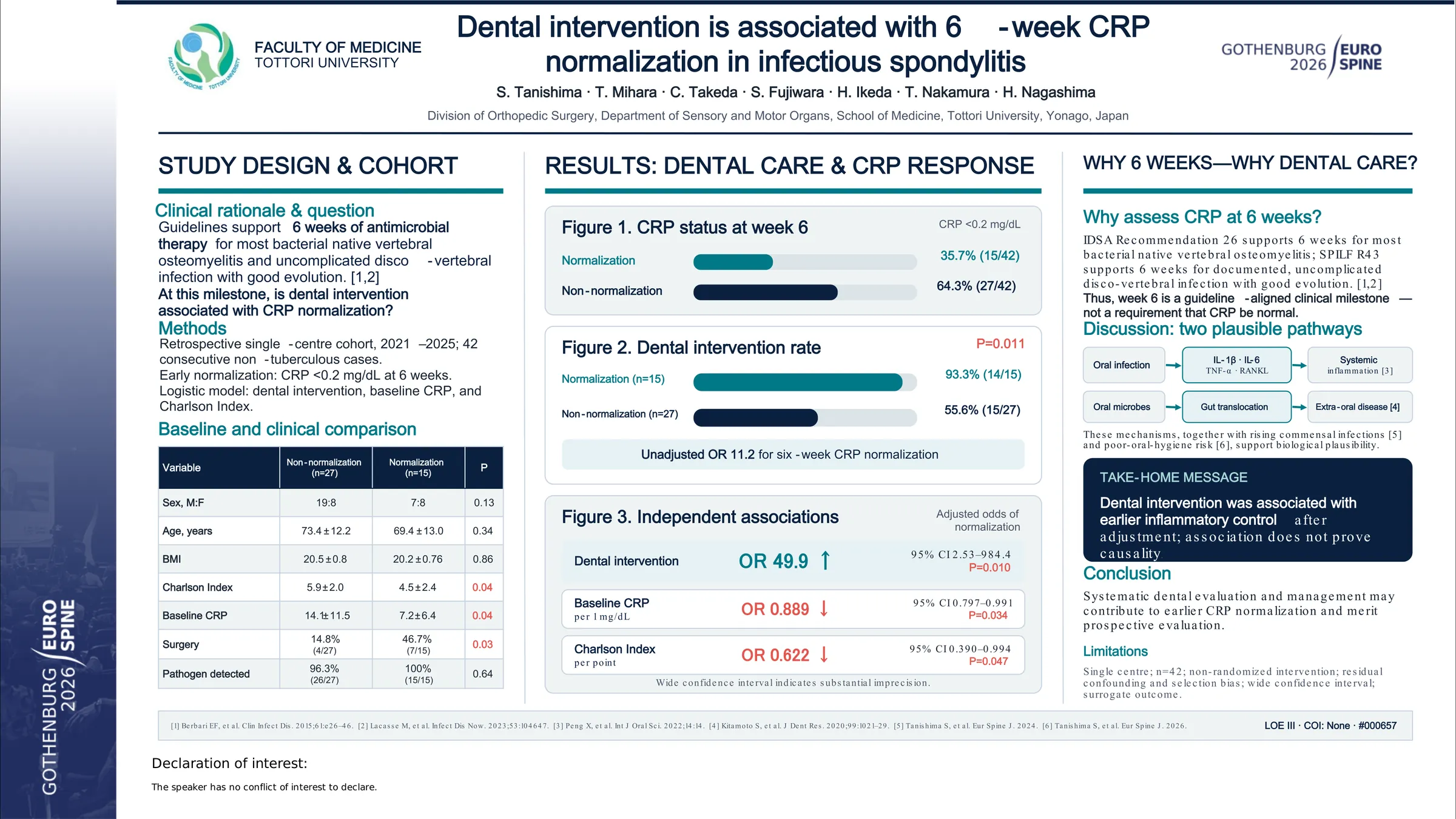
This retrospective single-center cohort study included 42 consecutive patients diagnosed with infectious spondylitis between 2021 and 2025. The mean age was 72.0 years (range, 32–88), and 26 patients (61.9%) were male. Tuberculous cases were excluded. Early CRP normalization was defined as CRP <0.2 mg/dL at 6 weeks after initiation of antimicrobial therapy. Dental intervention was performed at the discretion of the treating physician. Patients were classified into normalization (n=15) and non-normalization (n=27) groups based on CRP status at 6 weeks.
Multivariable logistic regression was performed including dental intervention, baseline CRP, and Charlson Comorbidity Index, given their clinical relevance and univariate associations.
Early CRP normalization occurred in 15 of 42 patients (35.7%). Causative pathogens were detected in 42 of 43 patients (97.7%). Dental intervention was performed in 29 patients (69.0%) and was more frequent in the normalization group than in the non-normalization group (93.3% vs 55.6%; unadjusted OR 11.2; Fisher’s exact p=0.011). Baseline CRP was significantly higher and Charlson Comorbidity Index was significantly greater in the non-normalization group.In multivariable analysis including dental intervention, baseline CRP, and Charlson Comorbidity Index, dental intervention remained independently associated with CRP normalization (adjusted OR 49.9, 95% CI 2.53–984.4; p=0.010). Higher baseline CRP (adjusted OR 0.889 per 1 mg/dL; 95% CI 0.797–0.991; p=0.034) and higher Charlson Comorbidity Index (adjusted OR 0.622 per point; 95% CI 0.390–0.994; p=0.047) were inversely associated with normalization.
In this retrospective single-center cohort, dental intervention was independently associated with 6-week CRP normalization in infectious spondylitis after adjustment for baseline inflammatory burden and comorbidity status. These findings suggest that systematic dental evaluation and management may contribute to earlier inflammatory control.