
Degenerative Thoracolumbar
The Effect of Preoperative High-Intensity Functional Interval Training on Outcomes in Lumbar Spinal Fusion
- VieCuri Medisch Centrum, Venlo, Netherlands
- Zuyderland MC, Heerlen, Netherlands
- Maastricht UMC+, Maastricht, Netherlands
- Radboud University Nijmegen, Nijmegen, Netherlands
Abstract
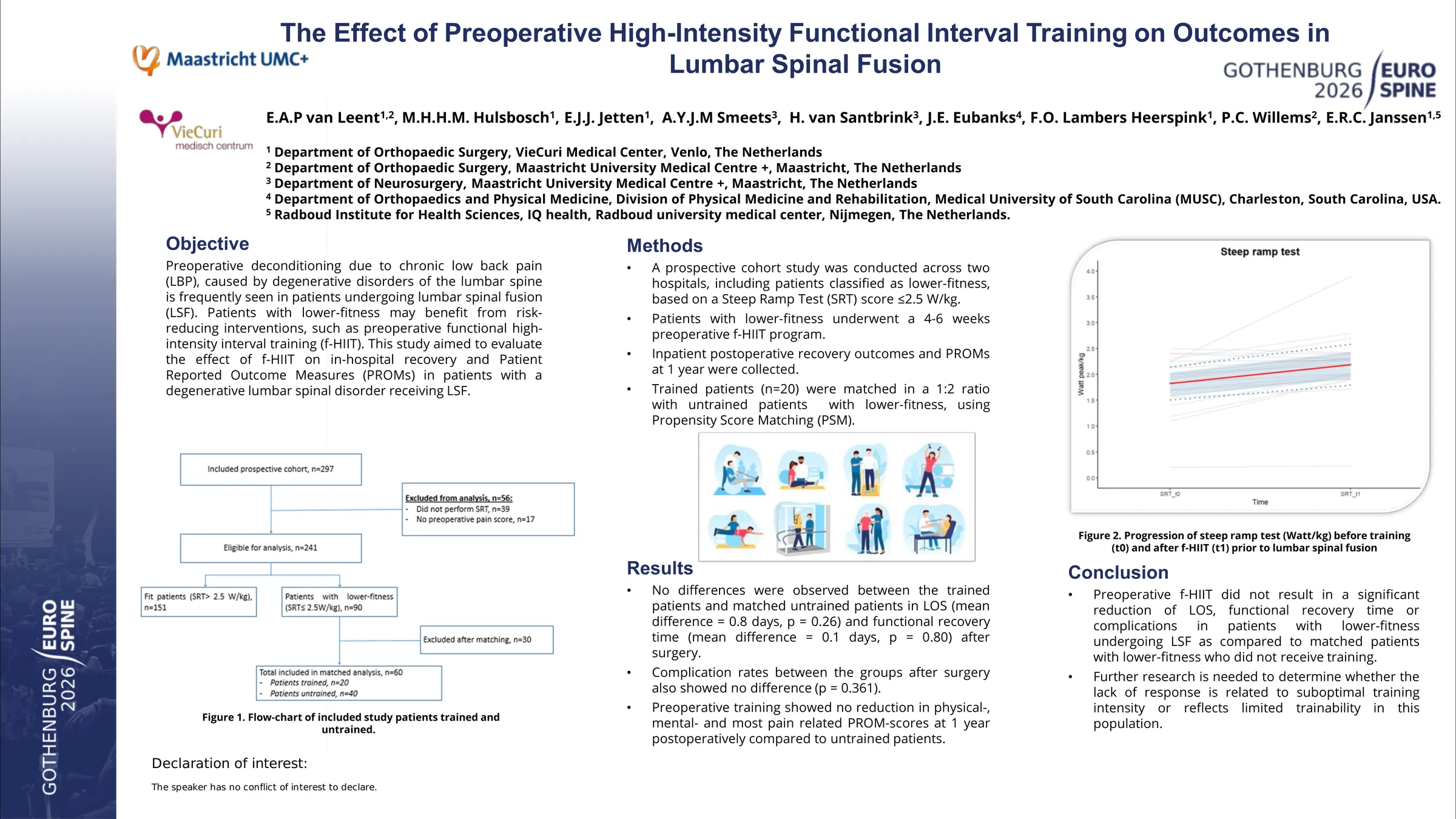
Severe deterioration of the physical condition due to low back pain (LBP) from degenerative disorders of the spine is commonly seen in patients undergoing lumbar spinal fusion (LSF), particularly those with neurogenic claudication. A decreased physical capacity preoperatively is related to an increased risk for negative postoperative outcomes and may benefit from risk-reducing interventions. Preoperative functional high-intensity interval training (f-HIIT) is a proven effective intervention to improve the physical capacity. This study aims is to study the effect of f-HIIT on length of stay (LOS) in hospital, functional recovery and complication in patients with degenerative disorder receiving LSF.
A prospective cohort study was conducted across two hospitals, including unfit patients with degenerative spinal disorders who underwent preoperative f-HIIT, 4-6 weeks prior to LSF. Postoperative outcomes and Patient Reported Outcome Measures (PROMS) were collected. Trained patients (n=20) were matched in a 2:1 ratio with a control cohort (n=241) using Propensity Score Matching (PSM). Between group differences were analysed using t-tests to evaluate the effect of f-HIIT training.
Trained patients showed no significant differences in LOS (mean difference = 0.8 days, p = 0.26) and functional recovery time (mean difference = 0.1 days, p = 0.80) compared to the matched group after LSF. There were no differences in complication rates after LSF in trained and matched patients (p = 0.361). In the cohort of trained and untrained patients we found those who were screened as unfit (SRT ≤2.5 W/kg) to have a longer LOS (mean difference = 2,5, p= 0.000) and time to functional recovery (mean difference = 1,3, p = 0.005), compared to fit patients (SRT >2.5 W/kg).
This study found no significant reduction in LOS, time to mILAS zero or complications in trained patients compared to the matched patients from a historical cohort after LSF. However, fit patients had a significant shorter LOS and time to mILAS zero after LSF, compared to the patients which were classified as unfit. As such, patient’s with limited preoperative physical capacity may be at risk for worse postoperative outcomes.