
Degenerative Thoracolumbar
Optimization and Validation of a Screening Prediction Model in Lumbar Spinal Fusion
- VieCuri Medisch Centrum, Venlo, Netherlands
- Zuyderland MC, Heerlen, Netherlands
- Maastricht UMC+, Maastricht, Netherlands
- Radboud University Nijmegen, Nijmegen, Netherlands
Abstract
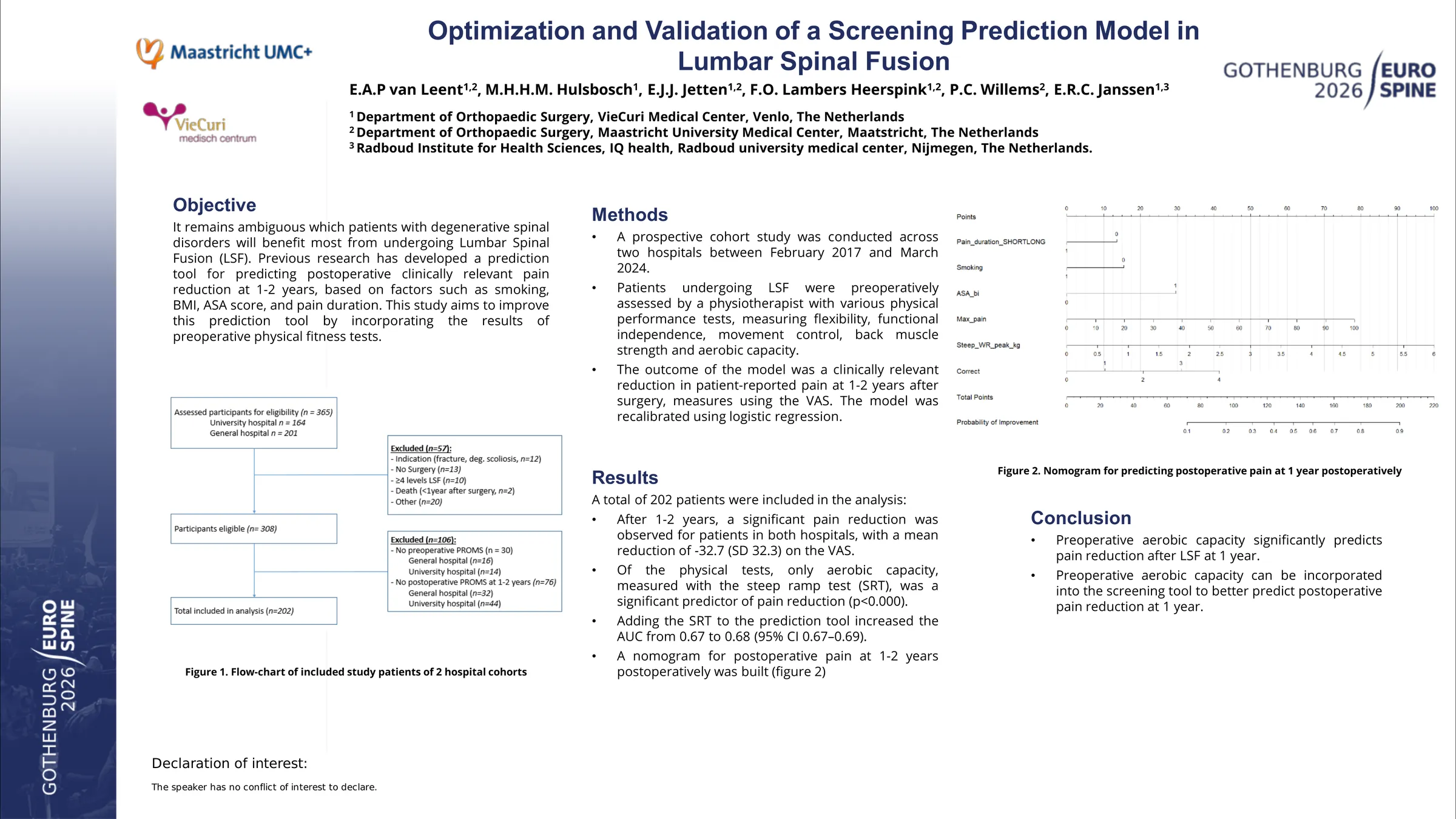
Degenerative spinal disorders can severely impair physical function. Lumbar spinal fusion (LSF) is commonly performed, particularly in cases of neurogenic claudication. Previous research has developed a predictive tool for forecasting postoperative pain reduction at 1 year, based on factors such as smoking, BMI, ASA score, and pain duration. This study aims to improve this tool by incorporating preoperative physical tests.
A prospective cohort study was conducted across two hospitals between February 2017 and March 2024. Patients undergoing LSF were preoperatively assessed by a physiotherapist with various physical performance tests, including the Timed-Up-and-Go test, motor control test, finger-floor distance, Sörensen test, steep ramp test, and a cycling test. The Morton Mobility Index (DEMMI) was also calculated, and postoperative patient-reported outcomes (PROMs) were collected.
A total of 202 patients were included. After 1 year, no significant difference in pain reduction was observed between the hospitals, with a mean reduction of -32.7 (SD 32.3) on the VAS scale for maximum pain. Of the physical tests, only the steep ramp test (SRT) was a significant predictor of pain reduction (p<0.000). Adding the SRT to the prediction tool increased the AUC from 0.67 to 0.68 (95% CI 0.67–0.69).
This study demonstrated that only the SRT cycling test significantly predicts pain reduction at 1 year. It can be incorporated into the predictive tool to better forecast postoperative pain reduction at 1 year.