
Degenerative Thoracolumbar
Good Clinical Outcome Despite Persistent Micromotion After Anterior Lumbar Interbody Fusion Measured by CT‑RSA: A Retrospective Cohort Study
- Gothenburg, Sweden
Abstract
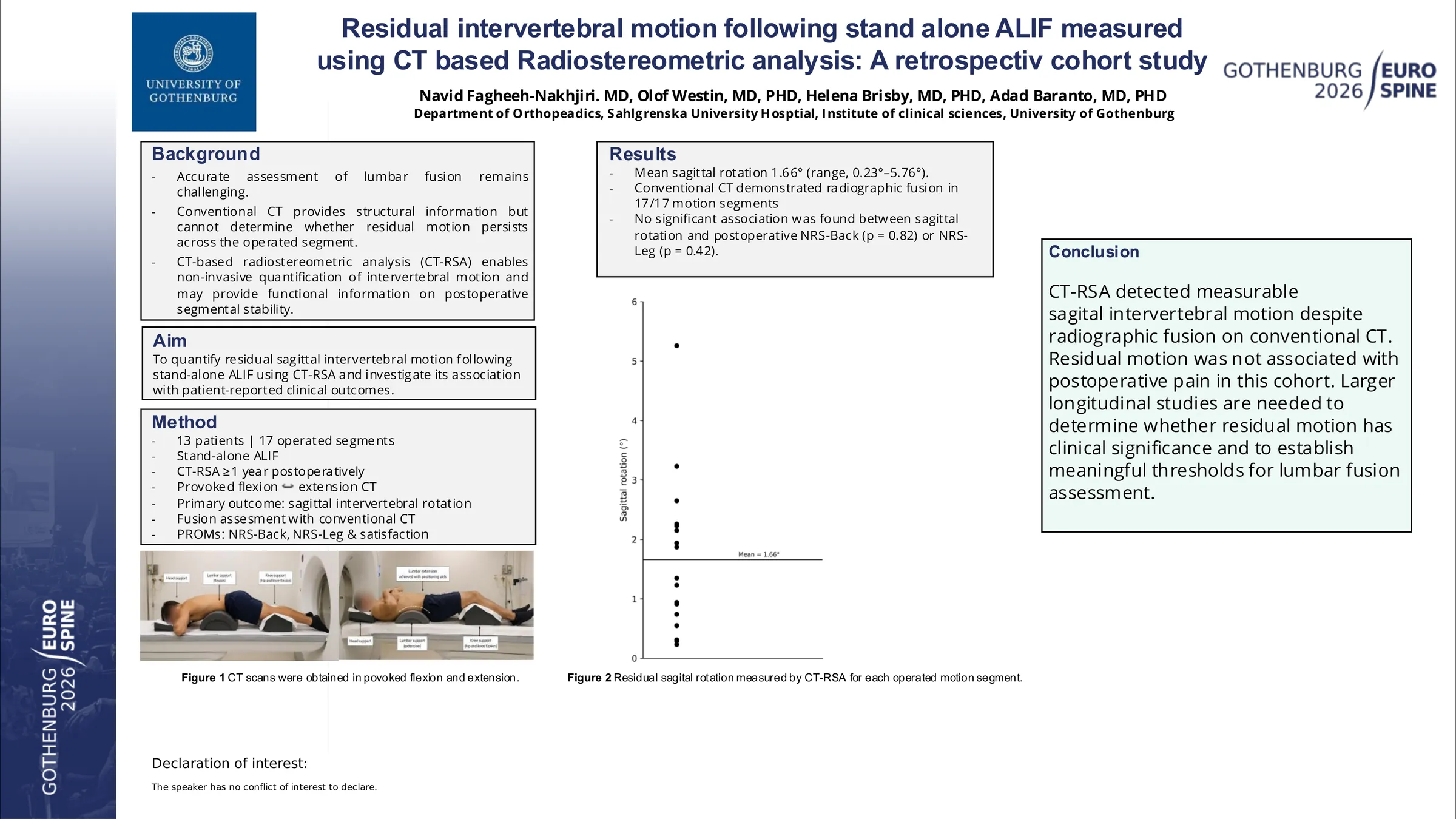
Chronic low back pain is a major cause of disability, and anterior lumbar interbody fusion (ALIF) is frequently performed when conservative treatment fails. However, reliable assessment of postoperative fusion remains challenging, as conventional imaging lacks precision and marker-based radiostereometric analysis is not routinely feasible. CT-based radiostereometric analysis (CT-RSA) offers a noninvasive method to quantify intervertebral motion, however, its use in evaluating lumbar fusion has not been established. The aim of this study was to quantify residual motion following ALIF using CT-RSA and to explore its association with patient-reported pain outcomes.
This retrospective cohort study included consecutive patients who underwent one- or two-level ALIF between 2018 and 2020. At ≥1 year postoperatively, patients underwent CT-based radiostereometric analysis (CT-RSA) with paired CT scans acquired in provoked flexion and extension to quantify intervertebral sagittal-plane rotation. Intersegmental motion was calculated using CT-RSA. Conventional CT at approximately two years postoperatively was used to assess fusion status. Patient-reported outcomes (NRS back and NRS leg) were collected preoperatively and at follow-up. Associations between residual sagittal-plane rotation and postoperative pain scores were analyzed using Spearman rank correlation
A total of 17 fused segments were analyzed. Mean rotational motion across fused segments was 1.66° (range 0.23°–5.76°). Conventional CT imaging indicated fusion in all 17 disc levels (100%). Postoperative mean NRS‑Back was 3.2 (SD 1.7) and mean NRS‑Leg was 1.6 (SD 2.8). No significant correlation was found between degree of rotation and NRS‑Back (p = 0.82) or NRS‑Leg (p = 0.42).
The majority of patients demonstrated minimal rotational motion consistent with successful fusion. However, a small subset exhibited mobility that could indicate incomplete osseous fusion, despite the absence of non-union signs on conventional CT imaging. CT-RSA appears to be a promising modality warranting further investigation in spinal surgery patients, with the potential to detect motion even when conventional CT fails to demonstrate signs of non-fusion. Its clinical relevance, particularly in relation to patient-reported pain, remains to be established.