
Complications & Epidemiology
Association Between Intraoperative Neuromonitoring Findings and Postoperative Motor Deficits After Lateral Lumbar Interbody Fusion
- Hospital for Special Surgery Main Hospital, New York, United States of America
Abstract
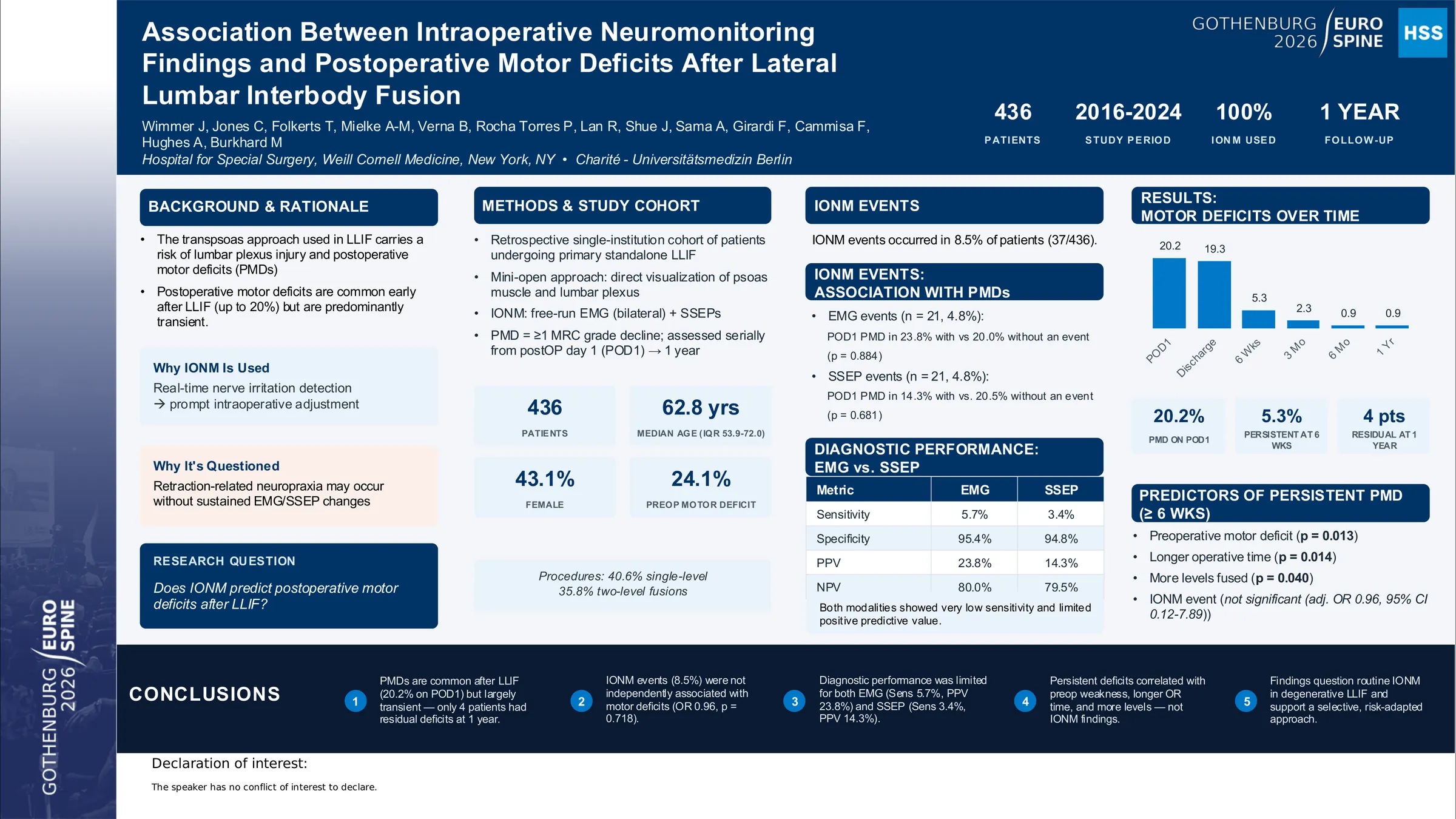
Lateral lumbar interbody fusion (LLIF) is widely used to achieve interbody fusion with reduced blood loss and tissue disruption; however, the transpsoas approach carries a risk of psoas muscle and lumbar plexus injury, potentially resulting in postoperative hip flexor weakness and neurologic deficits. Although intraoperative neuromonitoring (IONM) is routinely used during LLIF, its clinical utility and predictive value remain uncertain.
Patients undergoing standalone LLIF between 2016 and 2024 were reviewed. Cases with prior lumbar surgery, incomplete neuromonitoring data, or missing motor examinations were excluded. Neurologic outcomes were assessed using standardized pre- and serial postoperative motor examinations over one year. PMD were defined as a ≥1/5 strength decline compared with baseline, with hip flexion as the primary outcome.
A total of 436 patients were included (mean age 61.9 ± 13.2 years). PMD occurred in 88 patients (20.2%) on the first postoperative day and in 84 patients (19.3%) at discharge. At 3-month follow-up, 10 patients had residual deficits, decreasing to 4 patients at 1 year. IONM was negative in 399 patients and positive in 37 patients. PMD on FPOD occurred in 20.4% of patients without IONM abnormalities and in 18.9% of those with abnormalities, with no significant difference between groups (Fisher’s exact test, p=1.00). The PPV of IONM for FPOD PMD was 0.19, the NPV 0.80, sensitivity 0.08, and specificity 0.91. In mixed-effects logistic regression adjusting for surgical factors, IONM events were not independently associated with overall PMD (adjusted OR 0.63, 95% CI 0.05-7.90; p=0.718). The number of LLIF levels and surgical time were likewise not associated with overall PMD. Similarly, IONM events were not associated with postoperative iliopsoas motor deficits (OR 1.30, 95% CI 0.28-6.16; p=0.738), whereas LLIF levels and surgical time were statistically associated with this outcome.
In this LLIF cohort, PMD were common in the early postoperative period but largely resolved over time. The frequency of PMD did not differ significantly between patients with and without intraoperative neuromonitoring abnormalities. IONM demonstrated high specificity but low sensitivity and limited positive predictive value for postoperative motor deficits. Importantly, intraoperative neuromonitoring events were not independently associated with overall postoperative motor deficits or with iliopsoas-specific motor weakness. These findings suggest that the predictive value of routine IONM for clinically relevant motor deficits after LLIF is limited.