
Tumours & Infection
The effect of benzoyl peroxide on Cutibacterium acnes colonization in lumbar spine surgery
- Hospital del Mar, Barcelona, Spain
Abstract
In our previous prospective study, we demonstrated a Cutibacterium acnes colonization rate of 27% during primary posterior lumbar spine surgery for degenerative pathology, with a significantly higher incidence in young male patients. Given these results, strategies aimed at reducing the preoperative skin burden of C. acnes may be essential to minimize intraoperative contamination and potentially decrease the risk of postoperative low-grade infections. Benzoyl peroxide is a topical antimicrobial agent widely used in dermatology with proven activity against C. acnes; however, its role in spine surgery has not been clearly established. Therefore, the objective of the present study was to compare C. acnes colonization in superficial, subcutaneous, and deep tissues between patients preoperatively treated with benzoyl peroxide and a control group undergoing primary lumbar spine surgery for degenerative pathology.
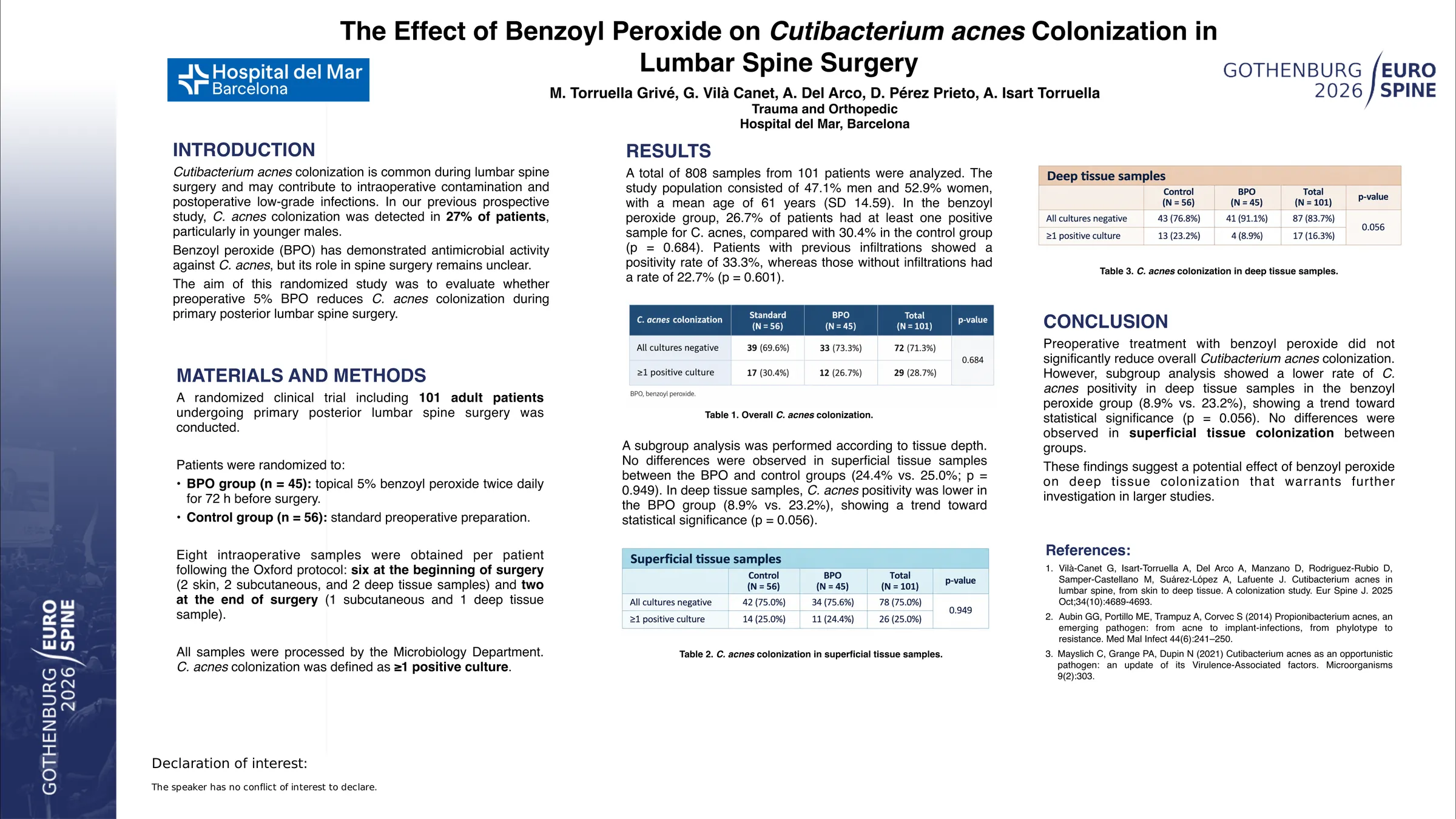
A randomized clinical study was conducted including 101 patients over 18 years of age undergoing their first posterior approach lumbar spine surgery. Forty-five patients received preoperative treatment with topical benzoyl peroxide, applied twice daily for 72 hours prior to surgery, while 56 patients constituted the control group. Eight intraoperative samples were obtained from each patient following the Oxford protocol: six at the beginning of the procedure (two skin, two subcutaneous tissue, and two deep tissue samples) and two at the end of the intervention (one deep tissue and one subcutaneous tissue sample). All specimens were processed by the microbiology department. In addition, age, sex, history of previous infiltrations, type of surgery, and postoperative clinical outcomes were recorded.
A total of 808 samples from 101 patients were analyzed. The study population consisted of 47.1% men and 52.9% women, with a mean age of 61 years (SD 14.59). In the benzoyl peroxide group, 26.7% of patients had at least one positive sample for C. acnes, compared with 30.4% in the control group (p = 0.684). Patients with previous infiltrations showed a positivity rate of 33.3%, whereas those without infiltrations had a rate of 22.7% (p = 0.601). Among patients with at least one positive sample for C. acnes, 7.4% developed postoperative infection, compared with 2.8% in patients with all negative samples (p = 0.305).
Preoperative treatment with benzoyl peroxide did not significantly reduce Cutibacterium acnes colonization.