
Trauma
EQ-5D vs SF-6D: Discrepancies in Measuring Health State Utility for Patients with Vertebral Compression
- Kolding Hospital, Kolding, Denmark
Abstract
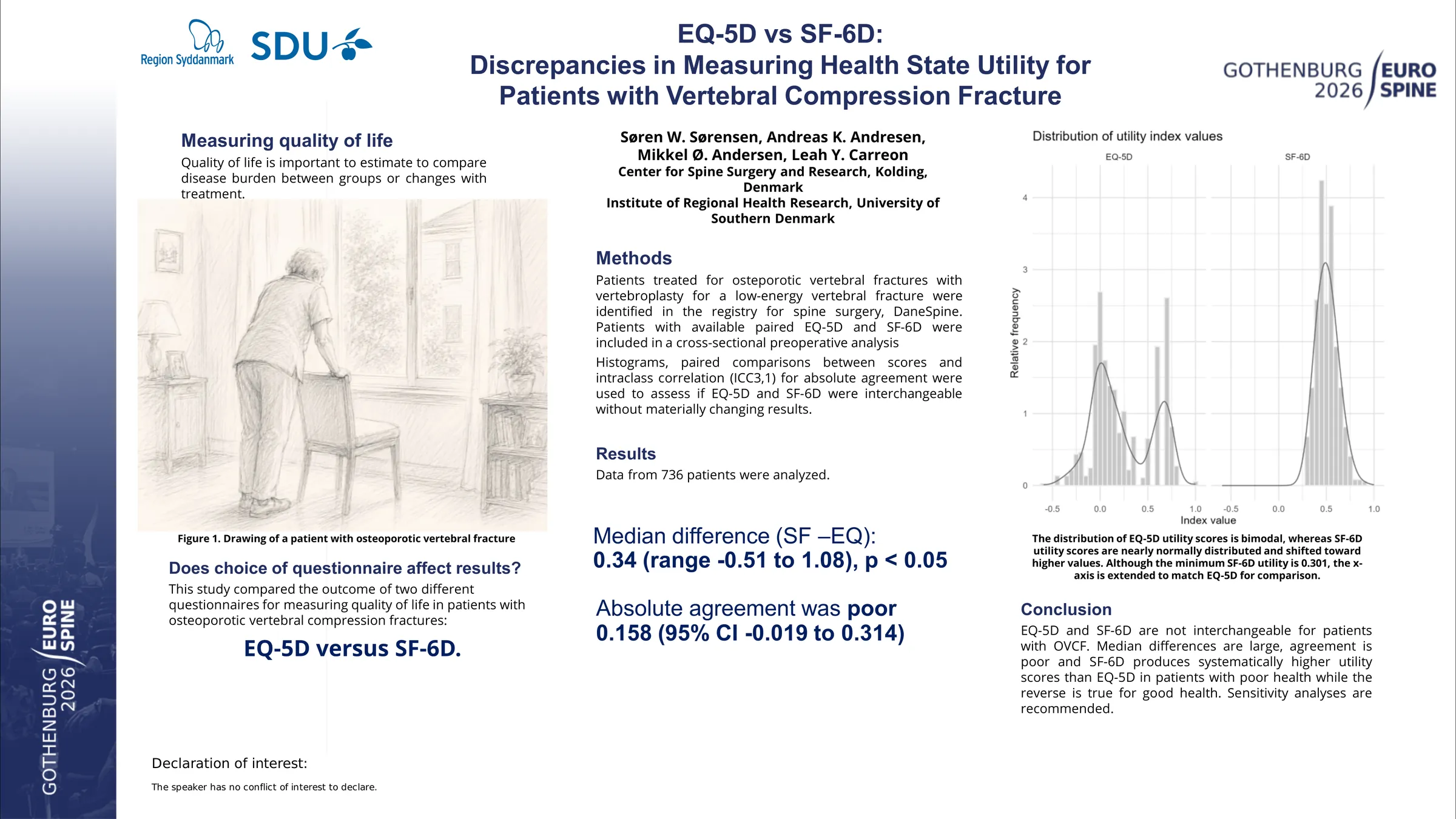
EuroQoL-5D (EQ-5D) and SF-6D are both designed to measure health states or utility but differ in questionnaire structure and scoring algorithm. This yields divergent results in several populations, at times favoring conflicting treatments in cost-effectiveness studies. The magnitude of this discrepancy in patients with osteoporotic vertebral compression fractures (OVCF) is unknown.
The aim of this study was to compare the health states and utility derived from EQ-5D and SF-6D, in patients scheduled for vertebroplasty due to an OVCF.
Preoperative EQ-5D and SF-6D from patients with OVCFs who were scheduled for percutaneous vertebroplasty were analyzed. Response distributions were evaluated for boundary effects. Discrepancy between utility scores was assessed by median difference and absolute agreement, which measures the tendency for EQ-5D and SF-6D to produce identical utility scores for the same patient.
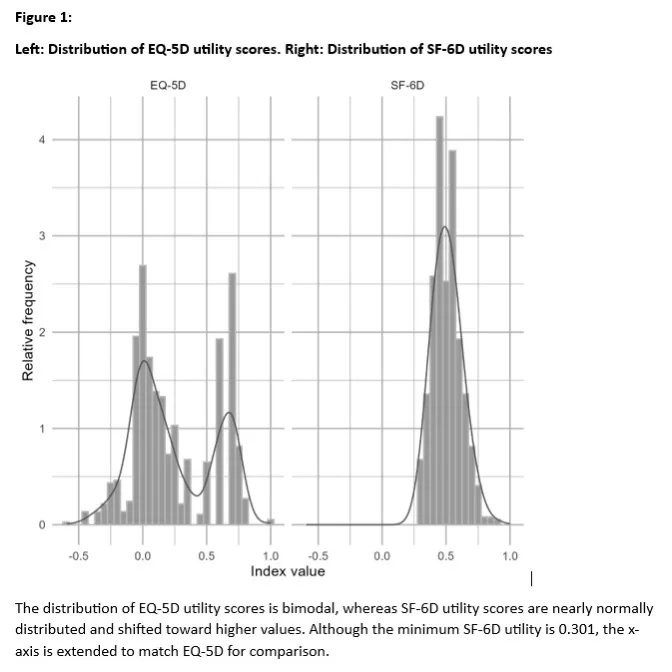
Paired EQ-5D and SF-6D from 736 patients were available for analysis. The most frequent response was the floor level in a single EQ-5D dimension (Pain) and in half of all SF-6D dimensions (Role Limitation, Pain, Vitality). The SF-6D utility was normally distributed with median 0.50 (range 0.30 to 0.91) whereas EQ-5D utility scores were bimodal with median 0.16 (range -0.594 to 1). SF-6D utilities were generally larger than EQ-5D: Median difference (SF – EQ) was 0.34 (range -0.51 to 1.08). Absolute agreement between the two instruments was poor: ICC = 0.158 (CI -0.019; 0.314).
EQ-5D and SF-6D are not interchangeable for patients with OVCF. Median differences are large, and SF-6D produces systematically higher utility scores than EQ-5D in patients with poor health while the reverse is true for good health. Aside from differing scoring algorithms, more widespread floor effects in SF-6D than EQ-5D may contribute to utility differences.
Researchers are urged to be mindful of this discrepancy when interpreting health states and utility scores in economic evaluations of clinical trials.
Figures and tables
As submitted with the abstract. Tap a figure to open it at full size.