
Cervical & Neural Pathologies
The Cord-to-Canal Ratio as a Radiographic Tool in Congenital Cervical Spinal Stenosis
- Medical University of South Carolina, Charleston, SC, United States of America
Abstract
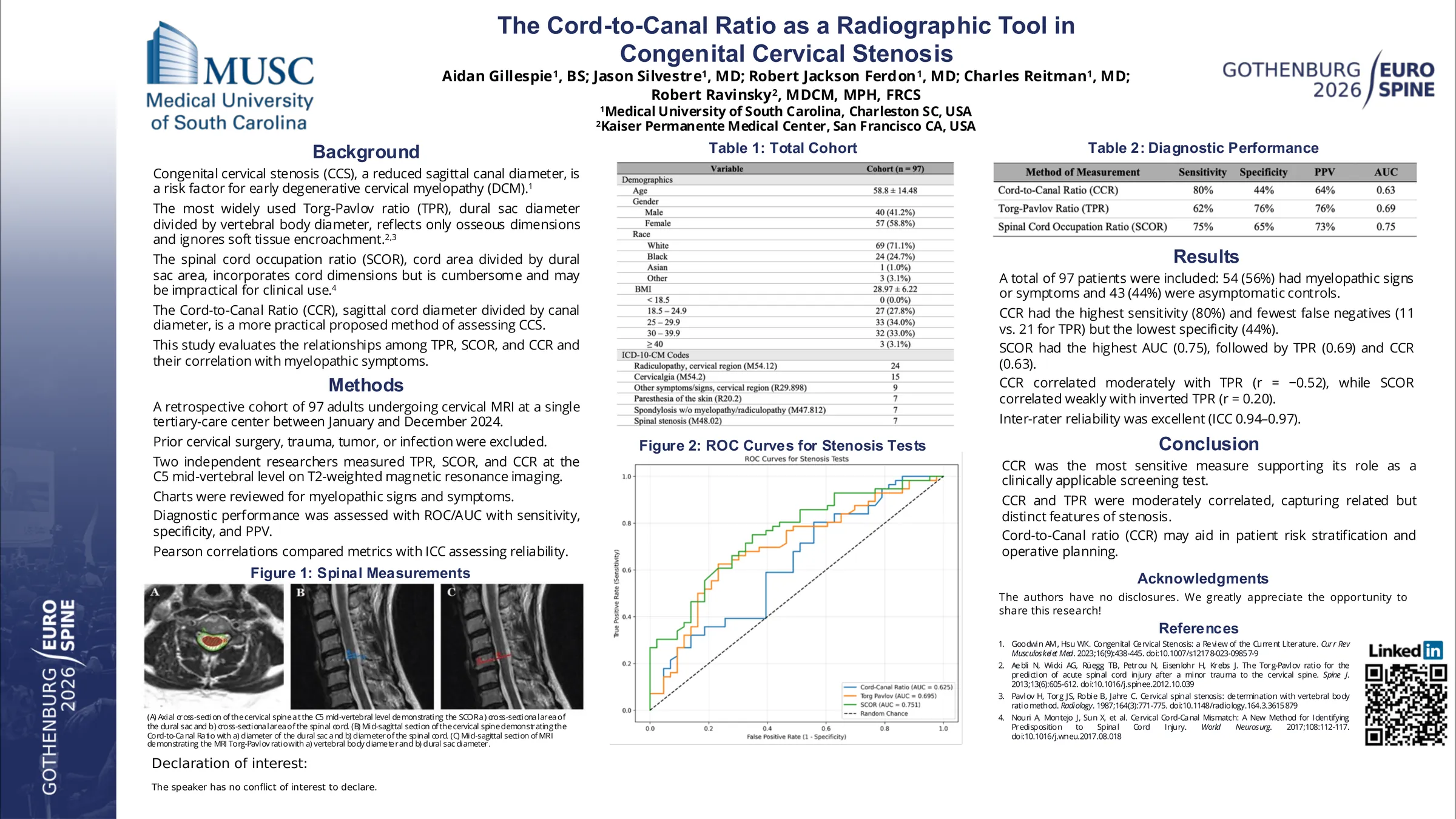
Congenital cervical spinal stenosis (CCS), characterized by reduced sagittal canal diameter, is a risk factor for early-onset degenerative cervical myelopathy (DCM). Traditional assessment using the Torg-Pavlov ratio (TPR) focuses solely on osseous anatomy. MRI enables visualization of both bony and soft tissue structures, allowing for advanced metrics like the Cord-to-Canal Ratio (CCR) and Spinal Cord Occupation Ratio (SCOR). However, no consensus exists on which MRI-based metric best correlates with symptomatic CCS. This study compares CCR, MRI TPR, and SCOR to assess their interrelationships and diagnostic performance.
97 patients undergoing cervical spine MRI at a tertiary care center from January-December 2024 were included. Measurements at the C5 mid-vertebral level were used to calculate CCR (cord/sac diameter), MRI TPR (dural sac/vertebral body diameter), and SCOR (cord/sac area). Patient charts were reviewed for myelopathic signs/symptoms. Sensitivity, specificity, and area under the curve (AUC) were evaluated via ROC analysis. Pearson correlation coefficients assessed metric interrelationships; TPR values were inverted for uniformity in severity interpretation.
56% (n = 54) of patients had myelopathic symptoms. CCR had the highest sensitivity (80%) but lowest specificity (44%). SCOR had the highest AUC (0.75), followed by TPR (0.69) and CCR (0.63). CCR correlated moderately with TPR (r = –0.52); SCOR showed weak correlation with inverted TPR (r = 0.20; p < 0.0001). No correlation differences were observed between symptomatic and asymptomatic groups.
CCR demonstrates clinical relevance and correlates with established metrics, supporting its use in CCS risk stratification and surgical planning.