
Basic Science & Economics
Determinants of Lumbar Vertebral Compression Strength Assessed by Finite Element Analysis
- Hospital for Special Surgery Main Hospital, New York, United States of America
- Showa University, Shinagawa City, Japan
- Duke University, Durham, United States of America
Abstract
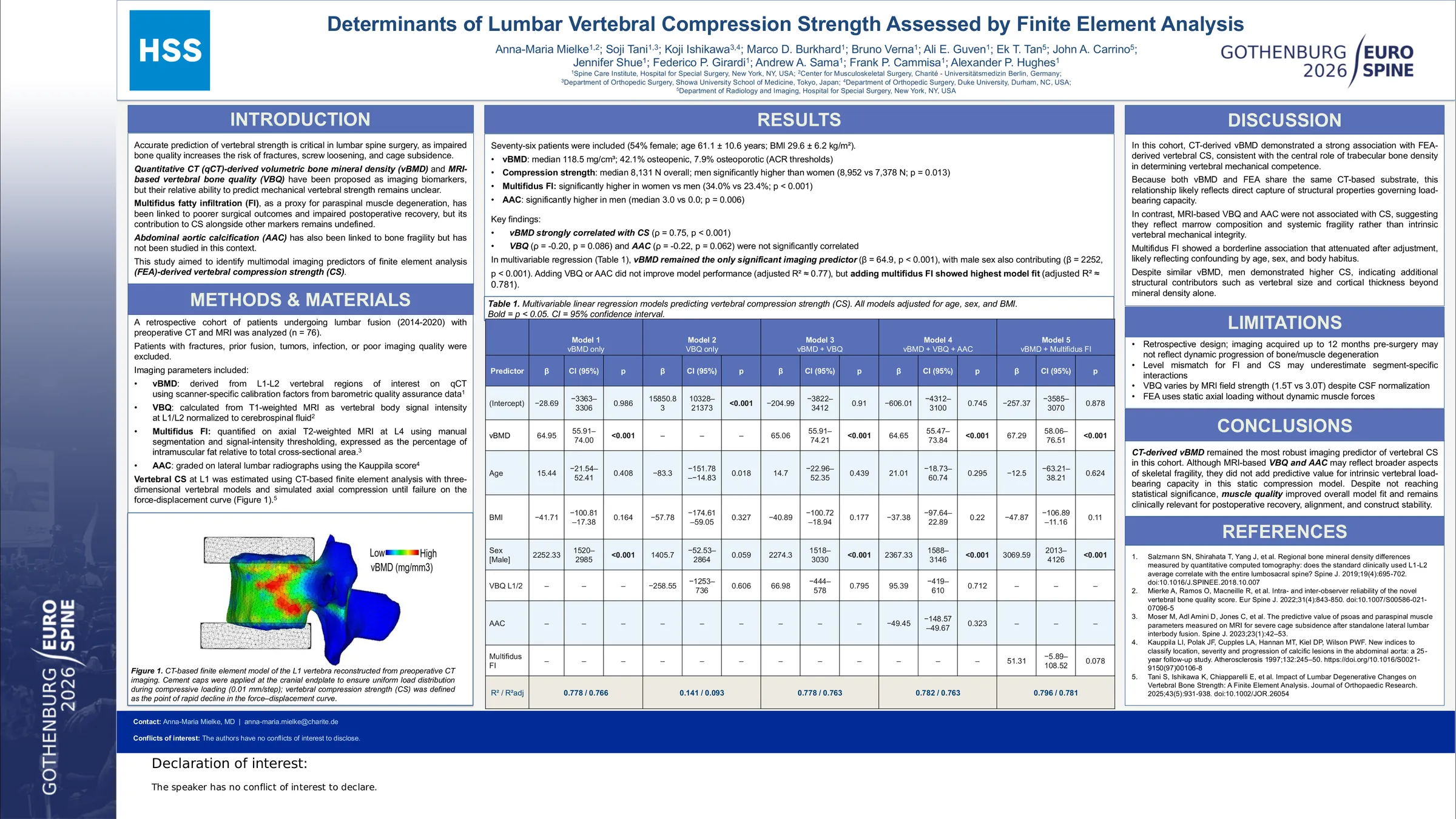
Preoperative assessment of vertebral strength is essential in spine surgery. While quantitative CT (QCT)-derived volumetric bone mineral density (vBMD) and MRI-based vertebral bone quality (VBQ) have been proposed as surrogate markers of bone integrity, their relative predictive value for biomechanical failure remains unclear. Additionally, paraspinal muscle fatty infiltration (FI) has been associated with poorer functional and postoperative outcomes, yet its contribution to vertebral compression strength (CS) is underexamined. This study aimed to identify multimodal imaging predictors of lumbar vertebral CS, focusing on vBMD, VBQ, abdominal aortic calcification (AAC), and multifidus FI, and to evaluate the cumulative and incremental predictive value of these routinely available imaging and patient-level factors for finite element analysis (FEA)-derived CS.
A retrospective analysis of 76 patients undergoing lumbar fusion with preoperative CT and MRI (2014-2020) was performed. CS at L1 was calculated using CT-based FEA. vBMD at L1-L2 was measured using asynchronous QCT. VBQ at L1/2 was derived from T1-weighted MRI normalized to cerebrospinal fluid. Multifidus FI was quantified at L4 on axial T2-weighted MRI. AAC was graded on lateral lumbar radiographs. Spearman correlation and multivariable linear regression were used to identify CS predictors.
Seventy-six patients were included (53.9% female; median age 61.9 years). CS was significantly lower in women than men (median 7,378 N vs. 8,952 N; p=0.013), and multifidus FI was significantly higher in women (median 34.0% vs. 23.4%; p<0.001). Men demonstrated greater AAC (median score 3.0 vs. 0.0; p=0.006).
Higher vBMD was associated with greater CS across all models (β=64.7-67.3 N per mg/cm³; all p<0.001). Neither VBQ nor AAC showed independent associations with CS or improved model performance. Multifidus FI showed a positive but non-significant association with CS (β=51.3 N per % increase; p=0.078), and its inclusion modestly increased overall model fit (adjusted R²=0.781). Male sex remained a significant predictor in all models (p<0.001).
CT-derived vBMD was the strongest and most consistent predictor of vertebral CS in patients undergoing lumbar fusion underscoring its central role in preoperative bone quality assessment. Although VBQ represents a marker of skeletal fragility, it did not independently predict CS in our models. Similarly, AAC and multifidus FI were not independently associated with CS. Nevertheless, multifidus FI remains clinically relevant, as muscle quality may influence postoperative recovery, sagittal alignment, and construct stability. Integrating assessments of muscle health and screening for sarcopenia may therefore help identify patients at elevated perioperative risk.