
Basic Science & Economics
Cost-utility analysis of transforaminal versus posterior lumbar interbody fusion for symptomatic single-level spondylolisthesis (LIFT): a multicentre controlled, patient blinded, randomized trial
- Zuyderland Medical Centre, Maastricht, Netherlands
- Zuyderland MC, Heerlen, Netherlands
- Maastricht UMC+, Maastricht, Netherlands
- CWZ, Nijmegen, Netherlands
- University Medical Center Groningen, Groningen, Netherlands
- VieCuri Medisch Centrum, Venlo, Netherlands
Abstract
Transforaminal lumbar interbody fusion (TLIF) and posterior lumbar interbody fusion (PLIF) are widely used and clinically comparable techniques for the treatment of symptomatic single‑level lumbar spondylolisthesis. When clinical effectiveness is similar, cost‑utility becomes a key determinant for treatment selection. To address the current evidence gap of studies directly comparing cost-utility of TLIF and PLIF, the lumbar interbody fusion trial (LIFT) was conducted.
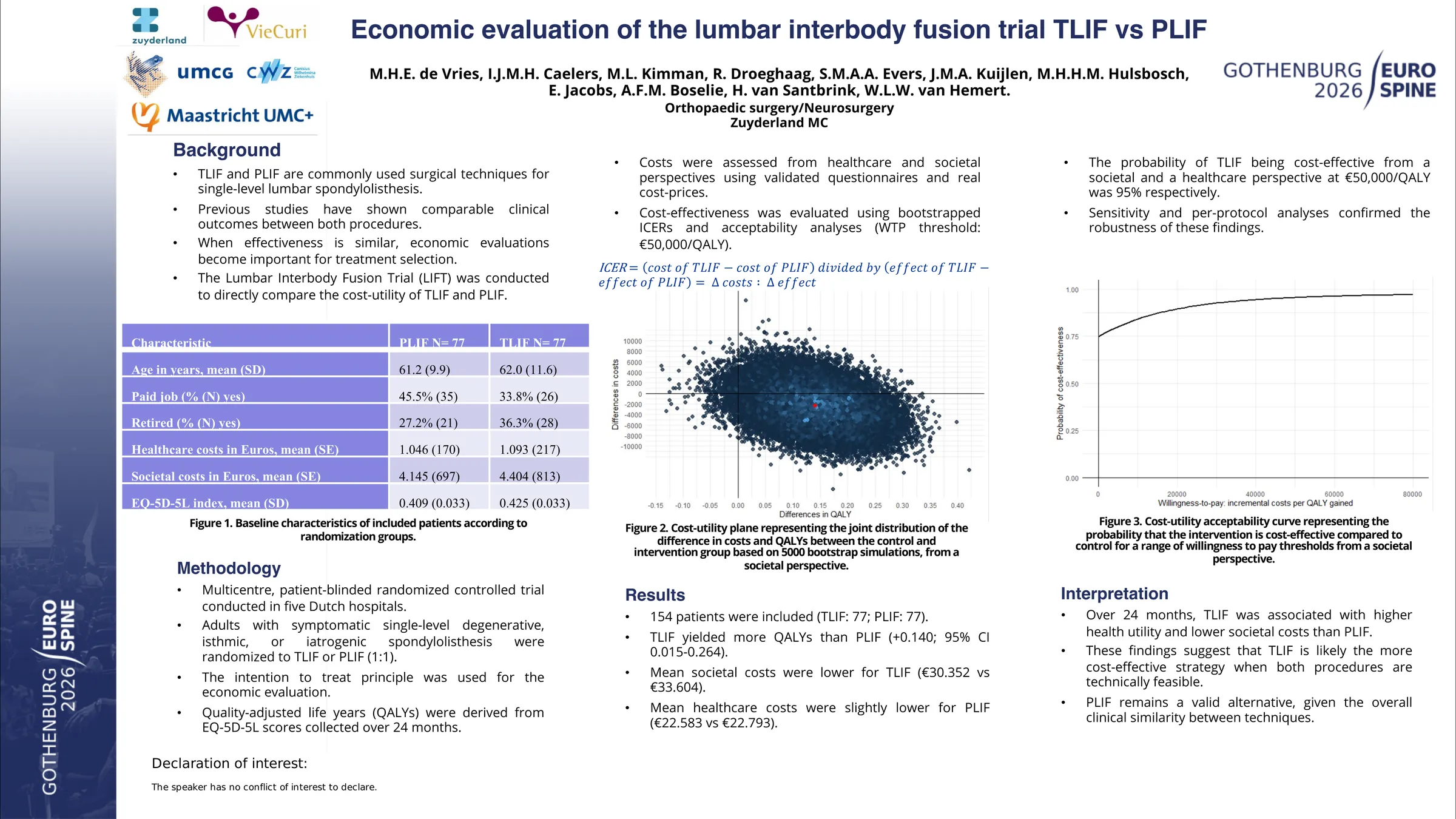
This cost‑utility analysis was conducted alongside a multicentre, patient‑blinded, randomized controlled trial in five hospitals in the Netherlands. Adults (≥18 years) with symptomatic single‑level degenerative, isthmic, or iatrogenic lumbar spondylolisthesis eligible for posterior lumbar fusion were randomly assigned (1:1), stratified by centre, to TLIF or PLIF. Health‑related quality of life was measured using the EQ‑5D‑5L at baseline, 3, 6, 12, and 24 months, and quality‑adjusted life‑years (QALYs) were calculated using the area‑under‑the‑curve method. Costs were assessed from both healthcare and societal perspectives, using validated questionnaires (iMCQ, iPCQ & iVCQ) and real cost prices. Incremental cost-effectiveness ratios (ICERs) were estimated using non‑parametric bootstrapping, and explored using cost‑effectiveness planes and acceptability curves. The willingness-to-pay (WTP) threshold was €50,000 per QALY. The trial was registered in the Dutch Trial Registry (NL5722).
A total of 154 patients were included in the modified intention‑to‑treat analysis (77 TLIF; 77 PLIF). Over 24 months, mean QALYs were higher in the TLIF group than in the PLIF group (mean difference 0.121; 95% bootstrapped CI -0.006 to 0.245, adjusted for baseline utility-scores). From a societal perspective, mean total costs were lower for TLIF (€31,811) than for PLIF (€34,094), yielding a mean cost difference of -€2,954 (95% bootstrap CI -€9,549 to €3,641, adjusted for baseline costs). TLIF was both more effective and less costly than PLIF. Uncertainty analyses showed that there was a 96% probability of TLIF being cost‑effective compared to PLIF at a WTP threshold of €50,000 per QALY. Sensitivity and per‑protocol analyses produced consistent results.
In patients with symptomatic single‑level lumbar spondylolisthesis, TLIF is cost‑effective compared to PLIF over a 24‑months’ time horizon, with higher health‑related quality of life and lower societal costs. When both procedures are technically feasible, TLIF is the preferred surgical option.