
Complications & Epidemiology
Impact of Serotonergic Modulators on Short- and Long-Term Outcomes After Transforaminal Lumbar Interbody Fusion
- Medical University of South Carolina, Charleston, SC, United States of America
Abstract
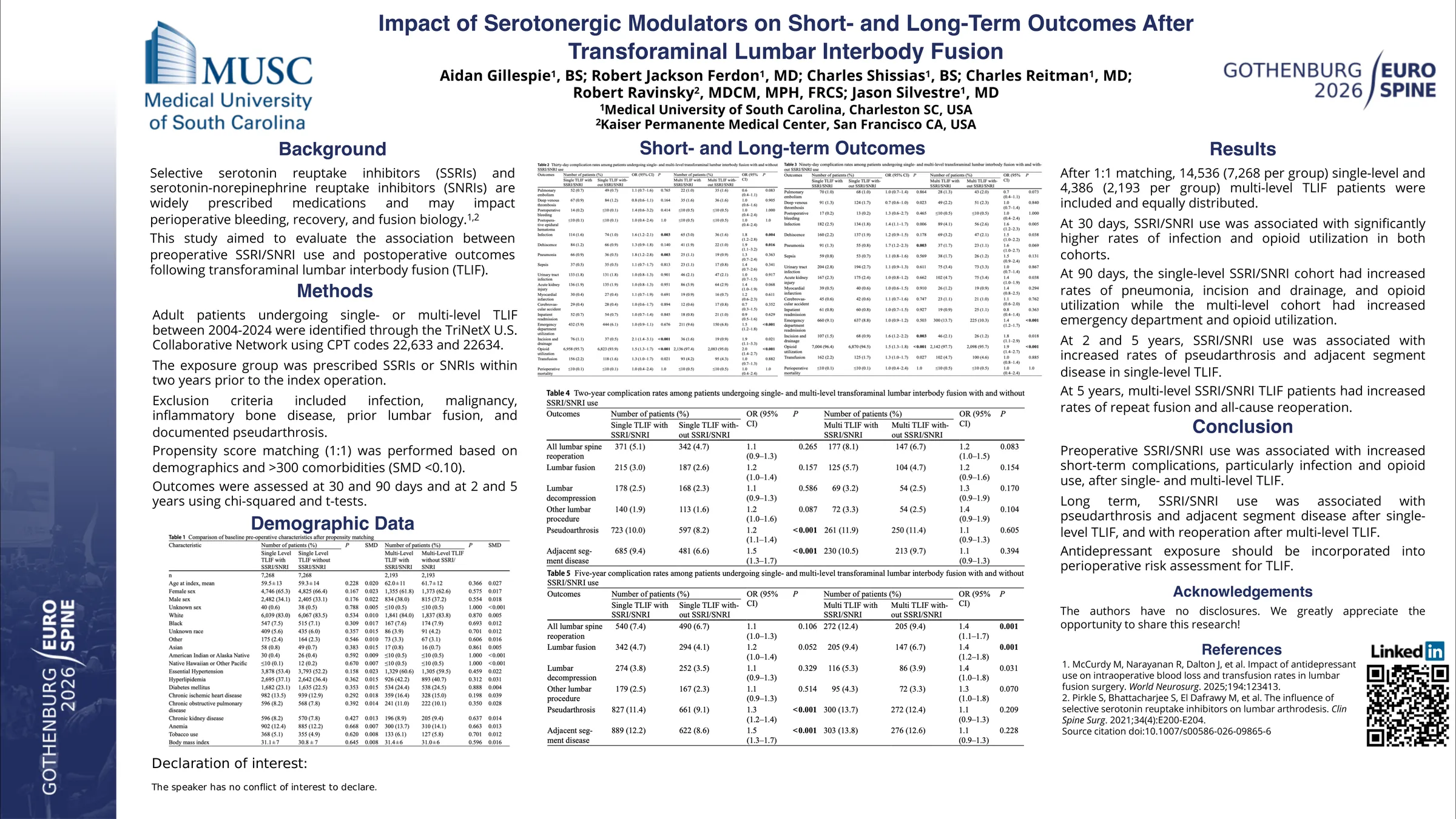
Selective serotonin reuptake inhibitors (SSRIs) and serotonin–norepinephrine reuptake inhibitors (SNRIs) are widely prescribed and may influence perioperative bleeding risk and fusion biology. This study evaluated the association between preoperative SSRI/SNRI use and postoperative outcomes following transforaminal lumbar interbody fusion (TLIF).
A retrospective propensity score–matched cohort study was conducted using a multi-institutional electronic medical record database. Adult patients undergoing single- or multi-level TLIF between 2004 and 2024 were identified using CPT codes 22633 and 22634. The exposure group included patients prescribed SSRIs/SNRIs within two years before surgery. Exclusion criteria included infection, malignancy, inflammatory bone disease, prior TLIF/ALIF, and documented pseudoarthrosis. Matching (1:1) was performed across demographics and >300 comorbidities. Outcomes were assessed at 30, 90 days, and 2-, and 5-year intervals using chi-squared tests, t-tests, and Kaplan–Meier survival estimates.
After matching, 7,268 single-level and 2,193 multi-level TLIF patients were included in each cohort. At 30 and 90 days, SSRI/SNRI use was associated with significantly higher rates of postoperative infection, incision and drainage, and opioid utilization in both surgical groups (all P < 0.05). Single-level SSRI/SNRI users additionally demonstrated higher rates of pneumonia and transfusion, while multi-level users showed increased dehiscence and emergency department utilization. At one year, single-level SSRI/SNRI use was associated with higher pseudoarthrosis and adjacent segment disease. Multi-level SSRI/SNRI users had increased cervical fusion procedures and reoperations. At five years, both cohorts demonstrated significantly elevated pseudoarthrosis rates, with multi-level patients also showing increased cervical fusion and overall reoperation.
Preoperative SSRI/SNRI use is independently associated with increased short-term complications and higher long-term risks of pseudoarthrosis and reoperation following TLIF, underscoring the importance of incorporating antidepressant exposure into perioperative risk assessment.