
Degenerative Thoracolumbar
Stand-Alone ALIF with Plate Has Lower Rates of Adjacent Segment Disease than TLIF/PSF: A Matched Cohort Comparison Study
- Mayo Clinic, Rochester, United States of America
Abstract
There are several technical options for treating degenerative lumbar spine pathology, particularly when the pathology is predominantly foraminal. Anterior lumbar interbody fusion (ALIF) is a standard treatment modality in the surgical management of degenerative lumbar spinal pathology. Often, ALIF is performed in conjunction with posterior spinal fusion and instrumentation. There has been limited literature comparing all anterior surgery (ALIF with plate) to all posterior treatment (TLIF/PSF), although some prior studies have suggested similar fusion rates and patient outcomes. One undesired risk of fusion surgery is the development of adjacent segment disease (ASD), which has not been evaluated between ALIF and TLIF/PSF. With this study, we sought to identify if there was a difference in the rate of developing adjacent segment disease between stand-alone ALIF and posterior TLIF/instrumented fusion.
A single-center retrospective study was performed. Patients who underwent stand-alone 1-2 level ALIF+plate procedures from 2007 to 2022 were compared to a group of 1-2 level TLIF+PSF procedures performed over 5 years from 2017 to 2021. Patients were matched for age and sex. Preoperative adjacent level spondylosis was recorded to assess the effect of the intervention on post-operative adjacent segment spondylosis. The primary outcome was the presence of UIV+1 spondylosis, and the secondary outcomes analyzed were pseudoarthrosis and reoperation.
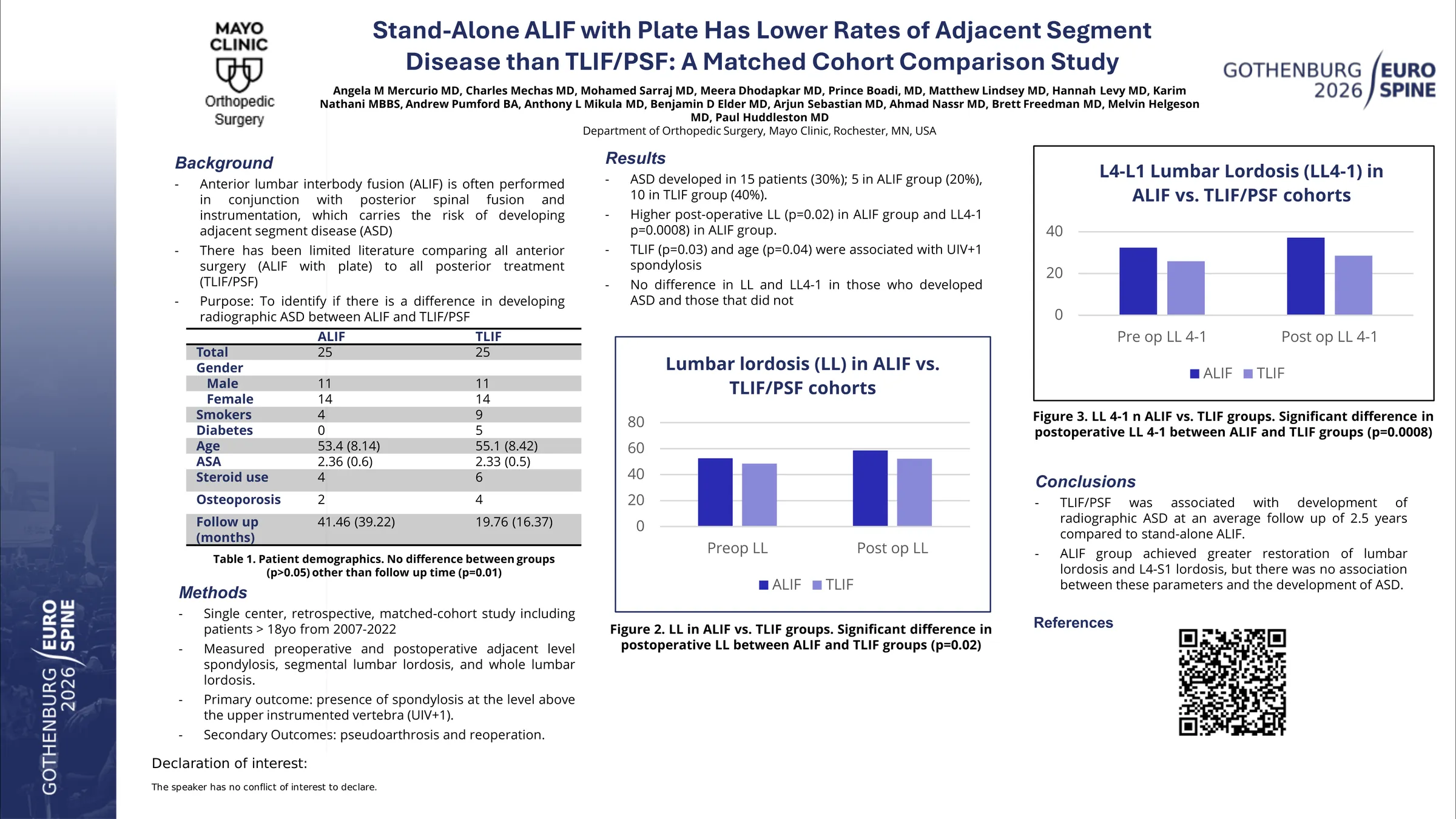
Fifty patients were analyzed, 25 in each group (ALIF/TLIF). There were no differences between the groups regarding age, sex, ASA score, smoking status, steroid use and presence of osteoporosis (all p>0.05). There were more diabetic patients in the TLIF group, approaching a significant difference (p = 0.0502). The average follow-up period was 2.5 years. The average follow-up period in the ALIF group was longer (3.5 years vs 1.7 years, p = 0.014). TLIF (p = 0.03) and age (p = 0.04) were both statistically significantly associated with UIV+1 post-operative spondylosis. Regarding pseudarthrosis and reoperation, there were no differences between the stand-alone ALIF group and the TLIF group. The ALIF group had a higher post-operative lumbar lordosis (p = 0.02) and L4-S1 lordosis (p = 0.0008). When comparing sagittal parameters for those in each group who developed ASD versus those who did not, no differences were observed.
TLIF was associated with a statistically significantly higher rate of ASD at UIV+1 compared to stand-alone ALIF at an average follow-up time of 2.5 years. While the ALIF group achieved better restoration of lumbar lordosis and L4-S1 lordosis, this was not significant when comparing those who developed ASD vs those who did not. Further studies comparing the outcomes of all anterior vs all posterior surgical techniques are warranted.