
Tumours & Infection
Spinal Instability Spondylodiscitis Score (SISS) as a Predictor of Reoperation After Surgical Treatment for Pyogenic Spondylodiscitis
- Takarazuka City Hospital, Takarazuka, Japan
- Hyogo College of Medicine, Nishinomiya, Japan
- Hyogo Medical University , Nishinomiya, Japan
- Ashiya St.Maria Hospital, Ashiya, Hyogo, Japan, Japan
- Sakai Heisei Hospital, Sakai, Japan
- Daiwa Central Hospital, Osaka, Osaka, Japan, Japan
Abstract
Surgery is indicated for pyogenic spondylitis in cases with neurological deficits, abscess formation, or spinal instability. However, postoperative complications and reoperations remain major concerns, particularly mechanical failure. The Spinal Instability Spondylodiscitis Score (SISS) has recently been introduced to evaluate instability based on spinal level, vertebral body destruction, alignment, and mechanical pain. This study aimed to determine the incidence, causes, and risk factors for reoperation after surgery for pyogenic spondylitis, focusing on the role of preoperative instability assessed by SISS.
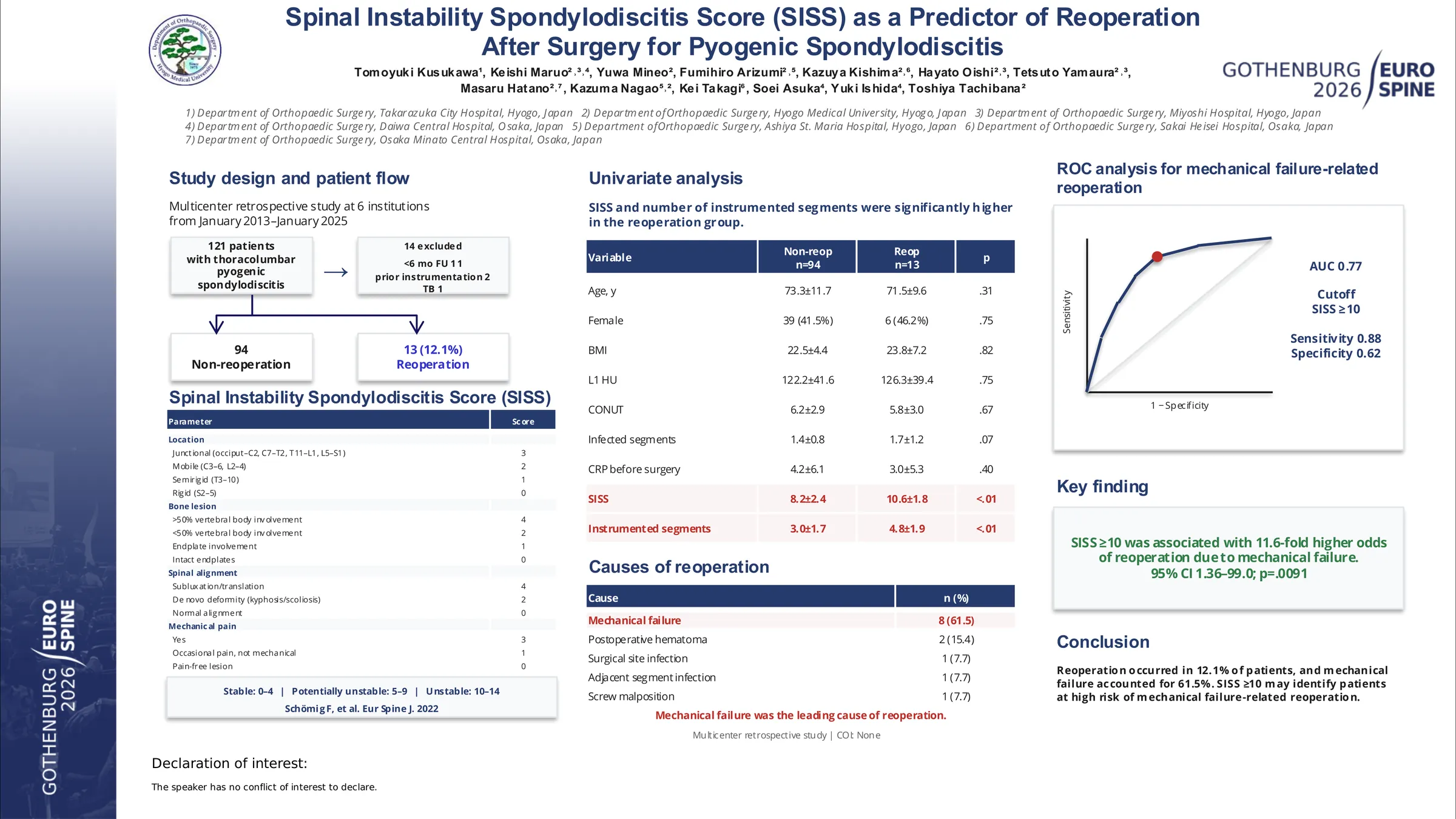
This multicenter retrospective study included patients who underwent surgery for thoracolumbar pyogenic spondylitis at six hospitals between January 2013 and 2025. A total of 107 patients were analyzed (mean age 73.1 years; 42.1% female). Initial surgery involved decompression or irrigation in 18, posterior spinal fixation (PSF) in 9, and PSF with interbody fusion in 80. We compared clinical and radiographic variables between patients who required reoperation and those who did not. Patient-related factors included age, sex, body mass index, Hounsfield unit value, and Controlling Nutritional Status (CONUT) score. Infection-related factors included affected spinal level, number of infected segments, CRP at initial visit and immediately before surgery, and SISS. Surgery-related factors included the surgical technique and the number of instrumented segments. In addition, the causes and types of reoperations were analyzed in detail.
Reoperation was required in 13 of 107 patients (12.1%). The primary cause of reoperation was mechanical failure in 8 (61.5%), followed by postoperative hematoma in 2, surgical site infection in 1, adjacent segment infection in 1, and screw malposition in 1. Among the eight patients requiring reoperation due to mechanical failure, fixation was extended in 5, reduced in 1, re-fixed at the same levels in 1, and implants were removed in 1. The reoperation group had a significantly greater number of instrumented segments at the initial surgery (4.8 vs. 3.0, p=0.003) and a significantly higher preoperative SISS (10.6 vs. 8.2, p<0.001). Patients who underwent reoperation due to mechanical failure had a significantly greater number of infected segments (2.3 vs. 1.4, p=0.002), a greater number of instrumented segments (4.5 vs. 3.0, p=0.03), and higher SISS (10.6 vs. 8.2, p=0.004).
Reoperation after surgery for pyogenic spondylitis occurred in 12.1% of patients, with mechanical failure accounting for the majority (61.5%) of cases. Higher preoperative SISS and a greater number of instrumented segments were significantly associated with reoperation. These findings suggest that spinal instability plays a critical role in postoperative mechanical complications. Preoperative evaluation of spinal instability using the SISS may aid in selecting an appropriate fixation range and potentially reduce the risk of reoperation.