
Complications & Epidemiology
Spaceflight-Associated Changes in Cervical Spine Structure, Muscle Function, and Disc Health in Astronauts
- University of Health Sciences, Bochum, Bochum, Germany
- German Sport University, Cologne, Germany
- Sahlgrenska University Hospital, Gothenburg, Sweden, Sweden
- University of Birmingham, Birmingham, UK, United Kingdom
- Johnson Space Center, Houston, United States of America
- Aeromedical Centre, Helsinki, Finland
- Institut für Unfallchirurgische Forschung und Biomechanik, Ulm, Germany
- Aachen University of Applied Sciences, Aachen, Germany, Germany
- Center for Muscle and Bone Research, Berlin, Germany, Germany
Abstract
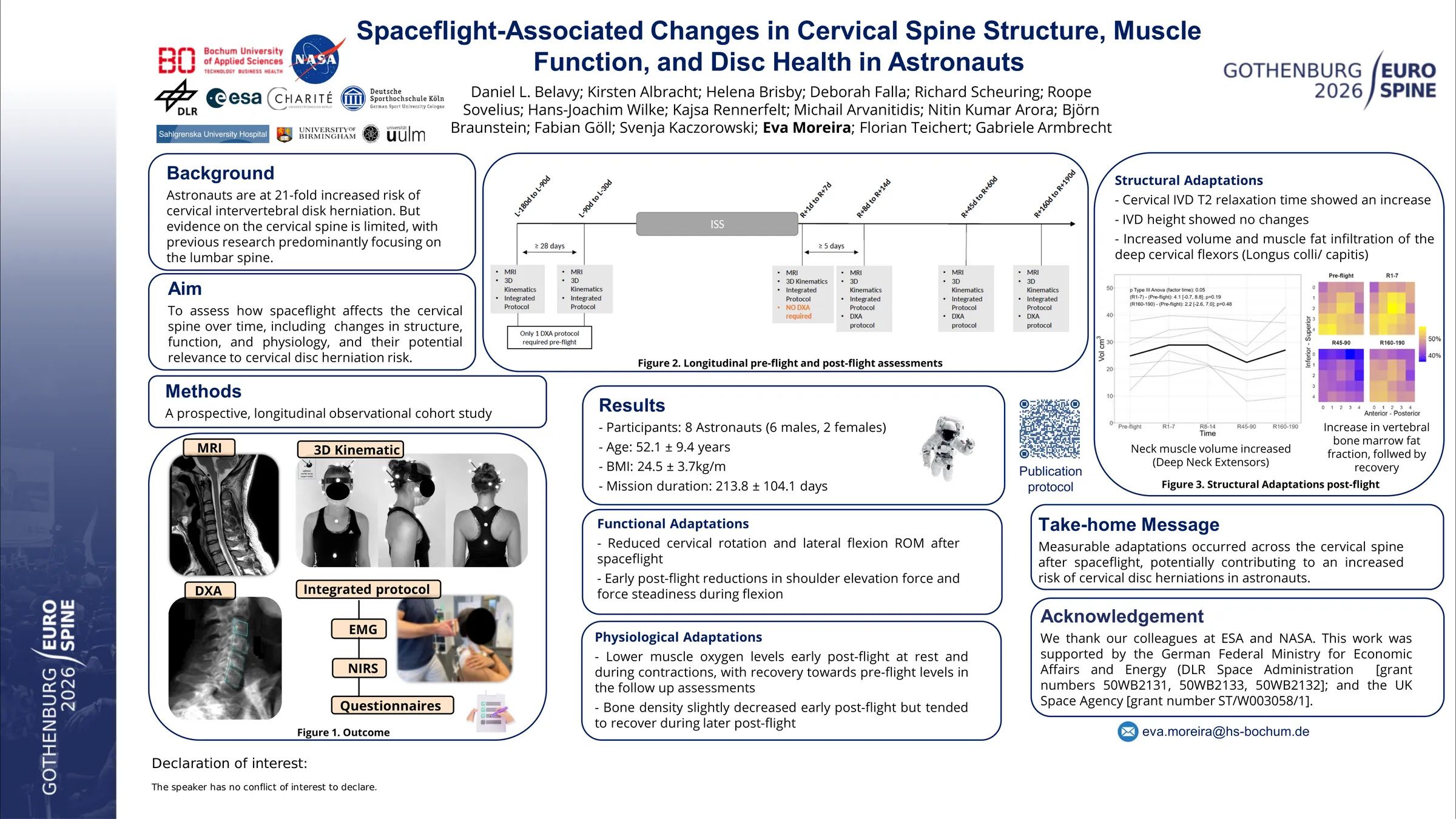
Astronauts have 21 times higher risk of cervical intervertebral disc (IVD) herniation, yet there is limited data on potential causes and existing data predominately focus on the lumbar spine. We aimed to examine alterations in the cervical spine after spaceflight that may be associated with the risk for disc herniation development.
In this prospective, longitudinal, observational cohort study, five astronauts undertaking space missions to the International Space Station were included and analysed to date. The participants were assessed at two pre-flight (Launch-210 to -30 days) and four post-flight time points (Return+1 to +190 days). We collected the following data: (a) magnetic resonance imaging (MRI) for cervical intervertebral disc, vertebral, and muscle morphology, (b) cervical spine kinematics, (c) electromyography and hand-held dynamometry measures (d) neck muscle oxygenation (Near-Infrared Spectroscopy (NIRS)), (e) dual-energy X-ray absorptiometry (DXA) for cervical bone mineral density and (f) questionnaires on pain and fighter-pilot experience.
Cervical IVD T2 relaxation time showed a post-flight increase followed by a long-term decrease, while IVD height showed no change. Vertebral fat fraction increased post-flight and decreased long-term. Muscle volume (deep cervical extensors and flexors) increased post-flight with inconsistent long-term changes whereas muscle fat infiltration increased post-flight and further increased long-term. Cervical spine range of motion reduced and aberrant motions increased post-flight. Shoulder shrug peak force and neck flexor force steadiness reduced at immediate post-flight timepoint (~5d). Baseline and contraction muscle oxygenation reduced post-flight but recovered at long-term timepoints. Cervical bone density slightly decreased early post-flight and increased thereafter.
This novel dataset investigates the cervical spine for the first time in an astronaut cohort. The early post-flight reductions in muscle oxygenation, bone density, range of motion and short-lasting neuromuscular changes indicate physiological changes that may precede or interact with disc injury mechanisms. The changes observed in cervical disc, vertebral, muscle and kinematic measures were relatively small in magnitude. Further data collection with five subsequent astronauts will give insight into the clinical and statistical significance of the effects observed.