Adult Deformity
Effectiveness of a Multimodal Preventive Bundle for Reducing Proximal Junctional Failure After Adult Spinal Deformity Surgery
- Hyogo College of Medicine, Nishinomiya, Japan
Abstract
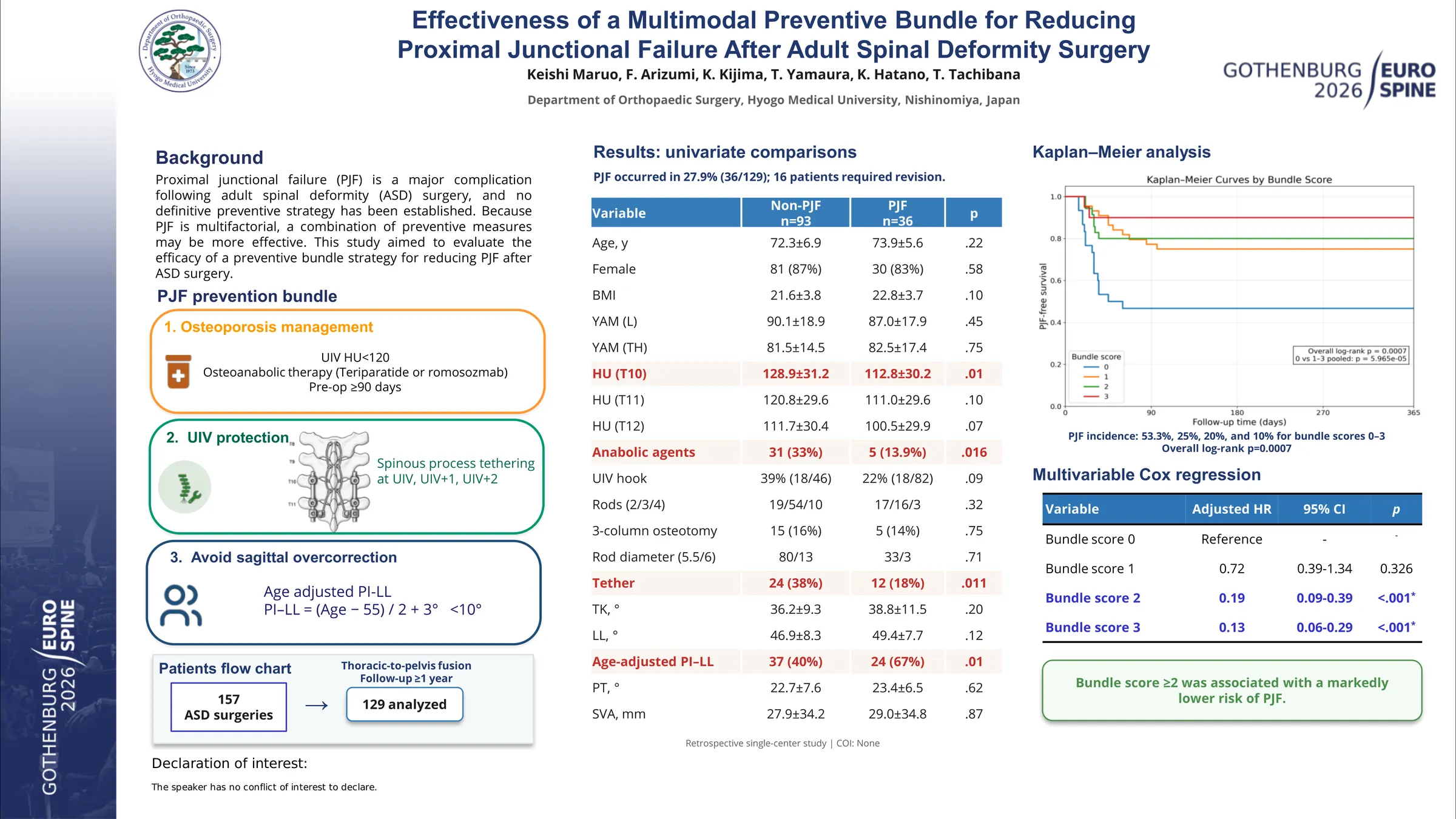
Proximal junctional failure (PJF) remains most challenging major complications following adult spinal deformity (ASD) surgery. Our institution has progressively modified perioperative management to reduce PJF, including preoperative bone quality optimization and refinement of upper instrumented vertebra (UIV) techniques. Recently, we hypothesized that a multimodal preventive bundle, addressing both biological and mechanical risk factors, may provide additive protective effects. The purpose of this study was to evaluate the effectiveness of a PJF prevention bundle in patients undergoing ASD surgery.
We retrospectively reviewed 157 consecutive patients who underwent ASD surgery between 2014 and 2024. Inclusion criteria were: 1) age ≥50 years, 2) fusion from thoracic spine to the pelvis, 3) minimum 1-year follow-up. A total of 129 patients met the criteria (mean age 72.7 years, 86% female). PJF was defined as following: UIV or UIV+1 fracture, instrumentation failure at the UIV, or revision surgery due to PJF. The PJF prevention bundle consisted of three components: 1) ≥90 days of preoperative anabolic osteoporosis therapy, 2) spinous process tethering at the UIV, 3) avoidance of overcorrection (age-adjusted PI–LL mismatch ≥ −10°). A bundle score (0–3) was calculated according to the number of preventive measures applied. Cumulative PJF incidence was analyzed using the Kaplan–Meier method and compared among bundle score groups using the log-rank test. Cox proportional hazards regression analysis was performed to evaluate the independent effects of each preventive measure and the overall bundle strategy.
PJF developed in 36 patients (28%), and 16 patients (44% of PJF cases) required revision surgery. The incidence of PJF was significantly lower in patients receiving: ≥90 days of anabolic therapy (13% vs. 34%, p = 0.02), UIV tethering (18% vs. 38%, p = 0.02), and avoidance of overcorrection (20% vs. 37%, p = 0.03). The cumulative PJF rate according to bundle score was: 0 components: 53%, 1 component: 25%, 2 components: 20%, and 3 components: 10%. Kaplan–Meier analysis demonstrated a significant stepwise reduction in PJF incidence with increasing bundle score. Preoperative anabolic therapy was independently associated with reduced PJF risk (HR 0.48, 95% CI 0.30–0.76, p<0.01). UIV tethering showed a strong protective effect (HR 0.05, 95% CI 0.02–0.10). Avoidance of overcorrection was not independently significant.
PJF occurred in 28% of patients after ASD surgery. A multimodal preventive bundle strategy was associated with a significant reduction in PJF incidence. Given that PJF is multifactorial, arising from patient-related factors (poor bone quality) and surgical factors (overcorrection, construct rigidity), a combined preventive approach appears more effective than isolated interventions.