
Degenerative Thoracolumbar
Robot-assisted spinal surgery – lessons from the learning curve of 100 cases at a teaching hospital
- King's College Hospital NHS Foundation Trust, London, United Kingdom
- University Hospital Center Zagreb, Zagreb, Croatia
Abstract
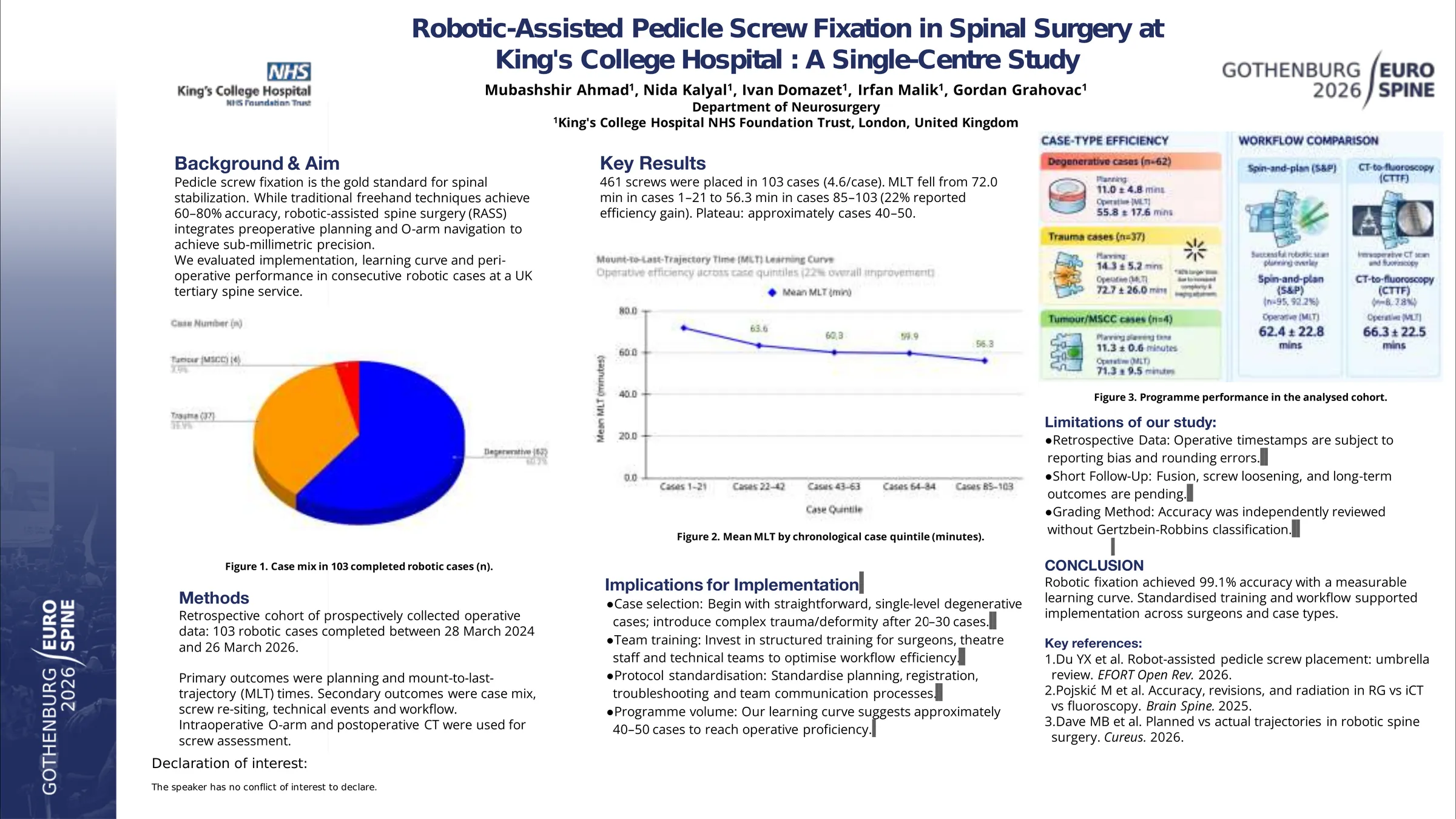
Robot-assisted pedicle screw placement has been associated with improved accuracy compared with fluoroscopic freehand techniques. Meta-analyses report accuracy rates of approximately 68–85% for freehand/fluoroscopy and 95–98% for computer-navigated techniques. We present the first 100 consecutive robot-assisted spinal cases performed at our centre using a CT-based robotic platform (MAZOR X, Medtronic), evaluating screw accuracy, early learning curve, and technical considerations.
A retrospective review was conducted of the first 100 consecutive robotic spinal procedures performed from March 2024. Indications included degenerative pathology, trauma, and metastatic spinal cord compression. All cases utilised intraoperative CT-based planning with robotic guidance for pedicle screw insertion. Operative metrics including planning time, screw insertion time, and total operative duration were analysed sequentially to evaluate the learning curve.
Across 100 cases, a total of 421 pedicle screws were inserted robotically with no neurologic complications attributable to screw malposition. The accuracy in our series was 95% and is comparable to published rates for navigated systems and higher than reported fluoroscopic freehand techniques. This is despite a high theatre and neurosurgery resident turnover to facilitate training with the robot.
Operative time demonstrated a clear learning curve, with a progressive reduction in planning time and per-screw insertion time over the first 20–30 cases, followed by plateau. The fast mount to last trajectory was 31 minutes, with the average being 69 minutes. Efficiency gains were most pronounced after standardisation of workflow, including optimised patient positioning, rigid reference frame fixation, identifying optimal pin placement and pre-planning of trajectories prior.
No robot-related returns to theatre were observed. Early experience highlights the importance of meticulous registration, avoidance of reference frame micromotion, and verification imaging before screw placement in multilevel constructs.
This represents the first UK series to achieve 100 robot-assisted spinal cases. Robotic pedicle screw placement demonstrated high accuracy consistent with international literature and superior to historical freehand benchmarks. A measurable but relatively short learning curve was observed, with workflow optimisation contributing significantly to operative efficiency. Robotic guidance is a safe and reproducible adjunct across degenerative, trauma, and oncological indications, supporting broader adoption within UK spinal practice.