
Degenerative Thoracolumbar
Results of instrumented fusion surgeries on lumbar spine with regard to "sagittal balance" parameters after posterior, anterior and combined approaches
- Hospital AGEL Zvolen, Zvolen, Slovakia
- UNLP kosice, 04001, Slovakia
Abstract
Sagittal balance has become a central topic in spinal surgery, particularly due to its impact on the outcomes of fusion procedures and postoperative quality of life. Malalignment of sagittal parameters is associated with adjacent segment degeneration, an increased risk of revision surgery, flat-back syndrome, and deterioration in postoperative quality of life.
The aim of our study is to compare the influence of the surgical approach as well as cage angulation on postoperative changes in sagittal alignment parameters
O
Our prospective study compares radiological parameters (LL and PI–LL) preoperatively and at 24 months postoperatively in patients undergoing lumbar interbody fusion between 2017 and 2024, with a total cohort of 852 patients.
Patients were divided into two main groups: single-level and two-level fusion. In the single-level cohort, patients were further categorized by surgical approach into four groups (TLIF, AxiaLIF, LLIF, and ALIF), and we also assessed the effect of cage angulation on postoperative lumbar lordosis.
In the two-level cohort, surgical approaches were classified into four categories: posterior/posterior (TLIF + TLIF), anterior + lateral (ALIF + LLIF), lateral/lateral (LLIF + LLIF), and anterior or lateral combined with posterior (ALIF/LLIF + TLIF).
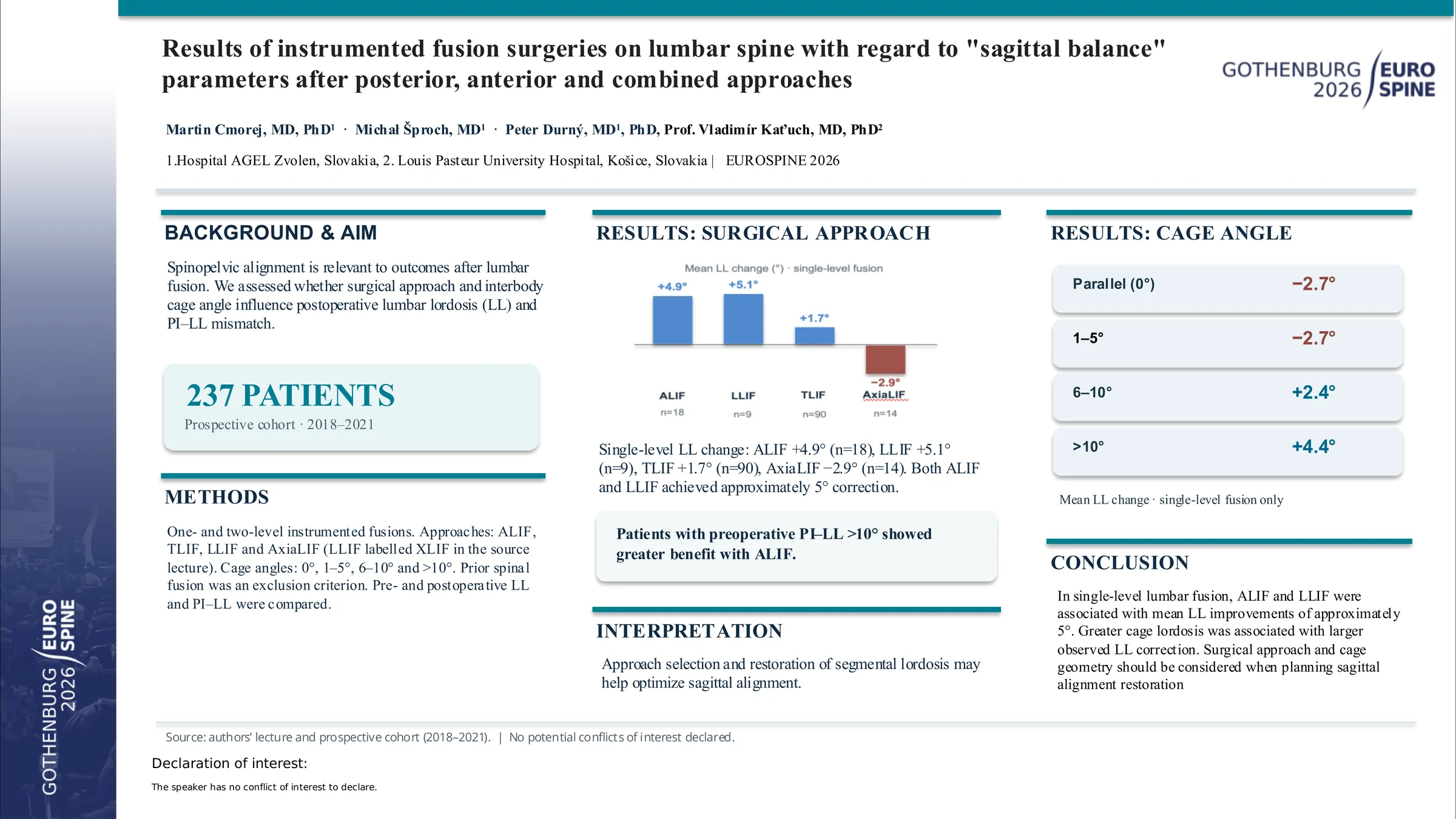
In single-level fusion procedures, the greatest lumbar lordosis (LL) correction was achieved with LLIF (mean +5.1°), followed by ALIF (+4.9°) and TLIF (+1.7°; p < 0.05). AxiaLIF was the only approach associated with postoperative deterioration, showing a mean decrease of 2.9°.
Regarding cage angulation, anatomical cages and those angled 1–5° showed comparable results, both associated with a mean LL decrease of 2.7°, whereas cages angled ≥10° provided the most favorable correction (+4.4°).
In two-level fusions, LL improvement was observed across all approaches, with similar gains in anterior and lateral techniques (+4.2° to +4.7°) compared to posterior approaches (+2.7°). In these procedures, lordotic cages resulted in LL improvement (+3.7°, +3.2°, +3.1°), while anatomical cages were associated with deterioration (–1.8°; p < 0.05).
The results of our prospective study confirm the assumption that anterior and lateral approaches have a greater potential for restoration of sagittal alignment parameters compared to posterior approaches.
Furthermore, our findings demonstrate that lordotic cages provide significantly greater improvement in lumbar lordosis compared to anatomical cages