
Complications & Epidemiology
Incidence and Risk Factors for Pulmonary Embolism Following Spinal Fusion Surgery Exceeding Six Hours: Dynamic Risk Stratification Using a Two-Stage Predictive Model
- HOCH Health Ostschweiz, Kantonsspital St.Gallen, St. Gallen, Switzerland
Abstract
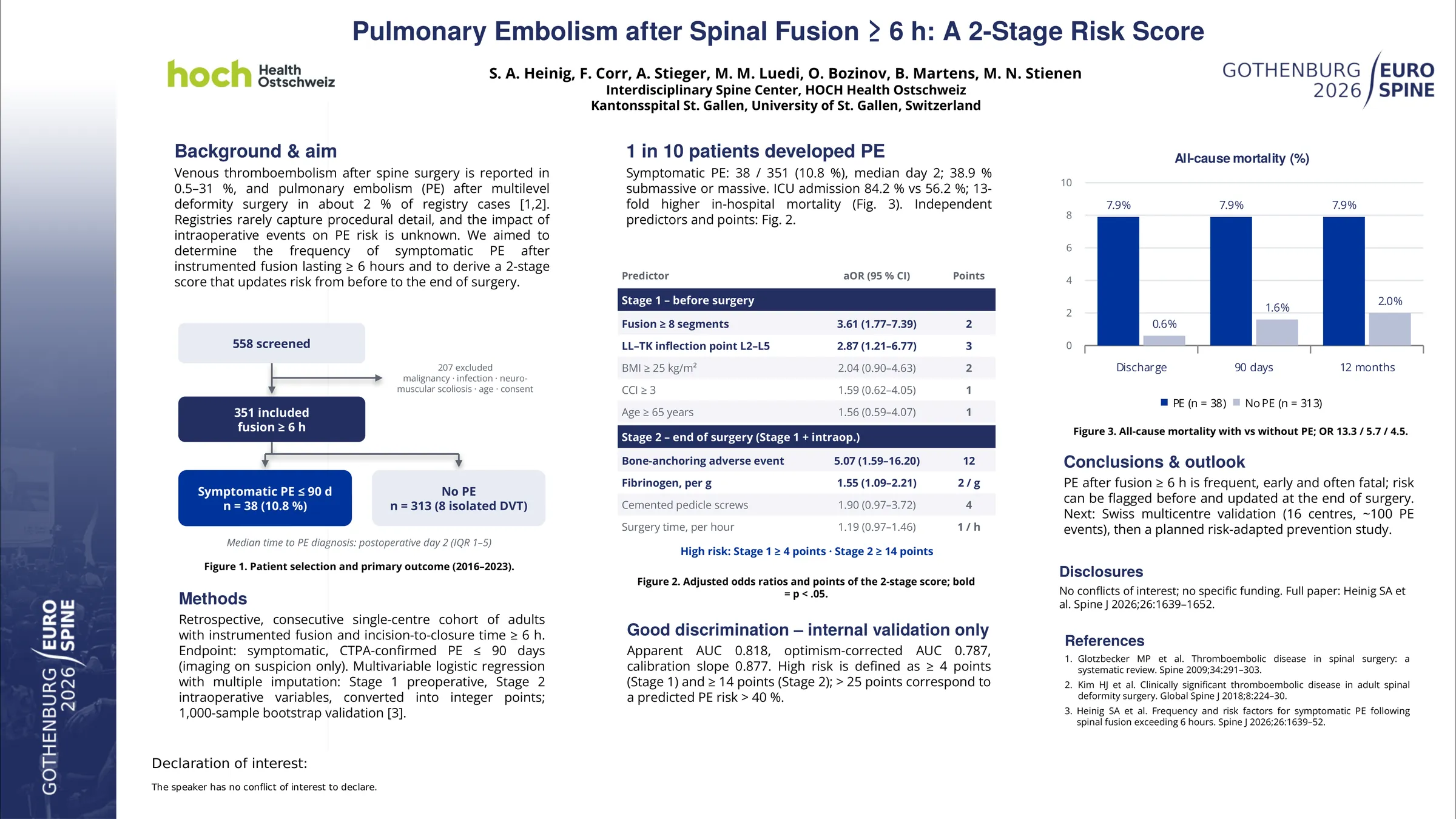
Major instrumented spinal fusion procedures with prolonged operative time are associated with considerable thromboembolic risk. However, the incidence, timing, and perioperative determinants of symptomatic pulmonary embolism (PE) in this specific high-risk population remain insufficiently characterized. This study aimed to determine the incidence of PE after spinal fusion lasting ≥6 hours and to develop a two-stage clinical prediction model integrating pre- and intraoperative risk factors.
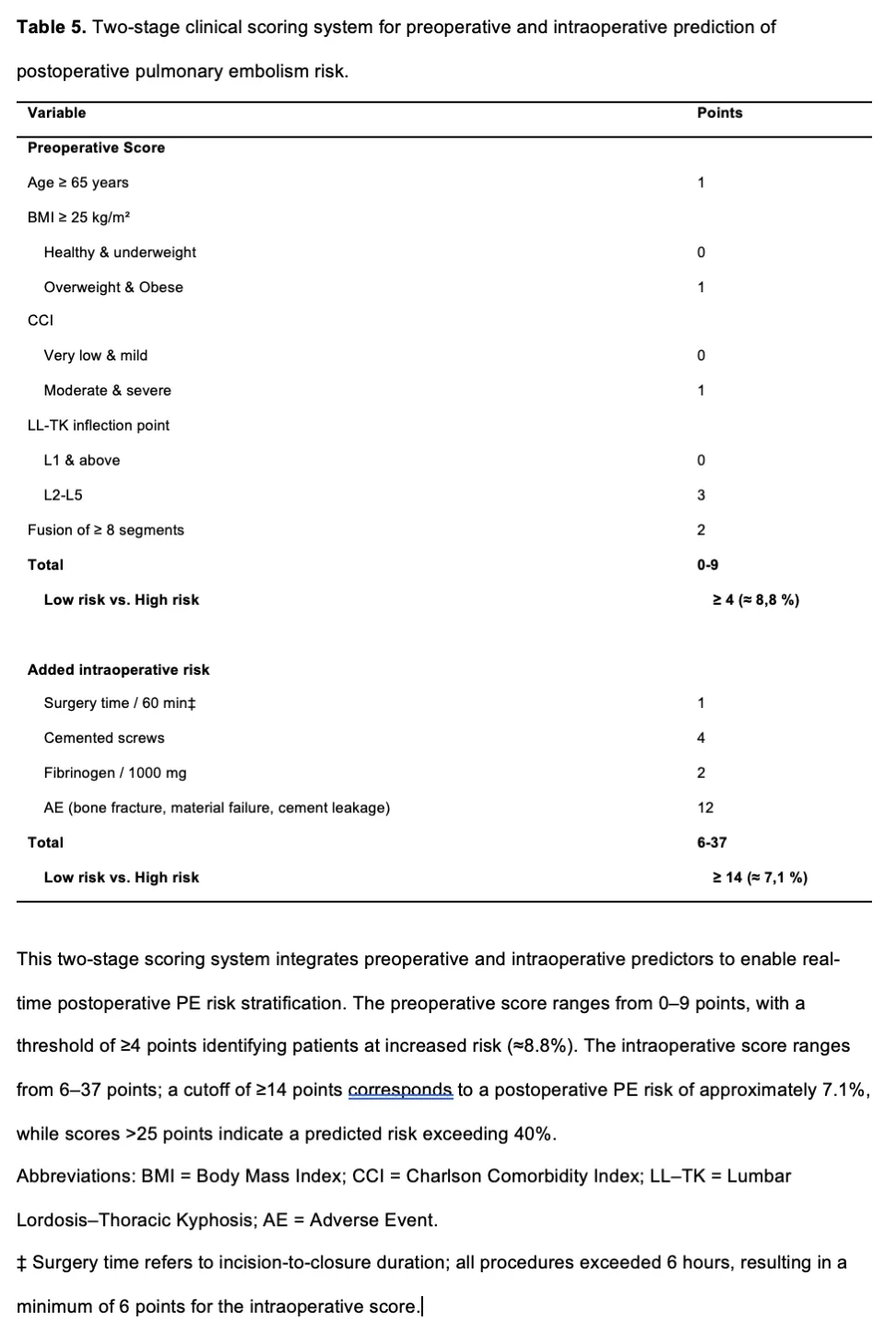
We conducted a retrospective single-center cohort study including 351 adults undergoing instrumented spinal fusion ≥6 hours for degenerative disease, deformity, or trauma between 2016 and 2023. The primary outcome was symptomatic PE within 90 days confirmed by CT angiography. Secondary outcomes included PE severity (AHA/ESC classification), perioperative risk factors, functional outcome (modified MacNab criteria), complications (TDN classification), and mortality at discharge, 90 days, and 12 months. Independent predictors were identified using multivariable logistic regression with multiple imputation. A hierarchical prediction model was constructed using preoperative variables (Stage 1) and intraoperative modifiers (Stage 2). Model performance was assessed by receiver operating characteristic analysis, calibration metrics, and bootstrap validation.
Symptomatic PE occurred in 10.8% (n=38), with diagnosis at a median of postoperative day 2. Independent preoperative predictors included fusion of ≥8 segments (OR 3.81, 95% CI 1.91–7.61) and a lumbar lordosis–thoracic kyphosis inflection between L2–L5 (OR 2.87, 95% CI 1.21–6.77). Intraoperative modifiers were osseous bone-anchoring complications (OR 5.07, 95% CI 1.59–16.20) and fibrinogen administration per gram (OR 1.55, 95% CI 1.09–2.21). Model discrimination was high (AUC 0.818) and remained robust after intraoperative augmentation (AUC 0.787). Patients with PE had higher ICU admission rates (84.2% vs. 56.2%, p=0.001) and significantly increased mortality at discharge (OR 13.3, p=0.005), at 90 days (OR 5.7, p=0.029), and at 12 months (OR 4.52, p=0.039).
In adults undergoing extensive instrumented spinal fusion exceeding 6 hours, symptomatic PE was frequent, occurred early postoperatively, and was associated with substantial morbidity and mortality despite institutional prophylaxis. This internally validated two-stage prediction model enables dynamic perioperative risk stratification in this high-risk subgroup. Prospective multicenter validation is warranted prior to broader clinical implementation.
Figures and tables
As submitted with the abstract. Tap a figure to open it at full size.