
Adult Deformity
Lumbar Apex Pelvic Angle (LaPA) as the Rosetta Stone of Spinal Shape: A PI-Based Predictive Cascade for Global Sagittal Reconstruction
- Vall d'Hebron University Hospital, Barcelona, Spain
- CHRU strasbourg - Les Hôpitaux Universitaires de Strasbourg , Strasbourg, France
- Ramón y Cajal Hospital, Madrid, Spain
- Vall d'Hebron Institut de Recerca (VHIR), Barcelona, Spain
- La Paz University Hospital, Madrid, Spain
- University of Texas Health Science Center at San Antonio, Sant Antonio, United States of America
- Rady Children's Hospital, San Diego, United States of America
- Chu De Bordeaux - Haut-Lévêque, Bordeaux, France
- Schulthess Klinik, Zurich, Switzerland
- Acibadem University Maslak Hospital, Istanbul, Türkiye
- . European Spine Study Group (Vall d'Hebron University Hospital, Barcelona, Spain
Abstract
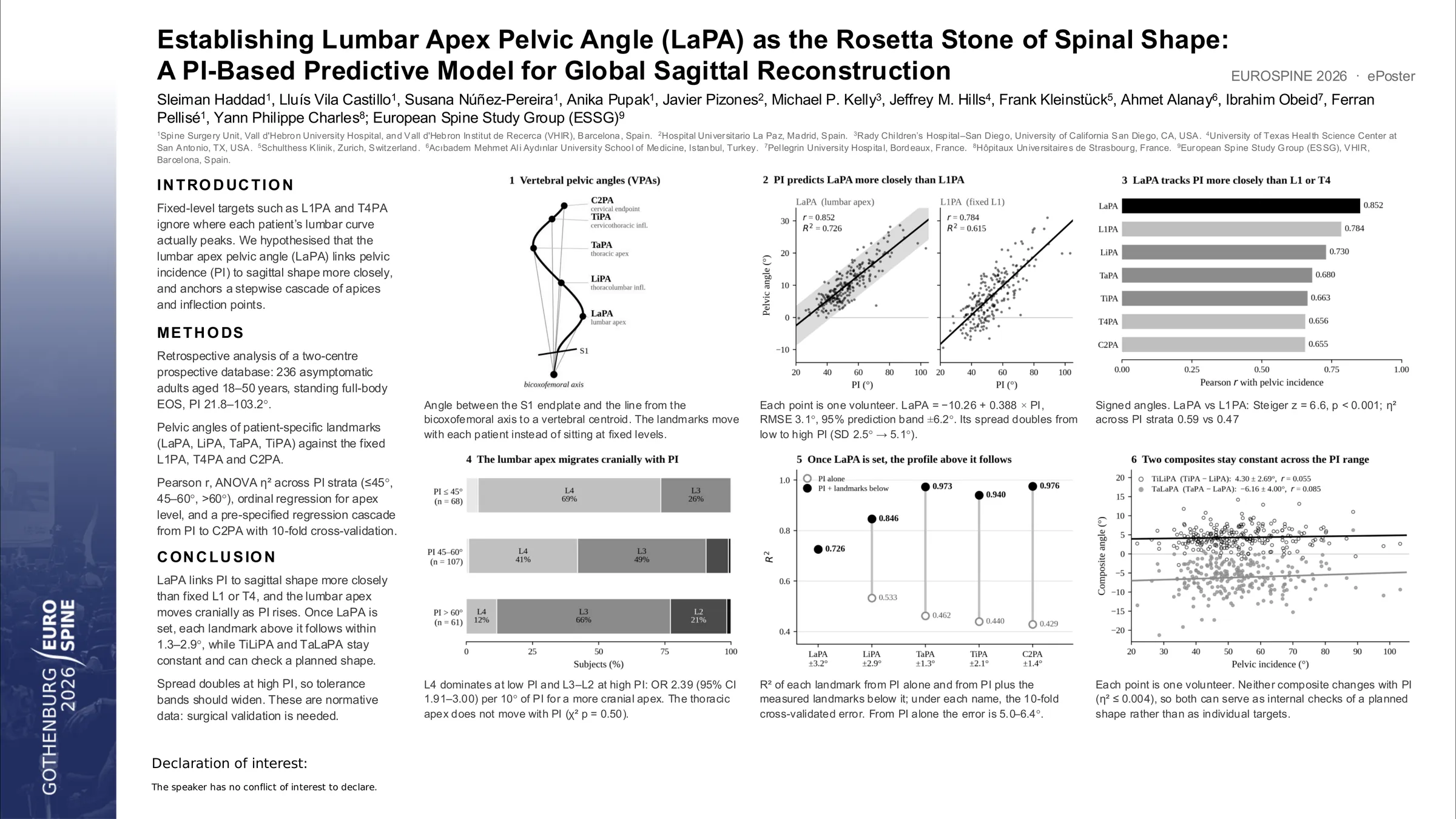
Pelvic incidence (PI) governs sagittal spinal morphology, yet translating this patient-specific constant into individualized alignment targets remains challenging. Existing models anchored to fixed vertebrae (e.g., L1, T4) fail to account for inter-individual variation in curve apices and inflection points. We hypothesized that the lumbar apex pelvic angle (LaPA) is the key PI-dependent landmark linking pelvic morphology to global spinal shape. We also determined and could segregate individual PI-driven variables from universal PI-independent geometric constraints.
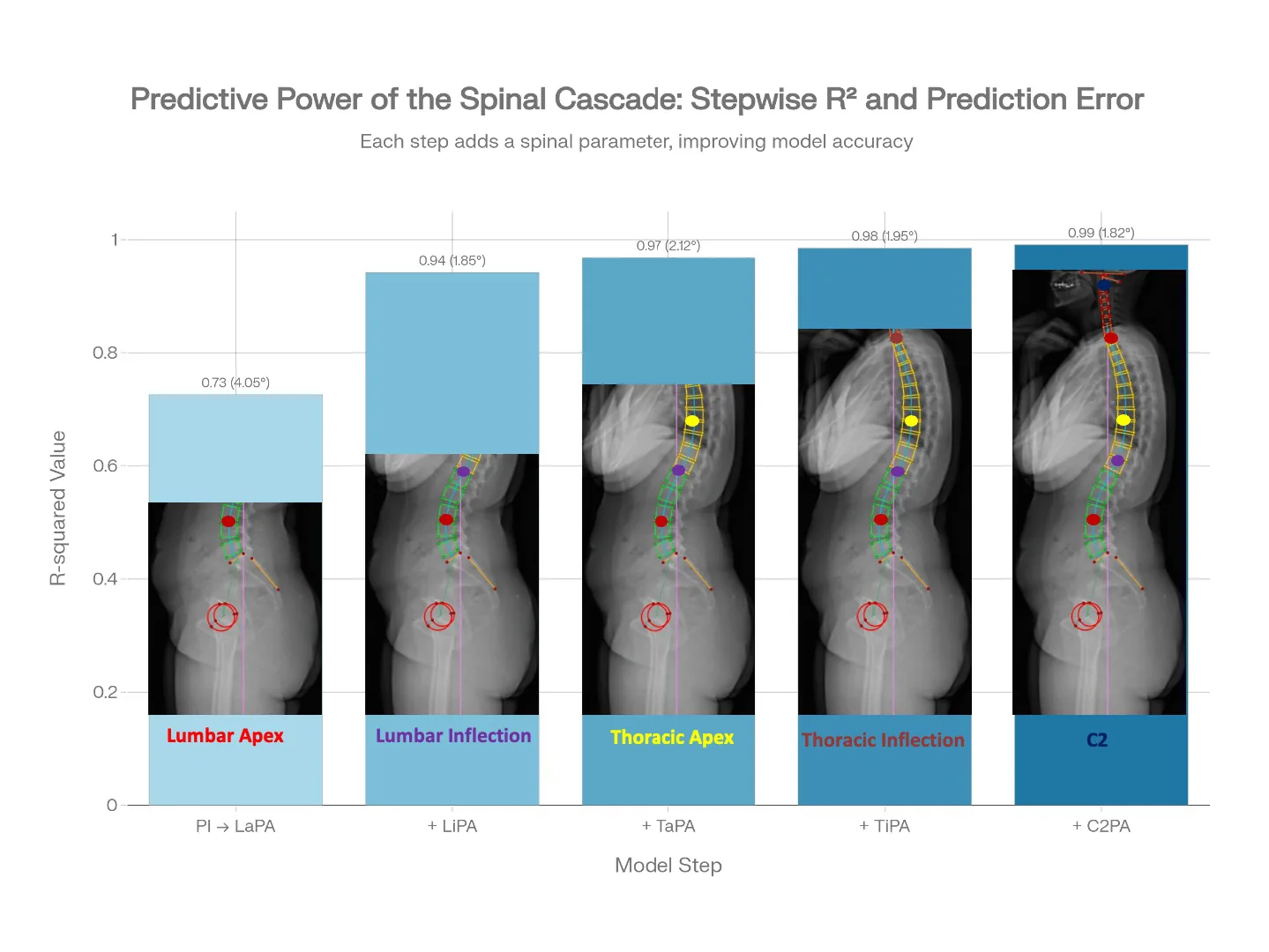
We analyzed 236 asymptomatic volunteers (age 20–50; PI 21.8–103.2°) using standardized standing full-spine radiographs. Pelvic angles (PA) were measured at regional landmarks: LaPA, LiPA (thoracolumbar inflection), TaPA (thoracic apex), and TiPA (cervicothoracic inflection), and compared with fixed vertebrae angles (L1PA, T4PA, C2PA). PI dependency was evaluated using Pearson correlation (r) and effect size (η²), and heteroscedasticity quantified variability across the PI spectrum. Inter-parameter relationships were analyzed to establish a stepwise predictive cascade from pelvis to cranial regional landmarks.
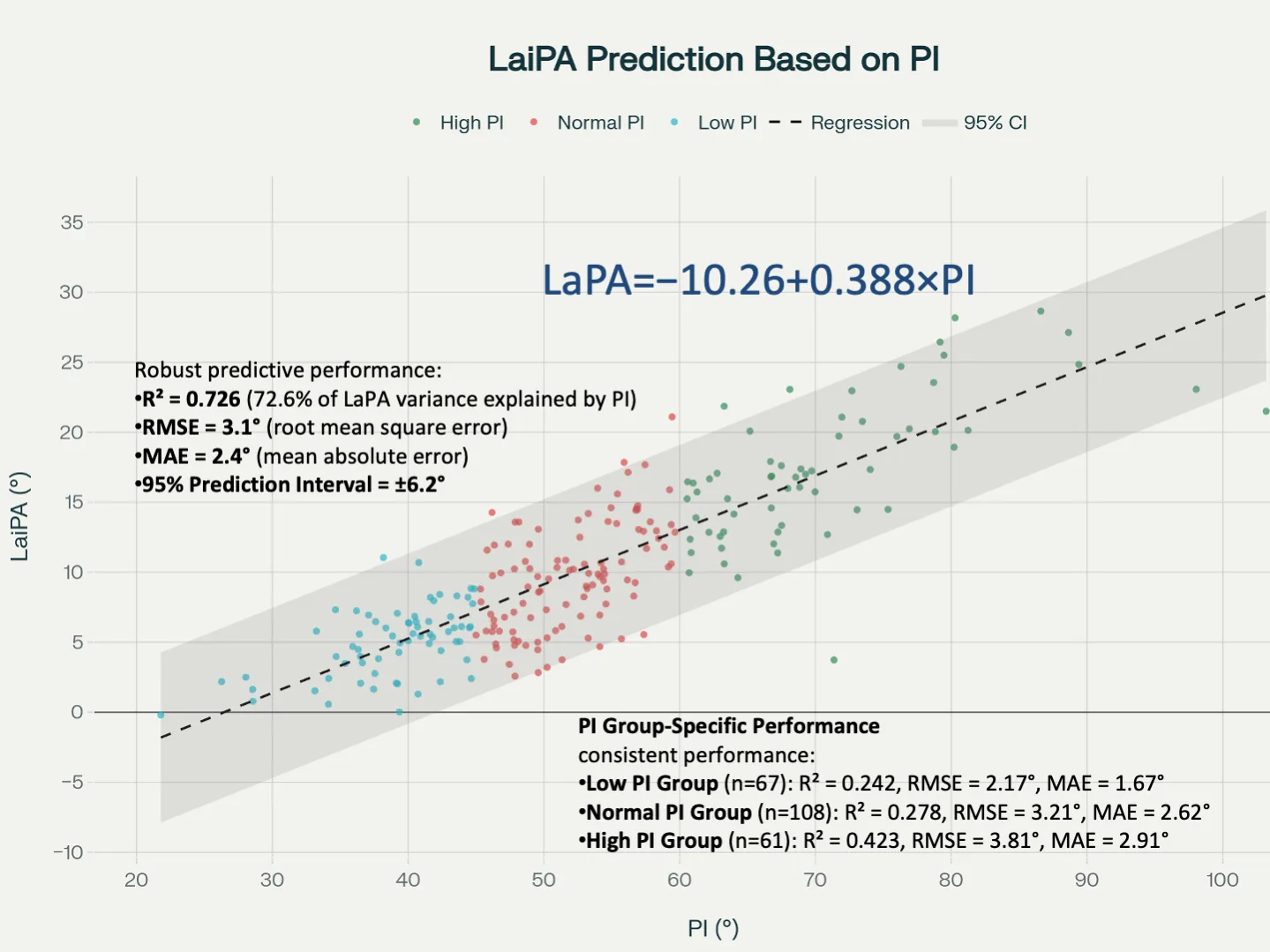
LaPA demonstrated the strongest PI dependency and enabled continuous prediction (LaPA = –10.26 + 0.39 × PI; r = 0.852, η² = 0.59, p < 0.001), outperforming L1PA (r = 0.784, η² = 0.47). Mean LaPA increased from 5.0° (low PI) to 17.4° (high PI), with stable correlation across the PI spectrum, including extremes where fixed-vertebra angles were less reliable. A robust cascade was identified: LaPA predicted LiPA (r² = 0.94), which sequentially predicted TaPA (r² = 0.97), TiPA (r² = 0.98), and C2PA (r² = 0.99). Composite indices (TiLiPA & TaLaPA) were PI-independent (r < 0.10, η² < 0.001), suggesting universal alignment rules or “checkpoints” useful for planning and model validation. Variability increased with higher PI, supporting broader acceptable ranges or "tolerance" for high-PI individuals.
LaPA functions as the optimal Rosetta Stone for PI-concordant shape reconstruction offering greater accuracy than fixed points. Calculating target LaPA from PI allows reliable sequential derivation of ideal regional landmarks via a strong correlation chain - while PI-independent parameters (TiLiPa & TaLaPa) provide universal bounds for model validation. This combined approach of regional landmarks and universal bounds offers a comprehensive framework to individualize spinal shape planning. Validation in a surgical cohort is warranted.
Figures and tables
As submitted with the abstract. Tap a figure to open it at full size.