Complications & Epidemiology
Cell Saver Use Does Not Improve Outcomes and May Increase Complications in Adult Spinal Deformity Surgery: A Propensity-Matched Analysis
- Vall d'Hebron University Hospital, Barcelona, Spain
- Vall d'Hebron Institut de Recerca (VHIR), Barcelona, Spain
- Ramón y Cajal Hospital, Madrid, Spain
- La Paz University Hospital, Madrid, Spain
- CHRU strasbourg - Les Hôpitaux Universitaires de Strasbourg , Strasbourg, France
- Chu De Bordeaux - Haut-Lévêque, Bordeaux, France
- Schulthess Klinik, Zurich, Switzerland
- Acibadem University Maslak Hospital, Istanbul, Türkiye
- . European Spine Study Group (Vall d'Hebron University Hospital, Barcelona, Spain
Abstract
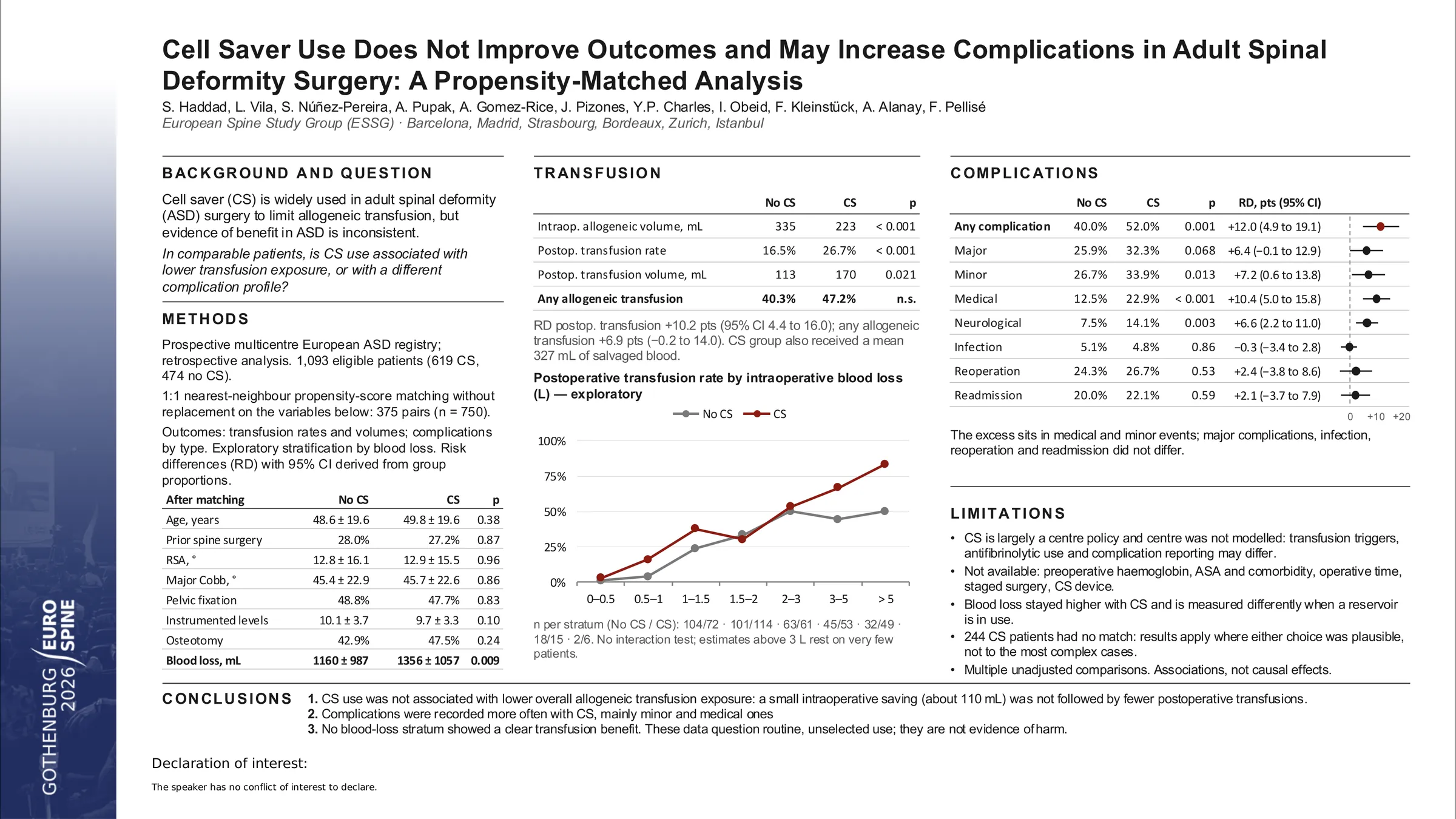
The use of cell saver (CS) is common practice in complex spine surgery, aiming to reduce the need for allogenic transfusions and associated risks. However, its true benefit and safety profile in adult spinal deformity (ASD) remain controversial. Our objective was to evaluate the impact of CS on transfusion requirements and postoperative complication rates in patients undergoing ASD surgery.
A propensity score-matched analysis was conducted to compare outcomes between patients who received CS and those who did not. The study cohort consisted of 1,093 ASD patients from a prospective, multicenter European ASD registry, resulting in 375 matched 1:1 pairs (n = 750) after matching. Matching variables included age, prior spinal surgery, baseline deformity parameters (relative sagittal alignment [RSA] and coronal curve magnitude), surgical complexity (number of fused levels, pelvic fixation, and osteotomies), and intraoperative blood loss, achieving adequate balance between groups (all p > 0.05).
Primary outcomes were transfusion rates and volumes—including intraoperative allogenic transfusions, CS transfusions, postoperative transfusions, and total blood loss—as well as complication rates and types. Additionally, threshold analysis stratified by intraoperative blood loss was performed to identify blood loss cutoffs where CS provided significant volume-sparing benefits.
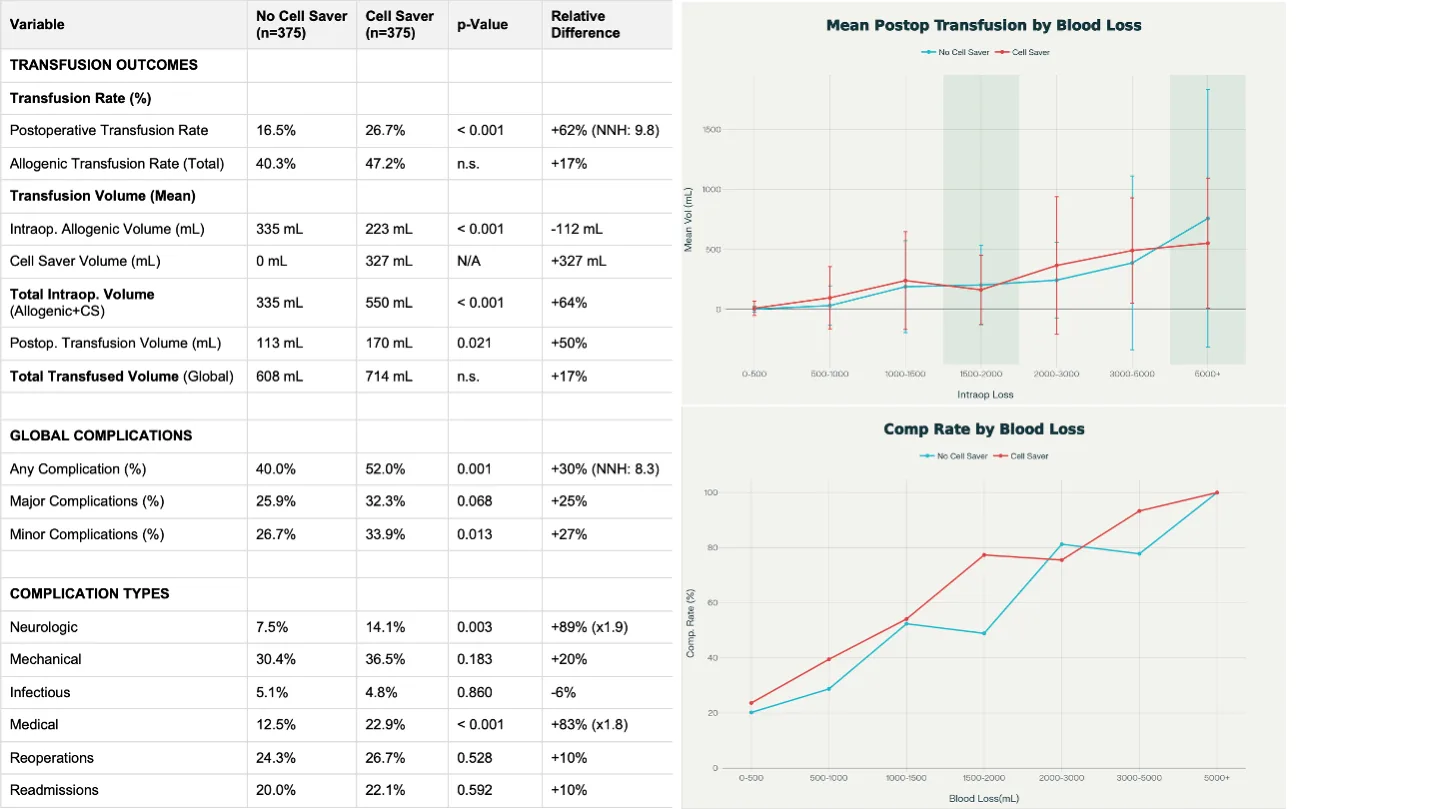
S use was associated with a lower volume of intraoperative allogenic transfusion (223 vs 335 mL). Paradoxically, the CS group exhibited a higher total volume of intraoperative transfusions (550 vs 335 mL) and a significantly higher rate of postoperative allogenic transfusion (26.7% vs 16.5%; 170 vs 113 mL). Furthermore, the total volume of allogenic blood transfused was increased in the CS group (714 vs 608 mL).The overall complication rate was significantly higher in the CS group (52.0% vs 40.0% NNH=8,3), primarily driven by minor complications (33.9% vs 26.7%). Notably, medical complications doubled in the CS group (22.9% vs 12.5%), while wound infection rate remained similar between groups (4.8% vs 5.1%). Threshold analysis did not identify any volume of blood loss at which CS was associated with a transfusion-saving benefit
Routine CS use in matched ASD patients did not reduce allogenic transfusions and was associated with a 30% relative increase in overall complications -mainly minor and medical. Prospective studies controlling for confounders such as preoperative hemoglobin, CS device type, and local transfusion practices, are needed to confirm these findings
Figures and tables
As submitted with the abstract. Tap a figure to open it at full size.