
Degenerative Thoracolumbar
Perioperative Analgesic Consumption Across Different Surgical Modalities of Lumbar Discectomy: A Comparative Analysis of Open, Tubular, and Endoscopic Approaches
- University Hospital in Hradec Králové, Charles University, Hradec Králové, Czech Republic
Abstract
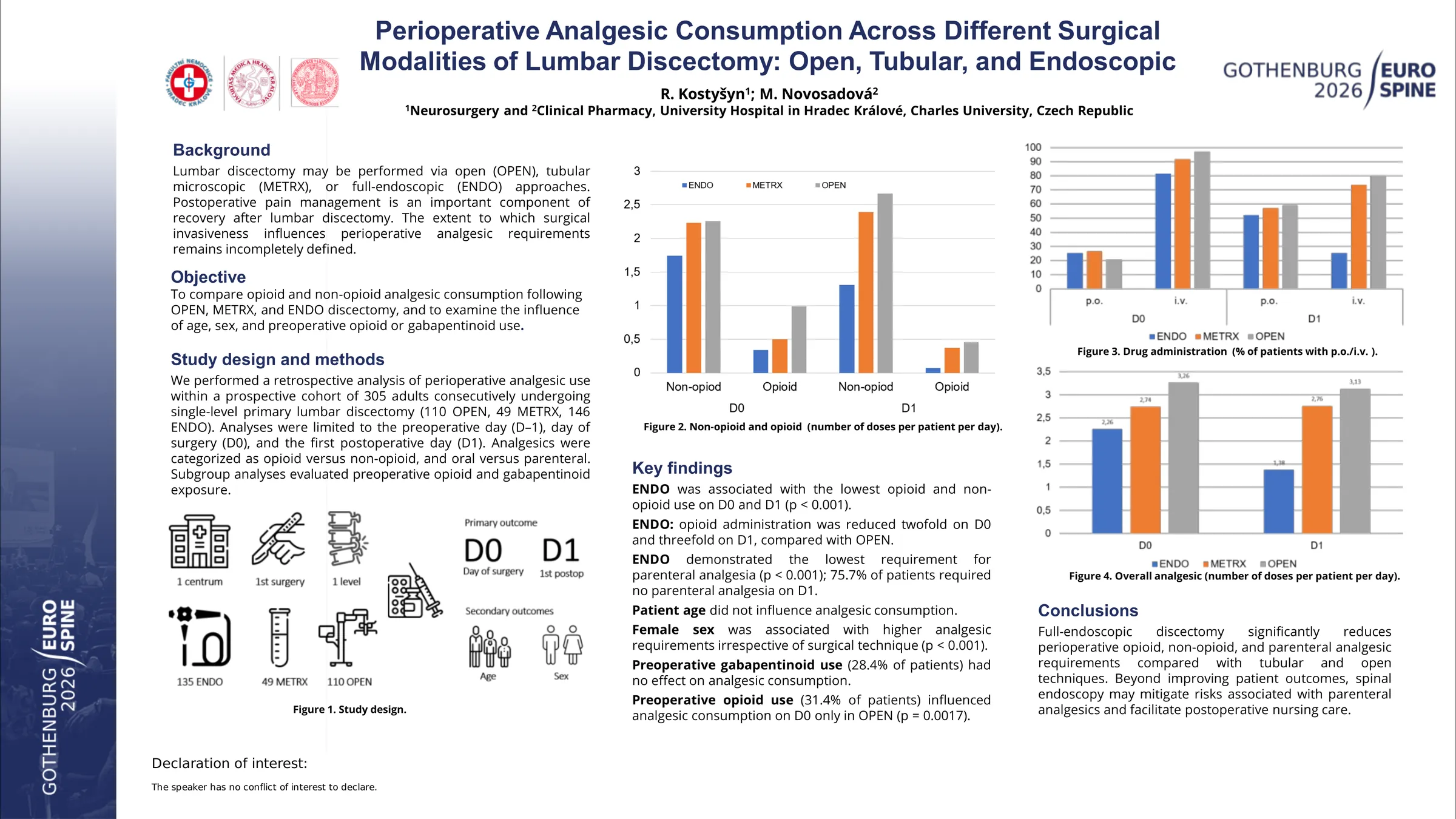
Lumbar discectomy may be performed using open (OPEN), tubular microscopic (TUBULAR), or endoscopic (ENDO) techniques. While previous comparative data demonstrated clinical advantages of full-endoscopic lumbar discectomy in terms of pain reduction, disability, recurrence risk, and recovery parameters, its impact on perioperative analgesic requirements remains insufficiently defined.
The primary aim of the study was to compare perioperative opioid and non-opioid analgesic consumption among OPEN, TUBULAR, and ENDO lumbar discectomy. Secondary aims were to evaluate the influence of age, sex, and preoperative opioid or gabapentinoid use on analgesic demand.
A retrospective analysis of perioperative analgesic consumption was conducted within a prospective clinical trial dataset including 305 consecutive adults undergoing single-level primary lumbar discectomy (OPEN n=110; TUBULAR n=49; ENDO n=146). Due to shorter hospitalization in ENDO, evaluation was limited to the preoperative day (D−1), day of surgery (D0), and first postoperative day (D1). Opioid and non-opioid consumption was assessed, stratified by oral and parenteral administration. Statistical significance was set at p<0.05.
ENDO demonstrated the lowest opioid and non-opioid consumption on D0 and D1 (p<0.001). Compared with OPEN, opioid use in ENDO was approximately twofold lower on D0 and threefold lower on D1. Surgical modality did not affect oral analgesic administration frequency. Parenteral analgesic use was highest in OPEN and lowest in ENDO (p<0.001); notably, 75.7% of ENDO patients required no parenteral analgesics on D1.
Age did not significantly influence total analgesic consumption. Female sex was associated with higher D1 analgesic requirements irrespective of technique (p<0.001), with significant correlations in OPEN (p=0.006) and ENDO (p=0.022). Preoperative gabapentinoid use (28.4%) had no impact on postoperative consumption. Preoperative opioid use (31.4%) did not influence D1 requirements, though it correlated with higher D0 consumption in OPEN (p=0.0017).
Full-endoscopic lumbar discectomy is associated with significantly lower perioperative opioid and non-opioid consumption and reduced need for parenteral analgesia compared with tubular and open techniques. These findings suggest that endoscopic surgery may enhance perioperative safety and optimize postoperative care pathways.